States of matter
🎯What you need to be able to do
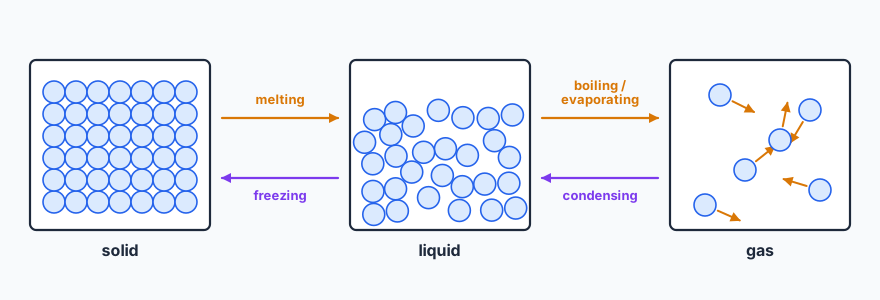
- State the distinguishing properties of solids, liquids and gases, and describe their particles: separation, arrangement and motion.
- Describe melting, boiling, evaporating, freezing and condensing.
- Describe how temperature and pressure affect the volume of a gas.
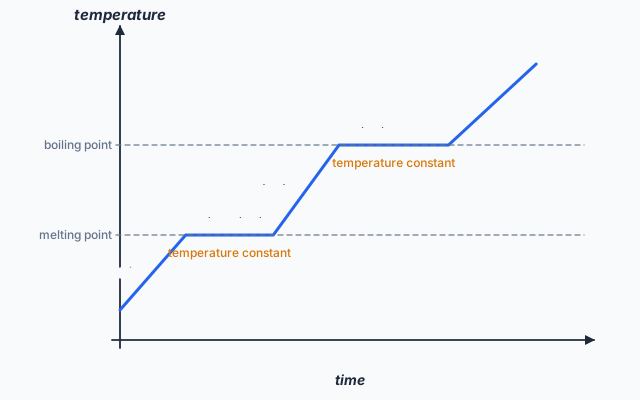
- Explain changes of state with kinetic particle theory, including heating and cooling curves EXTENDED.
- Explain the effects of temperature and pressure on gas volume in terms of particles EXTENDED.
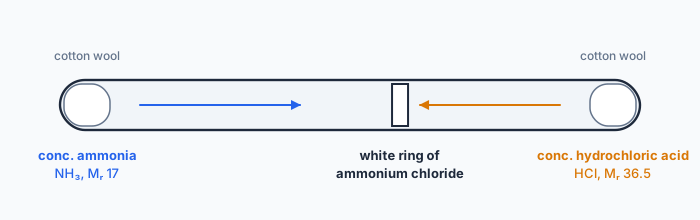
- Describe and explain diffusion; explain how relative molecular mass affects the rate of diffusion of a gas EXTENDED.
📚The chemistry
Three states, three particle pictures
Changes of state
Melting (solid → liquid) and boiling (liquid → gas) take energy in; freezing and condensing give it out. Evaporation is also liquid → gas, but it happens only at the surface and at any temperature below the boiling point, whereas boiling happens throughout the liquid at one temperature. A pure substance melts and boils at sharp, fixed temperatures — which is used to test purity (topic 12a).
EXTENDED On a heating curve the temperature rises while one state is heated, then stays constant during a change of state: the energy supplied is used to overcome the forces of attraction between the particles, not to make them move faster. A cooling curve is the reverse, with flat sections where the substance condenses and freezes, giving out energy as the attractions reform.
Gases: temperature and pressure
At constant pressure, heating a gas makes its volume increase; at constant temperature, increasing the pressure makes its volume decrease. EXTENDED Heated particles have more kinetic energy, move faster and hit the walls harder and more often, so the gas expands until the pressure is back to its original value. Squeezing a gas into a smaller volume means the same particles hit the walls more often, which is why pressure and volume are linked.
Diffusion
Diffusion is the net movement of particles from a region of higher concentration to a region of lower concentration, caused by their random motion. It happens in gases and liquids (slowly in liquids, whose particles are closer together and move less freely).
EXTENDED At the same temperature, gas particles with a lower relative molecular mass move faster, so they diffuse faster. In the classic experiment, ammonia (Mr 17) and hydrogen chloride (Mr 36.5) diffuse towards each other along a tube and meet to form a white ring of ammonium chloride — closer to the hydrogen chloride end, because the ammonia travelled further in the same time.
✏️Worked example
(a) Close together (touching), randomly arranged; the particles move around, sliding past each other.
(b) Boiling happens throughout the liquid, evaporation only at the surface; boiling happens at one fixed temperature (the boiling point), evaporation at any temperature below it.
(c) The energy absorbed is used to overcome the forces of attraction between the particles, so the particles’ average kinetic energy — and therefore the temperature — does not increase until all the solid has melted.
(d) Ammonia has a lower relative molecular mass (17) than hydrogen chloride (36.5), so its molecules move faster and diffuse further in the same time before the two gases meet.
📝Practise
In the style of the multiple-choice papers (1 and 2) and theory papers (3 and 4). EXTENDED marks Supplement content.
1. (Multiple choice.) Which describes the particles in a liquid? A: close together, regular, vibrating only. B: close together, random, moving past each other. C: far apart, random, moving quickly. D: far apart, regular, moving slowly.
2. (Theory.) Steam touches a cold window and forms droplets of water. Name this change of state, and state whether energy is taken in or given out. [2]
3. (Theory.) A sealed balloon is taken from a cold room into a warm room. State what happens to its volume. EXTENDED Explain your answer in terms of particles. [3]
4. (Multiple choice.) EXTENDED Which gas diffuses fastest at room temperature? A: CH4. B: O2. C: CO2. D: Cl2.
5. (Theory.) A student leaves a beaker of water on a windowsill. After a week the level has fallen, although the water never boiled. Name the process and explain how it happened. [2]
6. (Theory.) EXTENDED A cooling curve for a pure substance has a flat section at 80 °C. State what is happening during this section and why the temperature does not fall. [3]
7. (Theory.) A drop of purple potassium manganate(VII) solution is placed at the bottom of a beaker of water. After an hour the whole beaker is pale purple. Name the process and explain why it is slower than the same process in a gas. [3]
🔗Go deeper — other people’s work
These are external resources, not mine. If one stops working, tell me and everything above it on this page still stands.
- PhET “States of Matter” — heat and compress particles and watch them change state
- Royal Society of Chemistry — the ammonia and hydrogen chloride diffusion demonstration