Physical and chemical change, rates of reaction
🎯What you need to be able to do
- Identify physical and chemical changes and describe the differences.
- Describe the effect on rate of concentration, gas pressure, surface area, temperature and catalysts (including enzymes).
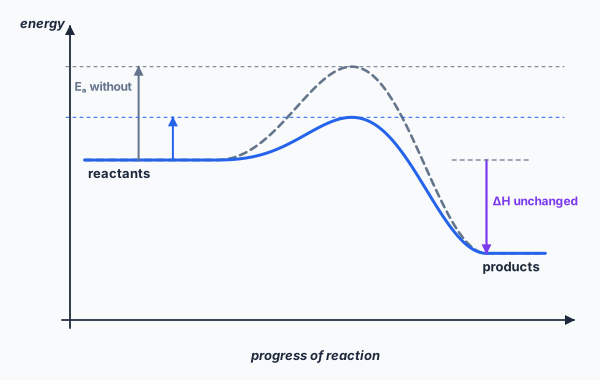
- State that a catalyst increases the rate and is unchanged at the end; that it lowers the activation energy EXTENDED.
- Describe practical methods for measuring rate (mass loss, gas volume) and interpret rate data and graphs; evaluate the methods EXTENDED.
- Explain the effects using collision theory: particles per unit volume, collision frequency, kinetic energy and activation energy EXTENDED.
📚The chemistry
Physical and chemical changes
A physical change (melting, dissolving, boiling) forms no new substance and is usually easy to reverse. A chemical change forms one or more new substances, is usually hard to reverse, and is often accompanied by an energy change, a colour change, a gas or a precipitate.
What speeds a reaction up
EXTENDED Collision theory explains all five. Particles must collide, with at least the activation energy, to react.
- Concentration, pressure and surface area increase the number of particles per unit volume (or exposed at the surface), so collisions are more frequent.
- Temperature gives particles more kinetic energy: they collide more often and a larger proportion of collisions have energy greater than Ea. The second effect is the bigger one.
- A catalyst provides a pathway with a lower activation energy, so more collisions are successful.
Measuring the rate
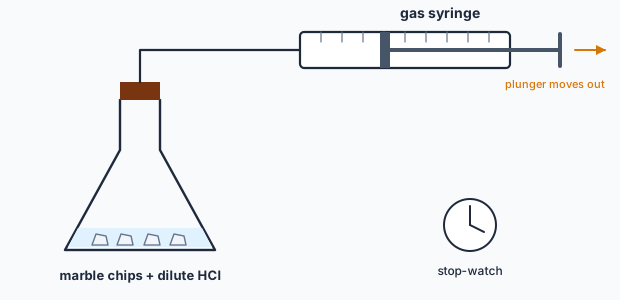
For a reaction that gives off a gas, such as calcium carbonate with hydrochloric acid, either
- collect the gas in a gas syringe and record its volume at regular times, or
- stand the flask on a balance (with a cotton wool plug to let gas out but stop acid spray) and record the loss in mass.
Reading rate graphs
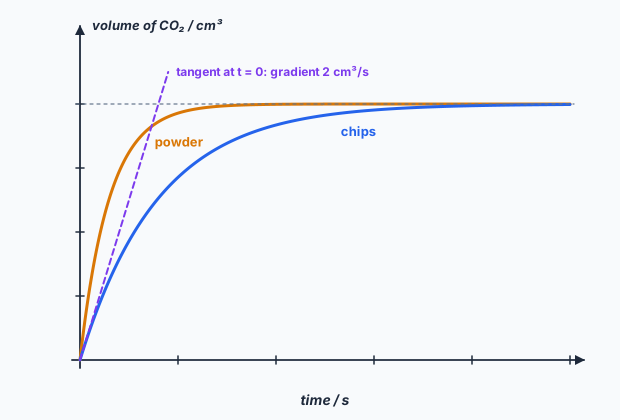
The gradient of a volume–time (or mass-loss–time) graph is the rate. It is steepest at the start, when the reactants are most concentrated, and becomes zero when a reactant has been used up. The final volume depends on the amount of the limiting reactant, not on how fast the reaction went. EXTENDED The rate at a particular time is the gradient of the tangent drawn there.
✏️Worked example
(a) The marble (the limiting reactant, since the acid is in excess) has been used up, so no more gas is made.
(b) The curve is steeper at the start and levels off sooner, but reaches the same final volume (80 cm³). The powder has a larger surface area, so collisions between acid particles and the solid are more frequent; the same mass of marble still produces the same amount of gas.
(c) The particles have more kinetic energy and move faster, so they collide more frequently, and a greater proportion of the collisions have energy equal to or greater than the activation energy, so more collisions are successful.
📝Practise
In the style of the multiple-choice, theory and practical papers. EXTENDED marks Supplement content.
1. (Multiple choice.) Which is a physical change? A: burning paper. B: rusting iron. C: melting ice. D: cooking an egg.
2. (Theory.) State two ways of increasing the rate of reaction between zinc and dilute sulfuric acid without changing the amounts of reactants. [2]
3. (Theory.) Using the graph above, state the total volume of gas produced by the marble chips and the approximate time when the reaction finished. [2]
4. (Practical.) In the mass-loss method, a flask of marble chips and acid is placed on a balance with a cotton wool plug in the neck. Explain why the mass decreases, and why the plug is used. [2]
5. (Practical.) In the first 20 s, 48 cm³ of gas is collected. Calculate the mean rate of reaction in this time, with units. [2]
6. (Theory.) EXTENDED Explain why increasing the concentration of the acid increases the rate. [2]
7. (Theory.) EXTENDED Explain how a catalyst increases the rate of a reaction. [2]
8. (Practical.) EXTENDED Suggest one advantage of collecting carbon dioxide in a gas syringe rather than over water in an upturned measuring cylinder. [1]
🔗Go deeper — other people’s work
These are external resources, not mine. If one stops working, tell me and everything above it on this page still stands.
- PhET “Reactions & Rates” — change temperature and concentration and watch the collisions
- Royal Society of Chemistry — the disappearing-cross (sodium thiosulfate) rate practical