Experimental techniques
🎯What you need to be able to do
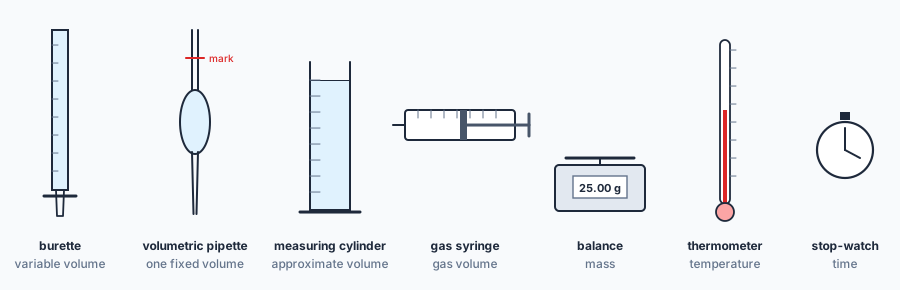
- Name apparatus for measuring time, temperature, mass and volume, and suggest advantages and disadvantages of methods and apparatus.
- Use the terms solvent, solute, solution, saturated solution, residue and filtrate.
- Describe an acid–base titration and how to find its end-point.
- Describe paper chromatography and interpret chromatograms; use a locating agent and calculate Rf EXTENDED.
- Describe and choose separation methods, and assess purity from melting and boiling points.
📚The chemistry
Apparatus
Solutions vocabulary
Acid–base titration
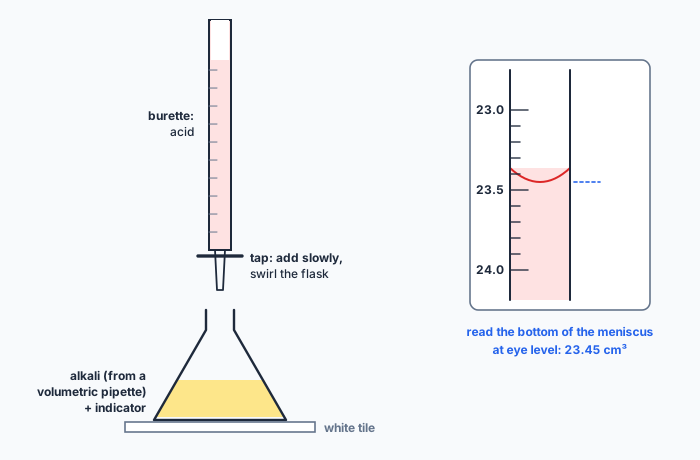
- Use a volumetric pipette to put a fixed volume (e.g. 25.0 cm³) of alkali in a conical flask, and add a few drops of a suitable indicator (methyl orange or thymolphthalein).
- Fill the burette with acid and record the starting reading.
- Add acid while swirling; near the end, add it drop by drop.
- The end-point is when the indicator just changes colour permanently (methyl orange: yellow to orange). Record the final reading.
- Repeat until two titres are concordant (within 0.10 cm³) and use their mean.
Chromatography
Paper chromatography separates a mixture of soluble substances. Spots are put on a pencil baseline (pencil does not dissolve), the paper is stood in a solvent whose level is below the baseline (or the spots would dissolve into it), and the solvent rises up the paper carrying each substance a different distance.
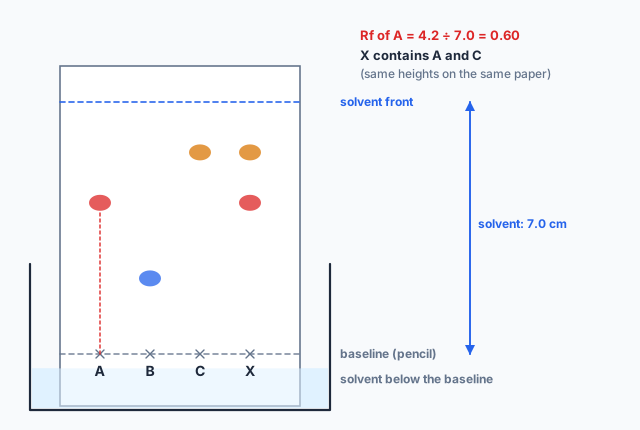
EXTENDED Colourless substances are made visible by spraying the dried chromatogram with a locating agent. Each substance has an Rf value for a given solvent:
Both distances are measured from the baseline. Rf has no units and is always less than 1.
Separation and purification
- A suitable solvent dissolves one substance but not another (water dissolves salt, not sand).
- Filtration separates an insoluble solid (residue) from a liquid (filtrate).
- Crystallisation gets a soluble solid from its solution: heat to the crystallisation point, then cool.
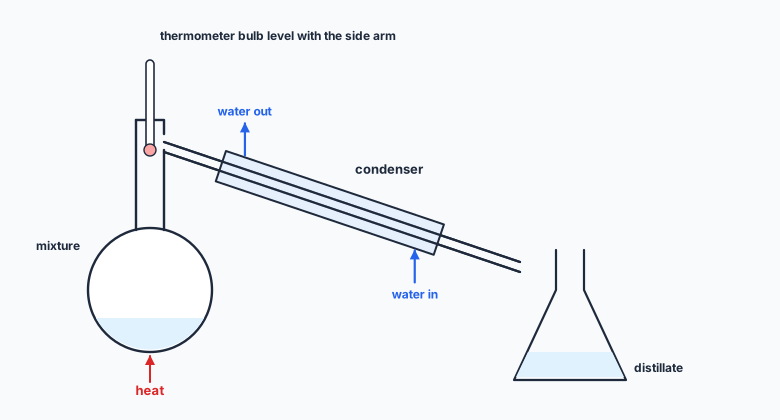
- Simple distillation separates a liquid (the solvent) from a solution: pure water from salt water.
- Fractional distillation separates miscible liquids with different boiling points, such as ethanol (78 °C) and water (100 °C). A fractionating column is fitted between the flask and the condenser; the liquid with the lower boiling point distils over first.
Purity. A pure substance melts and boils at sharp, fixed temperatures. Impurities lower the melting point and make it melt over a range, and raise the boiling point. Comparing measured values with data identifies a substance and shows whether it is pure — which matters for food and medicines.
✏️Worked example
(a) Add water and stir (salt dissolves, sand does not); filter — the sand is the residue and salt solution the filtrate; heat the filtrate to the crystallisation point and leave to crystallise (or evaporate to dryness); dry the crystals.
(b) No, it gives two spots. It contains A and C (spots at the same heights).
(c) \( R_f = 5.6 \div 7.0 = 0.80 \).
(d) Ink is a mixture of dyes that would dissolve and separate too; pencil (graphite) is insoluble.
📝Practise
In the style of the multiple-choice, theory and practical papers. EXTENDED marks Supplement content.
1. (Multiple choice.) Which apparatus measures exactly 25.0 cm³ of a solution into a flask? A: beaker. B: measuring cylinder. C: volumetric pipette. D: gas syringe.
2. (Theory.) Muddy water is filtered. Name the residue and the filtrate. [2]
3. (Theory.) Suggest how to separate ethanol (boiling point 78 °C) from water, and explain why the method works. [3]
4. (Practical.) In a titration, why is the conical flask placed on a white tile, and why is the acid added drop by drop near the end? [2]
5. (Theory.) Pure aspirin melts at 136 °C. A sample melts between 128 °C and 133 °C. What does this show? [2]
6. (Theory.) EXTENDED On a chromatogram the solvent moved 6.0 cm from the baseline and a spot moved 3.3 cm. Calculate Rf. [1]
7. (Theory.) EXTENDED A mixture of colourless amino acids is separated by chromatography. How are the spots made visible? [1]
8. (Practical.) Suggest a method to obtain (a) pure water from seawater, (b) copper(II) sulfate crystals from its solution. [2]
🔗Go deeper — other people’s work
These are external resources, not mine. If one stops working, tell me and everything above it on this page still stands.
- Royal Society of Chemistry — the titration screen experiment, a free online simulation
- Royal Society of Chemistry — chromatography of food colourings, a class practical