Atoms, elements and isotopes
🎯What you need to be able to do
- Describe the differences between elements, compounds and mixtures.
- Describe the atom (nucleus of protons and neutrons, electrons in shells) and state the relative charges and masses of the particles.
- Use proton number (atomic number) and mass number (nucleon number), and symbols such as 126C and 3517Cl−.
- Write the electronic configuration of elements and ions with proton numbers 1 to 20, and link it to group and period.
- Define isotopes; explain why isotopes have the same chemical properties EXTENDED.
- Calculate relative atomic mass from isotope masses and abundances EXTENDED.
📚The chemistry
Elements, compounds and mixtures
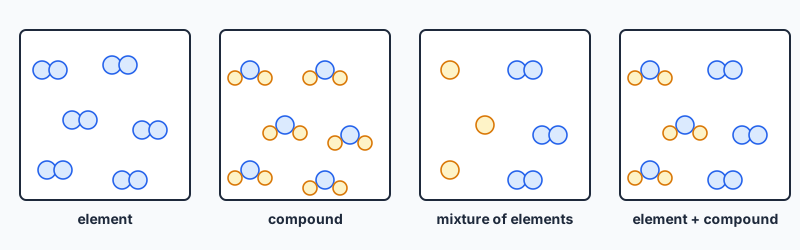
- An element contains only one type of atom.
- A compound contains two or more elements chemically combined in a fixed ratio; it has different properties from its elements and can only be separated by a chemical reaction.
- A mixture contains two or more substances not chemically combined; the proportions can vary and it can be separated by physical methods such as filtration or distillation (topic 12a).
Inside the atom
The proton number (atomic number, \(Z\)) is the number of protons in the nucleus; it identifies the element. The mass number (nucleon number, \(A\)) is the total number of protons and neutrons. So neutrons \( = A - Z \). An atom is neutral, so it has as many electrons as protons; an ion has gained or lost electrons, never protons.
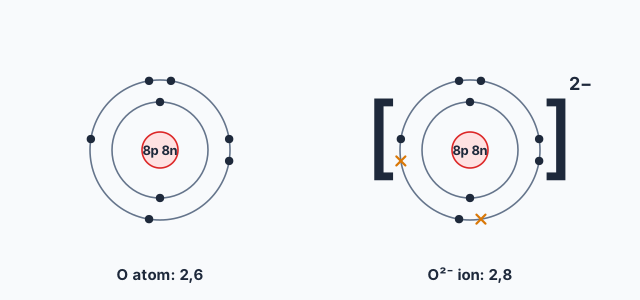
Electrons fill shells in order: 2 in the first, 8 in the second, 8 in the third, then the fourth begins (for proton numbers up to 20). The configuration of sodium is 2,8,1 and of calcium 2,8,8,2. For ions, add or remove electrons: Na+ is 2,8 and Cl− is 2,8,8.
- number of outer-shell electrons \( = \) group number (Groups I to VII);
- number of occupied shells \( = \) period number;
- Group VIII noble gases have a full outer shell, which is why they are unreactive.
Isotopes
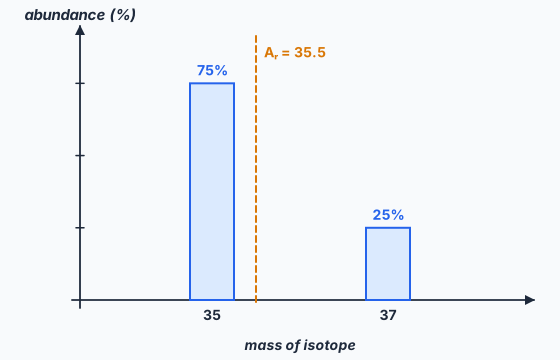
Isotopes are different atoms of the same element with the same number of protons but different numbers of neutrons: 35Cl has 18 neutrons and 37Cl has 20. EXTENDED Isotopes have the same chemical properties, because they have the same number of electrons and so the same electronic configuration — and chemistry is about electrons.
EXTENDED The relative atomic mass, Ar, is the average mass of an element’s atoms, weighted by the abundance of each isotope:
✏️Worked example
(a) 13 protons; \( 27 - 13 = 14 \) neutrons; \( 13 - 3 = 10 \) electrons. The atom is 2,8,3; the ion has lost its 3 outer electrons: 2,8.
(b) 6 outer electrons: Group VI. 3 shells: Period 3. Proton number \( 2 + 8 + 6 = 16 \): sulfur.
(c) \( A_\mathrm{r} = \dfrac{35 \times 75 + 37 \times 25}{100} = \dfrac{2625 + 925}{100} = 35.5 \).
📝Practise
In the style of the multiple-choice and theory papers. EXTENDED marks Supplement content.
1. (Multiple choice.) How many protons, neutrons and electrons are in 199F−? A: 9, 10, 9. B: 9, 10, 10. C: 10, 9, 10. D: 9, 19, 10.
2. (Multiple choice.) Which is a mixture? A: air. B: water. C: sodium chloride. D: carbon dioxide.
3. (Theory.) Give the electronic configurations of a calcium atom and a calcium ion, Ca2+. [2]
4. (Theory.) Element X has three occupied shells and five electrons in its outer shell. State its period and group, and name it. [3]
5. (Theory.) Define the term isotopes. [2]
6. (Theory.) EXTENDED Explain why 35Cl and 37Cl have the same chemical properties. [2]
7. (Theory.) EXTENDED Boron is 20% 10B and 80% 11B. Calculate the relative atomic mass of boron. [2]
8. (Theory.) EXTENDED Copper has Ar 63.5 and two isotopes, 63Cu and 65Cu. Calculate the percentage abundance of 63Cu. [3]
🔗Go deeper — other people’s work
These are external resources, not mine. If one stops working, tell me and everything above it on this page still stands.
- PhET “Build an Atom” — add protons, neutrons and electrons and watch the symbol and charge change
- Royal Society of Chemistry — the interactive Periodic Table, with isotope data for every element