Chemical energetics
🎯What you need to be able to do
- State that an exothermic reaction transfers thermal energy to the surroundings (temperature rises), and an endothermic reaction takes it in (temperature falls).
- Interpret reaction pathway diagrams for exothermic and endothermic reactions.
- Use \( \Delta H \) (negative for exothermic, positive for endothermic) and define activation energy, Ea EXTENDED.
- Draw and label reaction pathway diagrams with reactants, products, \( \Delta H \) and Ea EXTENDED.
- Explain \( \Delta H \) in terms of bond breaking (endothermic) and bond making (exothermic), and calculate it from bond energies EXTENDED.
📚The chemistry
Exothermic and endothermic
- Exothermic: thermal energy is transferred to the surroundings, so their temperature rises. Examples: combustion, neutralisation, most displacement reactions, respiration.
- Endothermic: thermal energy is taken in from the surroundings, so their temperature falls. Examples: thermal decomposition, photosynthesis, dissolving ammonium nitrate in water.
EXTENDED The thermal energy transferred is the enthalpy change, \( \Delta H \): negative for exothermic reactions (the chemicals lose energy) and positive for endothermic ones. The activation energy, Ea, is the minimum energy that colliding particles must have to react.
Reaction pathway diagrams
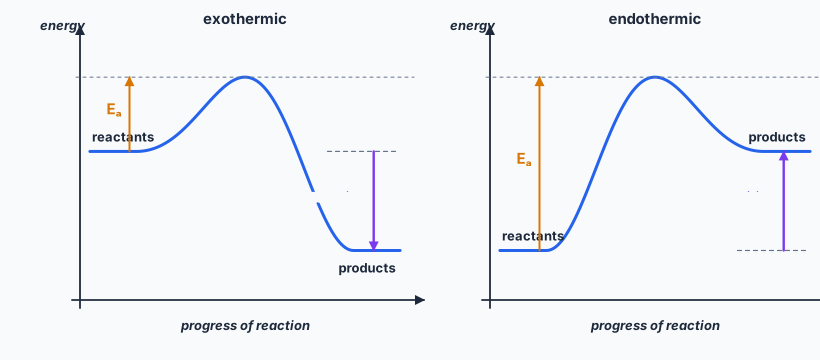
When you draw one: label both axes (energy; progress of reaction), write the formulae of the reactants and products on their levels, and draw the arrows with a single head. The \( \Delta H \) arrow starts at the reactants’ level and ends at the products’ level.
Bond energies EXTENDED
Breaking bonds is endothermic (energy must be put in); making bonds is exothermic (energy is released). A reaction is exothermic when more energy is released making the new bonds than is taken in breaking the old ones:
Draw the displayed formulae first so that you count every bond — including how many molecules of each substance the equation shows.
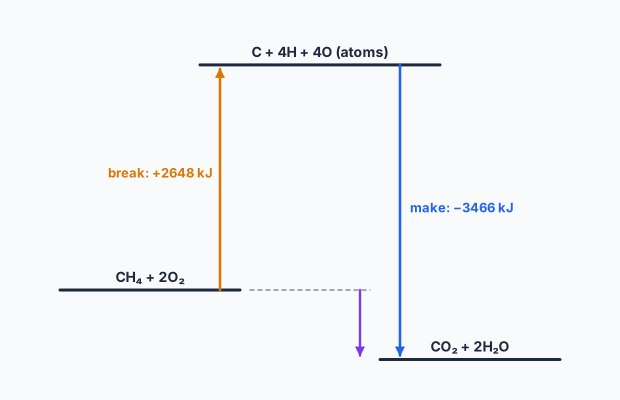
✏️Worked example EXTENDED
(a) 4 C–H and 2 O=O: \( 4(413) + 2(498) = 1652 + 996 = 2648 \) kJ.
(b) CO2 has 2 C=O; 2 H2O have 4 O–H: \( 2(805) + 4(464) = 1610 + 1856 = 3466 \) kJ.
(c) \( \Delta H = 2648 - 3466 = -818 \) kJ/mol. Negative, so exothermic.
📝Practise
In the style of the multiple-choice and theory papers. EXTENDED marks Supplement content.
1. (Multiple choice.) Which reaction is endothermic? A: burning methane. B: neutralising an acid with an alkali. C: the thermal decomposition of calcium carbonate. D: magnesium reacting with acid.
2. (Theory.) When ammonium nitrate dissolves in water the temperature falls from 21 °C to 14 °C. State whether the process is exothermic or endothermic, and explain how you know. [2]
3. (Theory.) A reaction pathway diagram shows the products at a lower energy level than the reactants. What type of reaction is it? [1]
4. (Theory.) EXTENDED Define activation energy, and state the sign of \( \Delta H \) for an endothermic reaction. [2]
5. (Theory.) EXTENDED Use bond energies (kJ/mol) N≡N 945, H–H 436, N–H 391 to calculate \( \Delta H \) for \( \mathrm{N_2 + 3H_2 \rightarrow 2NH_3} \). [3]
6. (Theory.) EXTENDED Explain, in terms of bonds, why the combustion of a fuel is exothermic. [2]
7. (Theory.) EXTENDED For a reaction, Ea = 150 kJ/mol and \( \Delta H = +60 \) kJ/mol. Sketch the reaction pathway diagram and give the energy of the peak above the products. [3]
🔗Go deeper — other people’s work
These are external resources, not mine. If one stops working, tell me and everything above it on this page still stands.
- Royal Society of Chemistry — temperature-change experiments for exothermic and endothermic reactions
- BBC Bitesize — bond energy calculations with worked steps