Reversible reactions, equilibrium and redox
🎯What you need to be able to do
- State that some reactions are reversible (symbol ⇌) and describe how heating hydrated salts, or adding water to anhydrous ones, reverses the direction.
- State the two conditions for equilibrium in a closed system EXTENDED.
- Predict and explain how temperature, pressure, concentration and a catalyst affect the position of equilibrium EXTENDED.
- State the equations, raw materials and conditions of the Haber and Contact processes, and explain the choice of conditions EXTENDED.
- Define oxidation and reduction as gain and loss of oxygen, and use Roman numerals for oxidation numbers.
- Define oxidation and reduction in terms of electrons and oxidation numbers; identify oxidising and reducing agents; use the colour changes of acidified potassium manganate(VII) and potassium iodide EXTENDED.
📚The chemistry
Reversible reactions
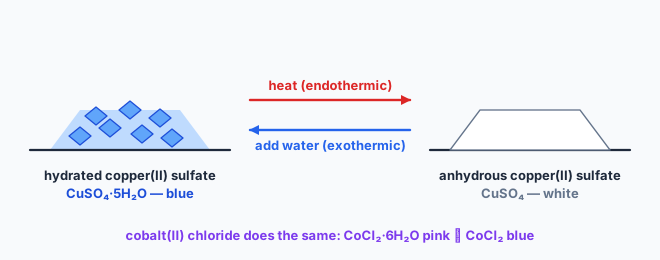
A reversible reaction can go in both directions, shown by the symbol ⇌. Changing the conditions changes which direction wins. Heating blue hydrated copper(II) sulfate drives off its water of crystallisation and leaves white anhydrous copper(II) sulfate; adding water turns it blue again and releases heat.
Equilibrium EXTENDED
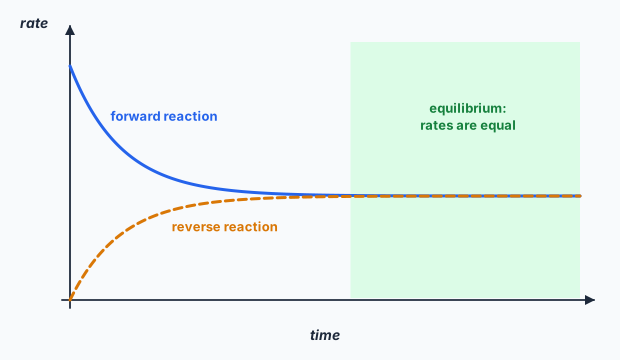
In a closed system (nothing gets in or out), a reversible reaction reaches equilibrium when
- the rate of the forward reaction equals the rate of the reverse reaction, and
- the concentrations of reactants and products no longer change.
Both reactions are still happening — the equilibrium is dynamic — but they cancel out. The concentrations are constant, not equal.
Moving the position of equilibrium. If the conditions change, the equilibrium shifts in the direction that opposes the change:
Questions give you the information you need: the \( \Delta H \) sign, the colours, or the number of gas molecules on each side. Count gas molecules from the balanced equation, ignoring solids and liquids.
The Haber process EXTENDED
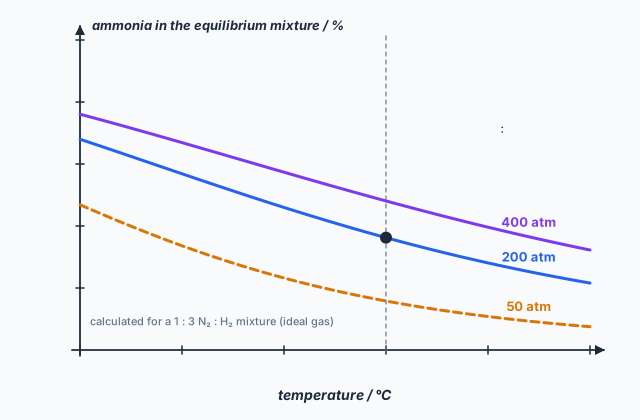
Nitrogen comes from the air; hydrogen from methane. Typical conditions: 450 °C, 20 000 kPa (200 atm) and an iron catalyst. Unreacted gases are recycled.
- Temperature. The forward reaction is exothermic, so a low temperature gives a higher yield — but the rate would be too slow. 450 °C is a compromise between yield and rate.
- Pressure. 4 gas molecules become 2, so a high pressure gives a higher yield and also a faster rate. Higher still would cost more to build and run (thicker pipes, more energy for compressors) and is more dangerous, so 200 atm is a compromise between yield, cost and safety.
- Catalyst. Iron increases the rate; it does not change the yield.
The Contact process EXTENDED
Sulfur dioxide comes from burning sulfur or roasting sulfide ores; oxygen from the air. Typical conditions: 450 °C, 200 kPa (2 atm) and a vanadium(V) oxide catalyst. The temperature is the same compromise as in the Haber process. The pressure is low because the equilibrium already lies far to the right at 2 atm, so a higher pressure would add cost and risk for very little extra yield. The sulfur trioxide is then used to make sulfuric acid.
Redox
A redox reaction is one in which oxidation and reduction happen together. The simplest definitions use oxygen:
- Oxidation is gain of oxygen; reduction is loss of oxygen. In \( \mathrm{CuO + H_2 \rightarrow Cu + H_2O} \), copper(II) oxide is reduced and hydrogen is oxidised.
- A Roman numeral gives an element’s oxidation number in a compound: iron(III) oxide contains Fe in the +3 state, Fe2O3.
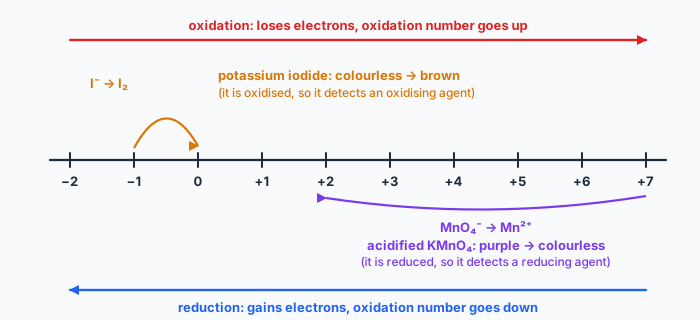
EXTENDED The wider definitions work for reactions without oxygen too:
Rules for oxidation numbers: an uncombined element is 0; a monatomic ion equals its charge (Na+ is +1, O2− is −2); the numbers in a compound add up to zero; those in an ion add up to its charge. In SO42−: \( S + 4(-2) = -2 \), so S is +6.
An oxidising agent oxidises something else and is itself reduced; a reducing agent reduces something else and is itself oxidised. Two colour changes identify them:
✏️Worked example EXTENDED
(a)(i) The yield decreases: the equilibrium shifts in the endothermic direction, which is the reverse reaction.
(ii) The yield increases: 3 gas molecules on the left, 2 on the right, so higher pressure shifts it to the side with fewer gas molecules.
(iii) No change: a catalyst speeds up the forward and reverse reactions equally, so equilibrium is reached sooner but its position is the same.
(b) Chlorine: 0 in Cl2 to −1 in KCl, a decrease, so it is reduced. Bromine: −1 in KBr to 0 in Br2, an increase, so it is oxidised. Both happen, so it is redox. Chlorine is the oxidising agent (it oxidises the bromide and is itself reduced). Potassium stays +1: a spectator.
📝Practise
In the style of the multiple-choice and theory papers. EXTENDED marks Supplement content.
1. (Theory.) White anhydrous copper(II) sulfate is used to test a liquid. Describe what is seen if the liquid contains water, and state whether this change releases or absorbs energy. [2]
2. (Theory.) In \( \mathrm{2PbO + C \rightarrow 2Pb + CO_2} \), which substance is oxidised and which is reduced? Give a reason for each. [2]
3. (Multiple choice.) What is the oxidation number of iron in iron(III) chloride, and what is its formula? A: +2, FeCl2. B: +3, FeCl3. C: +3, Fe3Cl. D: −3, FeCl3.
4. (Theory.) EXTENDED Brown nitrogen dioxide forms colourless dinitrogen tetroxide: \( \mathrm{2NO_2(g) \rightleftharpoons N_2O_4(g)} \); the forward reaction is exothermic. A sealed syringe of the equilibrium mixture is (a) placed in hot water, (b) compressed at constant temperature. Predict the colour change in each case and explain. [4]
5. (Theory.) EXTENDED Use the ammonia graph above. (a) Read the percentage of ammonia at 350 °C and 200 atm. (b) Suggest why 350 °C is not used, even though it gives more ammonia. [3]
6. (Theory.) EXTENDED Deduce the oxidation number of (a) sulfur in SO3, (b) chromium in Cr2O72−, (c) manganese in MnO4−. [3]
7. (Theory.) EXTENDED A few drops of an unknown solution Y are added to acidified aqueous potassium manganate(VII), which turns from purple to colourless. What does this show about Y? [2]
8. (Theory.) EXTENDED In the Contact process, explain why a pressure of only 2 atm is used, and state the catalyst. [3]
🔗Go deeper — other people’s work
These are external resources, not mine. If one stops working, tell me and everything above it on this page still stands.
- PhET “Reversible Reactions” — watch forward and reverse rates settle to equilibrium
- Royal Society of Chemistry — the nitrogen dioxide / dinitrogen tetroxide equilibrium demonstration