Alcohols, carboxylic acids and polymers
🎯What you need to be able to do
- Name and draw ethanol and ethanoic acid; name and draw unbranched alcohols, carboxylic acids and esters up to four carbons EXTENDED.
- Describe the manufacture of ethanol by fermentation and from ethene, its combustion and its uses; compare the two methods EXTENDED.
- Describe the reactions of ethanoic acid with metals, bases and carbonates; its formation by oxidising ethanol, and esterification EXTENDED.
- Define polymers and monomers; describe addition polymerisation of ethene and the environmental problems of plastics.
- Deduce repeat units of addition and condensation polymers; describe nylon, PET and proteins EXTENDED.
📚The chemistry
Alcohols and carboxylic acids
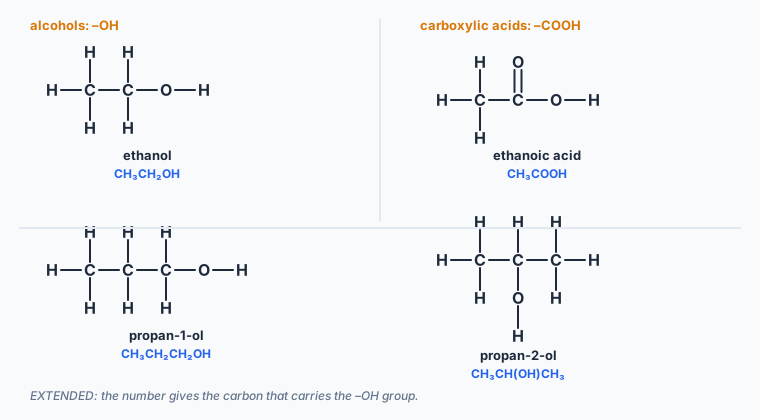
The acids in the series are methanoic (HCOOH), ethanoic, propanoic and butanoic acid. EXTENDED For alcohols from three carbons up, the number shows the position of the –OH: propan-1-ol and propan-2-ol, butan-1-ol and butan-2-ol.
Making ethanol
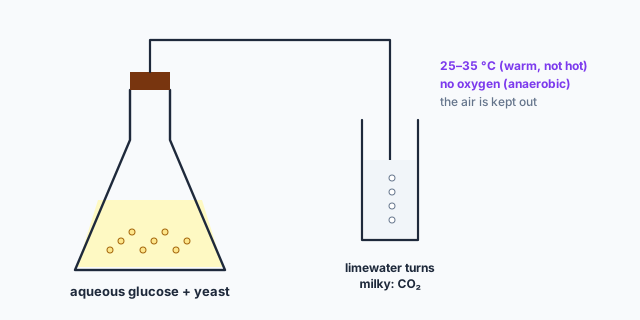
EXTENDED Comparing the two methods:
- Fermentation: uses a renewable raw material (sugar from crops) and needs little energy, but it is slow, is a batch process, and gives a dilute solution that must be distilled.
- Hydration of ethene: fast, continuous, and gives pure ethanol, but ethene comes from crude oil (non-renewable) and the high temperature and pressure need a lot of energy.
Ethanol burns cleanly and is used as a fuel and as a solvent:
Reactions of ethanoic acid
Ethanoic acid is a weak acid but has the typical acid reactions. Its salts are ethanoates:
EXTENDED Ethanoic acid is made by oxidising ethanol, either by heating it with acidified aqueous potassium manganate(VII) (purple to colourless) or by bacterial oxidation, which is how vinegar is made.
Esters EXTENDED
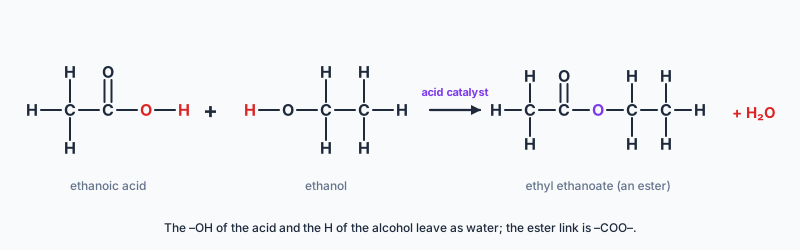
A carboxylic acid reacts with an alcohol, using an acid catalyst, to form an ester and water. The name starts with the alcohol part and ends with the acid part: ethanol + ethanoic acid gives ethyl ethanoate, CH3COOCH2CH3.
Polymers
Polymers are large molecules built up from many smaller molecules called monomers. Plastics are made from polymers. Poly(ethene) forms by addition polymerisation: the double bonds of many ethene molecules open and join into one long chain.
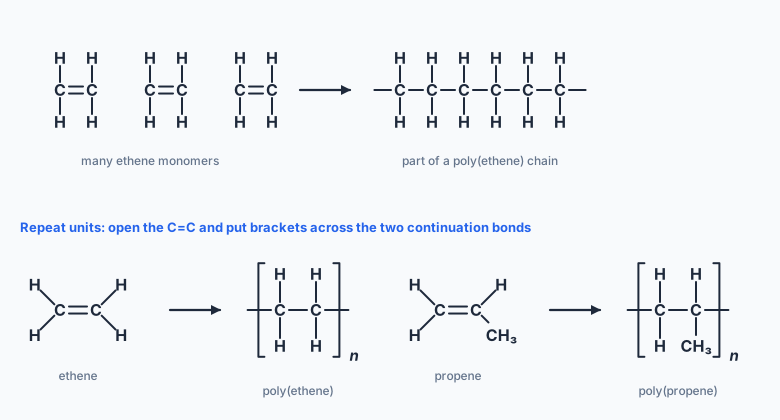
Plastics and the environment. Most plastics are not biodegradable, so they
- take up space in landfill sites for a very long time;
- accumulate in the oceans, harming marine life;
- form toxic gases when burned.
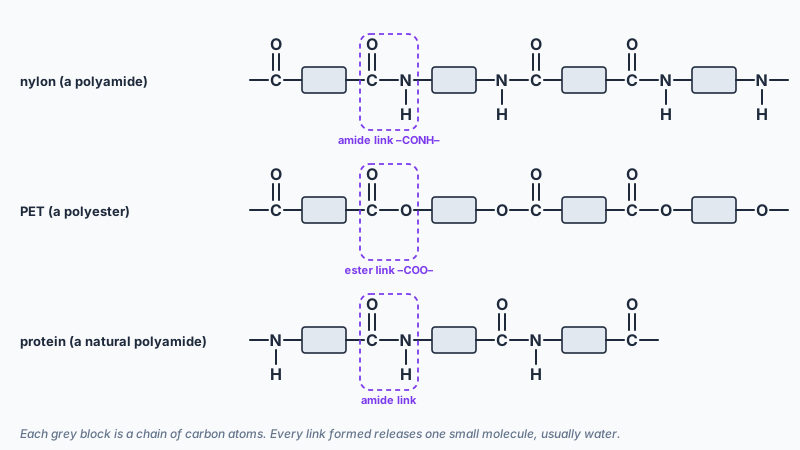
Condensation polymers EXTENDED
In condensation polymerisation two different functional groups react, and each link formed also releases a small molecule (usually water). Addition polymerisation uses one kind of monomer with a C=C and gives only the polymer.
- Polyamides (such as nylon) form from a dicarboxylic acid and a diamine: amide links, –CONH–.
- Polyesters (such as PET) form from a dicarboxylic acid and a diol: ester links, –COO–. PET can be converted back into its monomers and re-polymerised, which makes it easier to recycle.
- Proteins are natural polyamides made from amino acid monomers, H2N–CHR–COOH, where R is a side chain that varies.
✏️Worked example EXTENDED
(a) Ethyl propanoate: CH3CH2COOCH2CH3. The acid part (propanoate, three carbons including the C=O) is written first in the formula; the alcohol part (ethyl) comes first in the name.
(b) Two carbons joined by a single bond, with H, H on the first and H, Cl on the second, continuation bonds through square brackets, and n outside: poly(chloroethene).
(c) Addition polymerisation gives only the polymer; forming nylon (condensation) also releases water.
📝Practise
In the style of the multiple-choice and theory papers. EXTENDED marks Supplement content.
1. (Multiple choice.) What are the products when ethanoic acid reacts with calcium carbonate? A: calcium ethanoate and hydrogen. B: calcium ethanoate, water and carbon dioxide. C: calcium oxide and ethanol. D: ethyl ethanoate and water.
2. (Theory.) Name the compound CH3CH2CH2COOH and state the homologous series it belongs to. [2]
3. (Theory.) Give the name and formula of the salt formed when ethanoic acid reacts with sodium hydroxide. [2]
4. (Theory.) EXTENDED A country with plenty of sugar cane but no oil wants to make ethanol. Suggest which method it should use, and give one disadvantage of that method. [2]
5. (Theory.) EXTENDED Name the ester made from methanol and butanoic acid, and give its structural formula. [2]
6. (Theory.) Explain what is meant by a monomer and a polymer, using poly(ethene) as the example. [2]
7. (Theory.) Describe two environmental problems caused by disposing of plastics. [2]
8. (Theory.) EXTENDED The repeat unit of a polymer is –CH2–CH(CH3)–. Name and give the structural formula of its monomer. [2]
9. (Theory.) EXTENDED Name the type of monomers used to make a polyester, and name the link formed. [2]
10. (Theory.) EXTENDED Proteins and nylon are both polyamides. Name the monomers of proteins and give their general structure. [2]
🔗Go deeper — other people’s work
These are external resources, not mine. If one stops working, tell me and everything above it on this page still stands.
- Royal Society of Chemistry — making esters from alcohols and acids, microscale
- Royal Society of Chemistry — the “nylon rope trick” demonstration of condensation polymerisation