Acids, bases and salts
🎯What you need to be able to do
- Describe the reactions of acids with metals, bases and carbonates, and of bases with acids and ammonium salts.
- Describe the colours of litmus, thymolphthalein and methyl orange in acids and alkalis, and use universal indicator and the pH scale.
- State that acids contain H+(aq) and alkalis OH−(aq); write the ionic equation for neutralisation.
- Define acids as proton donors and bases as proton acceptors; strong and weak acids EXTENDED.
- Classify oxides as acidic or basic; amphoteric oxides EXTENDED.
- Describe how to prepare, separate and purify soluble salts; use the solubility rules; define hydrated and anhydrous.
- Prepare insoluble salts by precipitation, and define water of crystallisation EXTENDED.
📚The chemistry
Acids and bases
Aqueous acids contain hydrogen ions, H+(aq). A base is a metal oxide or hydroxide; an alkali is a soluble base, and its solution contains hydroxide ions, OH−(aq). The reactions to know:
Neutralisation between an acid and an alkali is always the same reaction between the ions:
The name of the salt comes from the acid: hydrochloric acid gives chlorides, sulfuric acid sulfates, nitric acid nitrates.
Indicators and pH
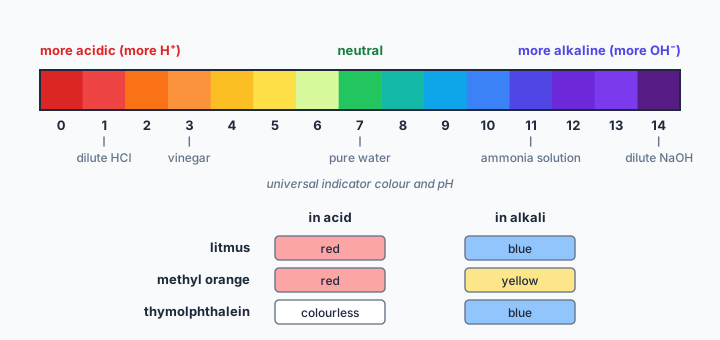
Strong and weak acids EXTENDED
An acid is a proton (H+) donor; a base is a proton acceptor. A strong acid is completely dissociated in aqueous solution; a weak acid is only partially dissociated:
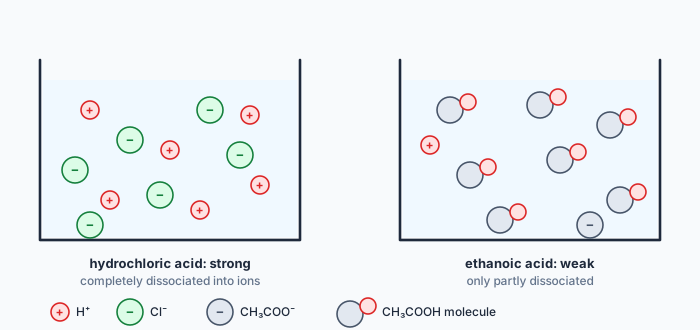
“Strong” is about dissociation, not concentration: a dilute solution of a strong acid is still a strong acid.
Oxides
Solubility rules
- All sodium, potassium and ammonium salts are soluble, and all nitrates.
- Chlorides are soluble, except silver and lead(II) chloride.
- Sulfates are soluble, except barium, calcium and lead(II) sulfate.
- Carbonates are insoluble, except sodium, potassium and ammonium carbonate.
- Hydroxides are insoluble, except sodium, potassium, ammonium and (partially) calcium hydroxide.
Preparing a soluble salt
Choose the method by what the other reactant is:
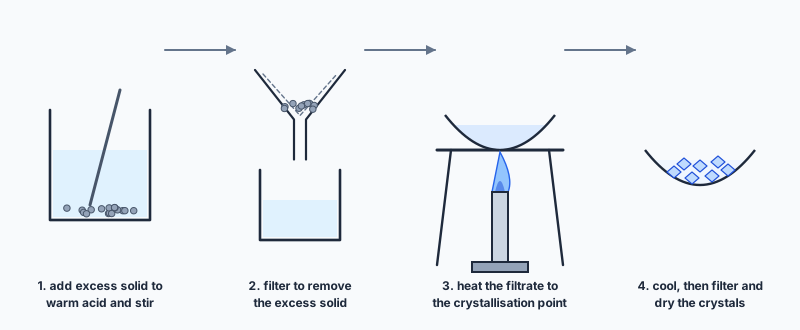
- Insoluble metal, base or carbonate: add it in excess to the acid, so that all the acid is used up; filter off the excess.
- Soluble alkali (or a sodium, potassium or ammonium carbonate): the excess could not be filtered out, so use a titration to find the exact volumes (topic 12a), then repeat the mixing without the indicator.
Preparing an insoluble salt EXTENDED
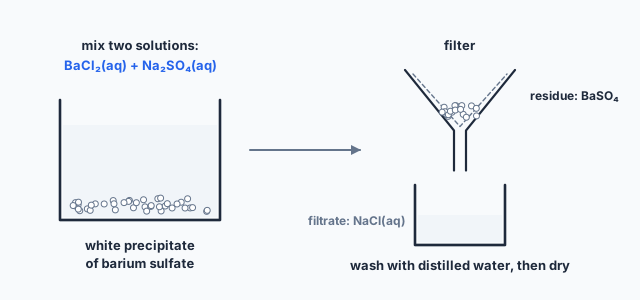
Mix solutions of two soluble salts, one containing each ion of the product. The insoluble salt forms as a precipitate; filter it off, wash it with distilled water to remove the soluble salts left on it, and dry it.
Hydrated and anhydrous
A hydrated substance is chemically combined with water; an anhydrous substance contains no water. EXTENDED The water of crystallisation is the water molecules present in hydrated crystals, such as CuSO4·5H2O and CoCl2·6H2O. The dot means the water is part of the formula: add it when you work out Mr.
✏️Worked example
(a) \( \mathrm{CuCO_3(s) + 2HCl(aq) \rightarrow CuCl_2(aq) + H_2O(l) + CO_2(g)} \)
(b) Warm the acid; add copper(II) carbonate a little at a time, stirring, until some is left over (excess). Filter to remove the excess solid. Heat the filtrate in an evaporating basin until it is saturated (crystals form on a cold glass rod dipped in it). Leave to cool and crystallise; filter off the crystals and dry them between filter papers.
(c) The fizzing stops, and solid remains undissolved however much you stir.
(d) Mr \( = 64 + 2(35.5) + 2(18) = 64 + 71 + 36 = 171 \). Water: \( \tfrac{36}{171} \times 100 = 21.1\% \).
📝Practise
In the style of the multiple-choice, theory and practical papers. EXTENDED marks Supplement content.
1. (Multiple choice.) A solution turns methyl orange yellow and thymolphthalein blue. What is its pH likely to be? A: 1. B: 5. C: 7. D: 12.
2. (Theory.) Write a word equation for the reaction of nitric acid with calcium carbonate, and state one observation. [2]
3. (Multiple choice.) Which salt is insoluble in water? A: ammonium carbonate. B: lead(II) nitrate. C: silver chloride. D: calcium chloride.
4. (Theory.) Ammonium chloride is warmed with sodium hydroxide solution. Name the gas given off and give a test for it. [2]
5. (Theory.) Explain why sodium sulfate is made by titration rather than by adding excess sodium hydroxide to sulfuric acid. [2]
6. (Theory.) EXTENDED Solutions of hydrochloric acid and ethanoic acid have the same concentration. Explain why the hydrochloric acid has the lower pH. [2]
7. (Theory.) EXTENDED In \( \mathrm{NH_3 + HCl \rightarrow NH_4Cl} \), identify the acid and the base, and explain your choice. [2]
8. (Theory.) EXTENDED Silver chloride is made by precipitation. Name two solutions you could mix, write the ionic equation with state symbols, and explain why the solid is washed. [4]
9. (Theory.) EXTENDED Zinc oxide reacts with dilute hydrochloric acid and with aqueous sodium hydroxide. What type of oxide is it? [1]
🔗Go deeper — other people’s work
These are external resources, not mine. If one stops working, tell me and everything above it on this page still stands.
- PhET “Acid-Base Solutions” — compare strong and weak acids at the particle level
- Royal Society of Chemistry — the copper(II) sulfate crystals practical, step by step