Chemistry of the environment
🎯What you need to be able to do
- Test for water and for pure water; explain why distilled water is used in practical work.
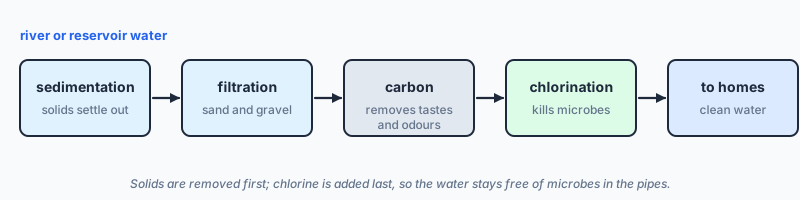
- State what natural water may contain, which substances are beneficial or harmful, and how domestic water is treated.
- State that ammonium salts and nitrates are fertilisers, and describe NPK fertilisers.
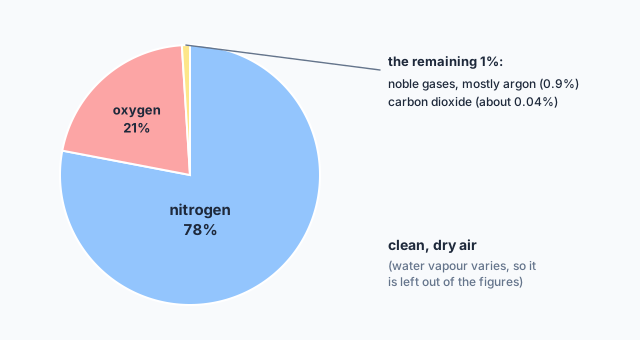
- State the composition of clean, dry air, and the sources and effects of CO2, CO, particulates, methane, oxides of nitrogen and SO2.
- Explain strategies against climate change and acid rain; describe photosynthesis.
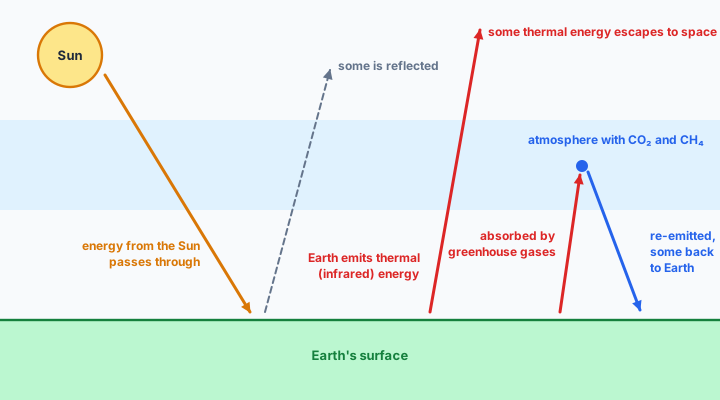
- Explain the greenhouse effect, how oxides of nitrogen form and are removed by catalytic converters, and give the photosynthesis equation EXTENDED.
📚The chemistry
Water
Testing for water: it turns anhydrous copper(II) sulfate from white to blue, and anhydrous cobalt(II) chloride from blue to pink. These show that water is present. Testing for purity: pure water melts at exactly 0 °C and boils at exactly 100 °C (at normal pressure); impurities change these values. Distilled water is used in practical chemistry rather than tap water because it contains fewer chemical impurities that could interfere with results.
Water from natural sources can contain:
Fertilisers
Plants need nitrogen, phosphorus and potassium for good growth. NPK fertilisers supply all three. Ammonium salts and nitrates (for example ammonium nitrate, NH4NO3) supply nitrogen; potassium comes from potassium salts and phosphorus from phosphates.
Air
The pollutants on the syllabus, with their sources and effects:
- Carbon dioxide — complete combustion of carbon-containing fuels. More CO2 increases global warming, which leads to climate change.
- Carbon monoxide and particulates — incomplete combustion of carbon-containing fuels. CO is a toxic gas; particulates increase the risk of respiratory problems and cancer.
- Methane — decomposition of vegetation and waste gases from digestion in animals. It increases global warming.
- Oxides of nitrogen — car engines. They cause acid rain, photochemical smog and respiratory problems.
- Sulfur dioxide — burning fossil fuels that contain sulfur compounds. It causes acid rain.
Reducing the damage
- Climate change: planting trees (they take in CO2), less livestock farming (less methane), burning fewer fossil fuels, and using more hydrogen and renewable energy such as wind and solar.
- Acid rain: catalytic converters in vehicles; low-sulfur fuels; and flue gas desulfurisation, in which calcium oxide reacts with the sulfur dioxide in power-station waste gases.
The greenhouse effect EXTENDED
Catalytic converters EXTENDED
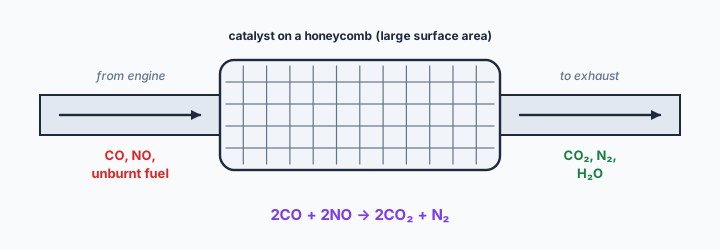
In a car engine the temperature is high enough for nitrogen and oxygen from the air to react: \( \mathrm{N_2 + O_2 \rightarrow 2NO} \). The catalytic converter turns the harmful gases in the exhaust into less harmful ones. Carbon monoxide is oxidised and nitrogen monoxide is reduced:
Photosynthesis
Plants make glucose from carbon dioxide and water, using energy from light, in the presence of chlorophyll:
carbon dioxide + water → glucose + oxygen
EXTENDED The symbol equation is Supplement. Photosynthesis removes CO2 from the air, which is why planting trees is a climate strategy.
✏️Worked example
(a) Sulfur dioxide. It causes acid rain.
(b) Calcium oxide (flue gas desulfurisation). Sulfur dioxide is an acidic oxide and calcium oxide is a basic oxide, so they react together.
(c) CO2 absorbs thermal energy emitted by the Earth’s surface and re-emits it, some back towards the Earth. This reduces the thermal energy lost to space, so the atmosphere warms.
📝Practise
In the style of the multiple-choice and theory papers. EXTENDED marks Supplement content.
1. (Multiple choice.) Approximately what percentage of clean, dry air is oxygen? A: 1%. B: 21%. C: 78%. D: 79%.
2. (Theory.) In the treatment of drinking water, state the purpose of (a) carbon, (b) chlorine. [2]
3. (Theory.) A colourless liquid turns anhydrous copper(II) sulfate blue. Does this show that the liquid is pure water? How could you check? [2]
4. (Theory.) A farmer uses potassium nitrate and ammonium phosphate. Which of the elements N, P and K does each supply? [2]
5. (Theory.) A gas heater burns methane in a poorly ventilated room. Name the toxic gas that can form, and explain why it forms. [2]
6. (Theory.) Give two strategies for reducing climate change, and explain how one of them works. [3]
7. (Theory.) Fertiliser washes from a field into a river. Describe the effect on the river. [2]
8. (Theory.) EXTENDED Explain why oxides of nitrogen form in a car engine, and write an equation for their removal in a catalytic converter. [3]
9. (Theory.) EXTENDED Write the balanced symbol equation for photosynthesis, and name the two conditions it needs. [3]
🔗Go deeper — other people’s work
These are external resources, not mine. If one stops working, tell me and everything above it on this page still stands.
- PhET “The Greenhouse Effect” — add greenhouse gases and watch the energy balance change
- NASA Climate — the carbon dioxide record, with live data