Organic formulae, fuels, alkanes and alkenes
🎯What you need to be able to do
- Draw and interpret displayed formulae; use general formulae; define functional group, homologous series, saturated and unsaturated.
- Write structural formulae, define structural isomers, and describe the characteristics of a homologous series EXTENDED.
- Name the fossil fuels; describe the fractional distillation of petroleum, how properties change up the column, and the uses of the fractions.
- Describe alkanes as saturated and generally unreactive; the substitution reaction with chlorine EXTENDED.
- Describe alkenes, cracking and the reasons for it, and the bromine water test; addition reactions with bromine, hydrogen and steam EXTENDED.
📚The chemistry
Formulae and families
A displayed formula shows every atom and every bond. A homologous series is a family of compounds with similar chemical properties because they have the same functional group — the atom or group of atoms that determines how the compounds react. General formulae:
The first part of the name counts the carbons: meth- 1, eth- 2, prop- 3, but- 4. A saturated compound has only single carbon–carbon bonds; an unsaturated compound has at least one C=C double bond.
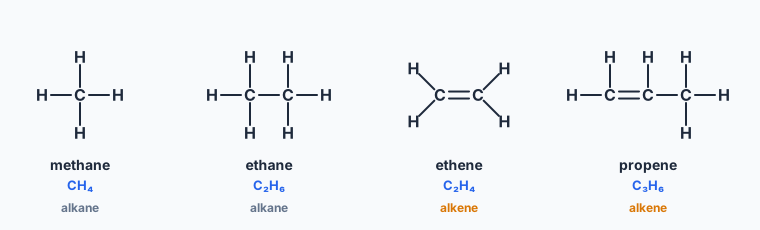
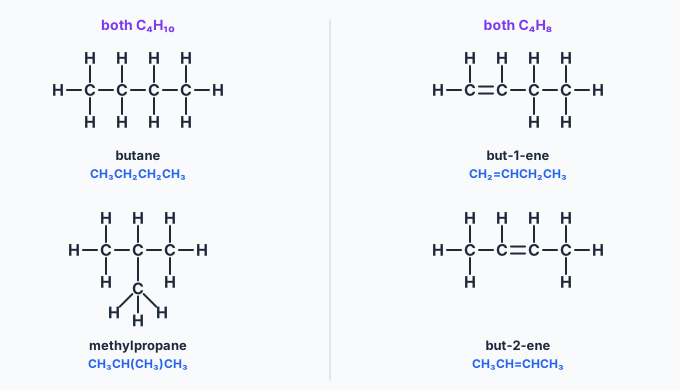
EXTENDED A structural formula describes the arrangement unambiguously without drawing every bond: CH2=CH2, CH3CH2OH. Members of a homologous series have the same functional group and general formula, differ by a –CH2– unit, show a trend in physical properties (boiling point rises with chain length) and have similar chemical properties. Structural isomers have the same molecular formula but different structural formulae:
Fuels and fractional distillation
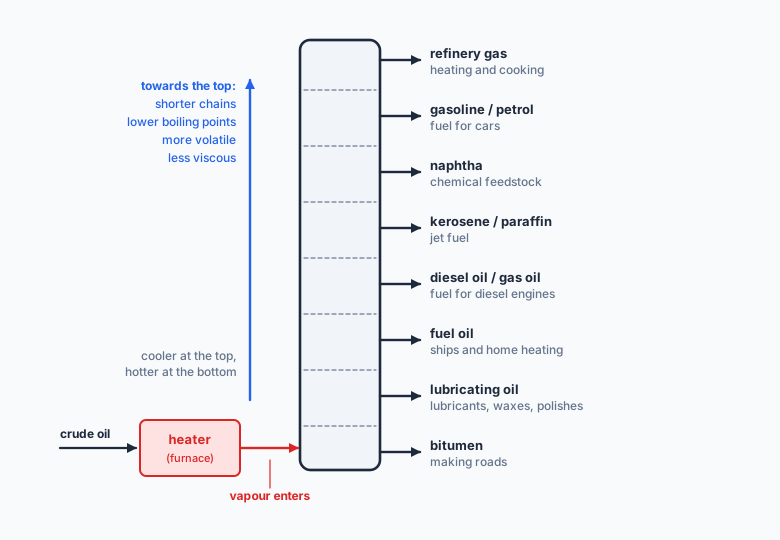
The fossil fuels are coal, natural gas (mainly methane) and petroleum. Petroleum (crude oil) is a mixture of hydrocarbons — compounds of hydrogen and carbon only. It is separated into useful fractions by fractional distillation: the oil is vaporised, and the vapours rise up a column that is hotter at the bottom than at the top, so each fraction condenses at a different height.
Alkanes
Alkanes have only single covalent bonds: they are saturated hydrocarbons. They are generally unreactive, except that they burn (combustion) and react with chlorine by substitution.
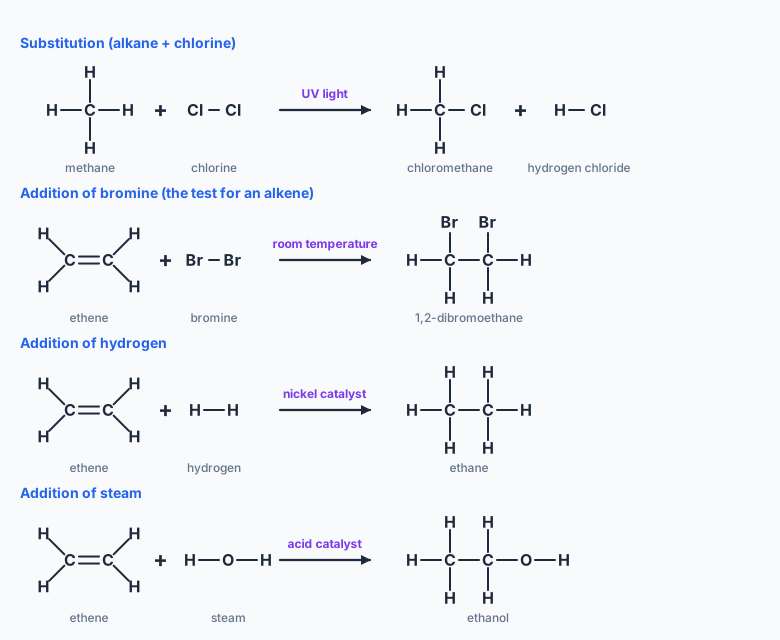
EXTENDED In a substitution reaction one atom or group of atoms is replaced by another. The reaction of an alkane with chlorine is photochemical: ultraviolet light provides the activation energy.
Alkenes and cracking
Alkenes contain a C=C double bond: they are unsaturated hydrocarbons. They are made by cracking larger alkane molecules, using a high temperature and a catalyst; cracking also produces hydrogen.
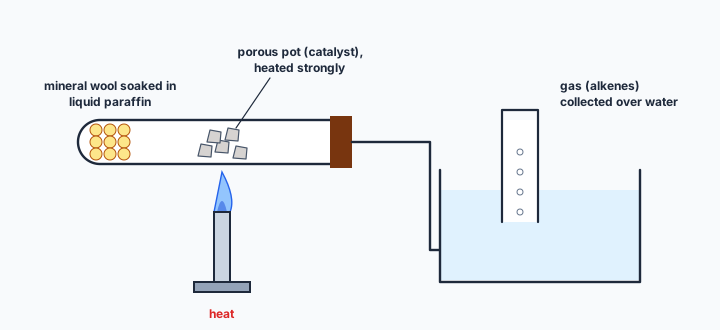
Why crack? Fractional distillation gives more of the long-chain fractions than are needed, and less of the short-chain ones such as petrol. Cracking converts the surplus into shorter, more useful alkanes, plus alkenes (to make polymers and ethanol) and hydrogen.
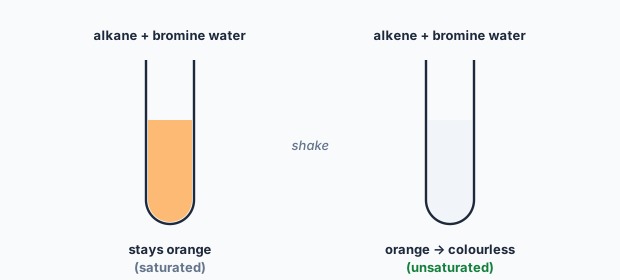
Test for unsaturation: shake the hydrocarbon with aqueous bromine (bromine water).
Addition reactions EXTENDED
In an addition reaction two molecules join to form only one product. The double bond opens and the atoms add across it:
✏️Worked example
(a) \( \mathrm{C_{12}H_{26} \rightarrow C_8H_{18} + 2C_2H_4} \): 12 C and 26 H on each side.
(b) Shorter alkanes like octane are in greater demand (petrol) than long ones; ethene is needed to make polymers and ethanol.
(c) Shake each with bromine water: ethene turns it from orange to colourless; octane leaves it orange.
(d) Nickel; ethane; addition.
📝Practise
In the style of the multiple-choice and theory papers. EXTENDED marks Supplement content.
1. (Multiple choice.) Which formula is an alkene? A: C3H8. B: C4H8. C: C5H12. D: C2H6.
2. (Theory.) Give the molecular formula of the alkane with six carbon atoms, and state whether it is saturated or unsaturated. [2]
3. (Theory.) Name the fraction used as jet fuel, and state how the viscosity of the fractions changes towards the bottom of the column. [2]
4. (Theory.) Complete the cracking equation: \( \mathrm{C_{14}H_{30} \rightarrow C_{10}H_{22} + \ ?\ C_2H_4} \). [1]
5. (Theory.) Hexane and hex-1-ene are both colourless liquids. Describe a chemical test to tell them apart, with the result for each. [3]
6. (Theory.) EXTENDED Ethane reacts with chlorine. State the condition needed, and draw the displayed formula of the organic product of monosubstitution. [3]
7. (Theory.) EXTENDED Propene reacts with bromine. Name the product and give its structural formula. What type of reaction is this? [3]
8. (Theory.) EXTENDED Define structural isomers, and write the structural formula of an isomer of but-1-ene. [3]
9. (Theory.) EXTENDED Give three characteristics of a homologous series. [3]
🔗Go deeper — other people’s work
These are external resources, not mine. If one stops working, tell me and everything above it on this page still stands.
- MolView — build and rotate 3D models of alkanes, alkenes and their isomers
- Royal Society of Chemistry — cracking hydrocarbons, a class practical