Identifying ions and gases
🎯What you need to be able to do
- Describe the tests for the anions carbonate, chloride, bromide, iodide, nitrate, sulfate and sulfite.
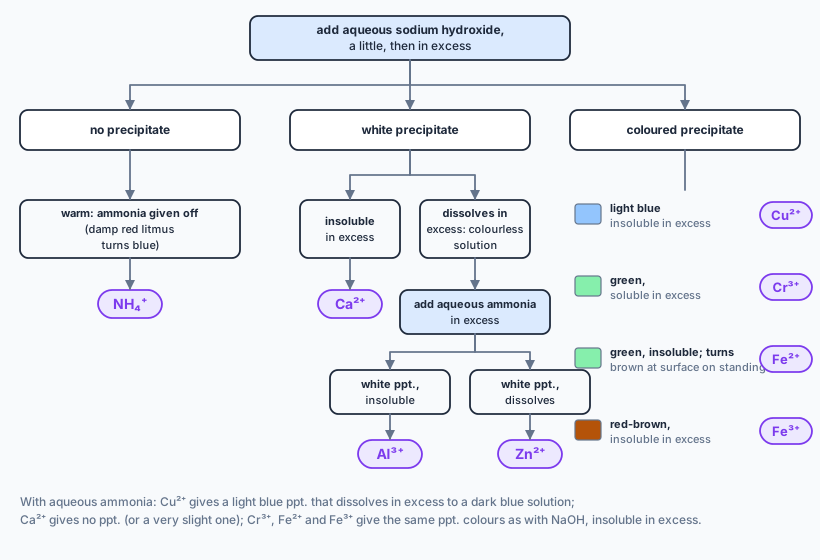
- Describe the tests with aqueous sodium hydroxide and aqueous ammonia for Al3+, NH4+, Ca2+, Cr3+, Cu2+, Fe2+, Fe3+ and Zn2+.
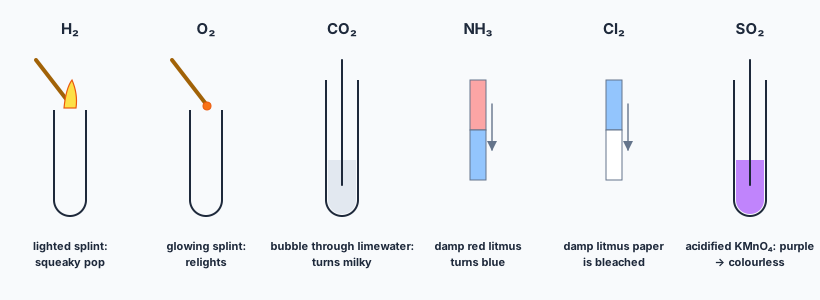
- Describe the tests for ammonia, carbon dioxide, chlorine, hydrogen, oxygen and sulfur dioxide.
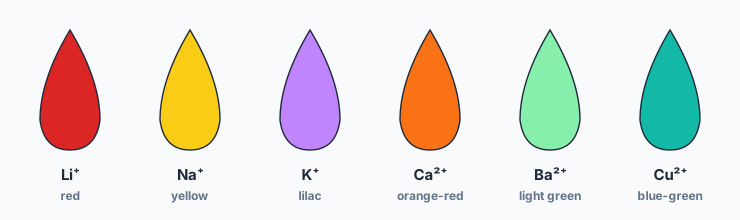
- Describe flame tests for Li+, Na+, K+, Ca2+, Ba2+ and Cu2+.
📚The chemistry
All of this topic is Core, and the same tests are printed as the “Notes for use in qualitative analysis” in the practical papers (5 and 6). In the theory papers you must know them. Learn the wording as well as the colour: examiners want “white precipitate” (or “ppt.”), not “goes cloudy”.
Tests for anions
- Carbonate, CO32−: add dilute acid — effervescence; the gas (carbon dioxide) turns limewater milky.
- Chloride, bromide, iodide (in solution): acidify with dilute nitric acid, then add aqueous silver nitrate — white, cream and yellow precipitates respectively.
- Nitrate, NO3− (in solution): add aqueous sodium hydroxide, then aluminium foil; warm carefully — ammonia is produced (damp red litmus turns blue).
- Sulfate, SO42− (in solution): acidify with dilute nitric acid, then add aqueous barium nitrate — white precipitate.
- Sulfite, SO32−: add a small volume of acidified aqueous potassium manganate(VII) — it changes from purple to colourless.
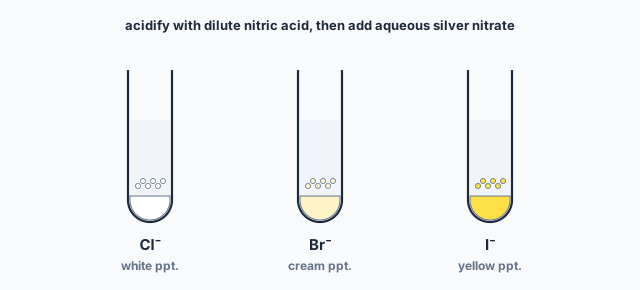
Why nitric acid? Hydrochloric acid would add chloride ions (a false positive for chloride), and sulfuric acid would add sulfate ions (a false positive for sulfate).
Tests for aqueous cations
Add aqueous sodium hydroxide a few drops at a time, then in excess; repeat with aqueous ammonia where you need to decide between two ions.
Flame tests
Dip a clean wire (nichrome or platinum), moistened with acid, into the solid and hold it in a blue Bunsen flame.
Tests for gases
✏️Worked example
(a) Tests 1 and 2: copper(II), Cu2+. Test 3: nitrate, NO3−. Z is copper(II) nitrate.
(b) Ammonia.
(c) Blue-green.
📝Practise
In the style of the multiple-choice, theory and practical papers.
1. (Multiple choice.) Which gas relights a glowing splint? A: carbon dioxide. B: hydrogen. C: oxygen. D: chlorine.
2. (Theory.) Describe how to show that a white powder is a carbonate. [3]
3. (Theory.) Two white solids give flame colours of orange-red and light green. Identify the metal ions. [2]
4. (Theory.) Solutions of aluminium sulfate and zinc sulfate both give a white precipitate with aqueous sodium hydroxide that dissolves in excess. Describe a test to tell them apart. [2]
5. (Practical.) Describe the test for sulfate ions, and explain why dilute hydrochloric acid would not be used if you then tested the same sample for chloride. [3]
6. (Theory.) Describe how aqueous sodium hydroxide distinguishes iron(II) ions from iron(III) ions. [2]
7. (Theory.) A gas bleaches damp litmus paper. Name the gas. [1]
8. (Practical.) A solution of X is warmed with aqueous sodium hydroxide. A gas is given off that turns damp red litmus blue. Name the gas and the ion present in X. [2]
9. (Theory.) A solution decolourises a small volume of acidified aqueous potassium manganate(VII), and gives no precipitate with acidified barium nitrate. Which anion from the list could it contain: sulfate, sulfite or carbonate? [1]
🔗Go deeper — other people’s work
These are external resources, not mine. If one stops working, tell me and everything above it on this page still stands.
- Royal Society of Chemistry — flame tests, with photographs of each colour
- Royal Society of Chemistry — identifying ions, a microscale practical