Bonding and structure
🎯What you need to be able to do
- Describe how atoms form positive ions (cations) and negative ions (anions), and state that an ionic bond is a strong electrostatic attraction between them.
- Draw dot-and-cross diagrams for ionic compounds of Group I and Group VII; for any metal and non-metal EXTENDED.
- Describe and explain the properties of ionic compounds; describe the giant ionic lattice EXTENDED.
- Draw dot-and-cross diagrams for H2, Cl2, H2O, CH4, NH3 and HCl; also CH3OH, C2H4, O2, CO2 and N2 EXTENDED.
- Describe and explain the properties of simple molecular substances, using weak intermolecular forces EXTENDED.
- Describe diamond and graphite and relate their structures to their uses; describe silicon(IV) oxide EXTENDED.
- Describe metallic bonding and explain the conductivity, malleability and ductility of metals EXTENDED.
📚The chemistry
Ionic bonding
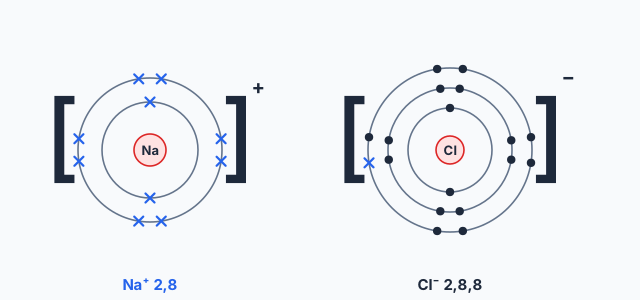
Metal atoms lose their outer electrons to form positive ions (cations); non-metal atoms gain electrons to form negative ions (anions). Both end up with a full outer shell. The ionic bond is the strong electrostatic attraction between the oppositely charged ions. In a dot-and-cross diagram, show one atom’s electrons as dots and the other’s as crosses, put each ion in square brackets, and write its charge outside the bracket.
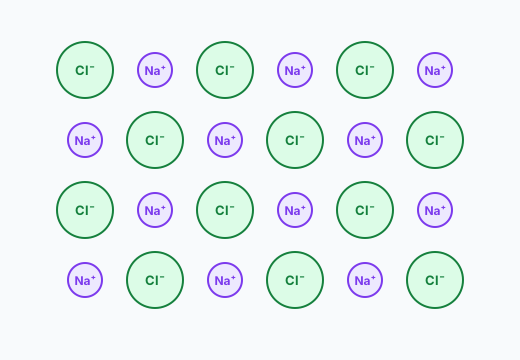
Ionic compounds have high melting and boiling points, and they conduct electricity when molten or in aqueous solution, but not as solids. EXTENDED They form a giant lattice: a regular arrangement of alternating positive and negative ions. Many strong ionic bonds must be broken to melt it, which takes a lot of energy. In the solid the ions are fixed in place; when molten or dissolved they are free to move and carry charge.
EXTENDED Work out the formula from the charges so that they cancel: Mg2+ and O2− give MgO; Al3+ and O2− give Al2O3 (\( 2 \times 3 = 3 \times 2 \)); Ca2+ and Cl− give CaCl2.
Covalent bonding
A covalent bond is a shared pair of electrons between two non-metal atoms, which gives each atom a noble-gas configuration. In diagrams, overlap the outer shells and put the shared pairs in the overlap. A double bond is two shared pairs (as in O2, C2H4 and CO2); a triple bond is three (N2). Check each atom: hydrogen should have 2 outer electrons, every other atom 8.
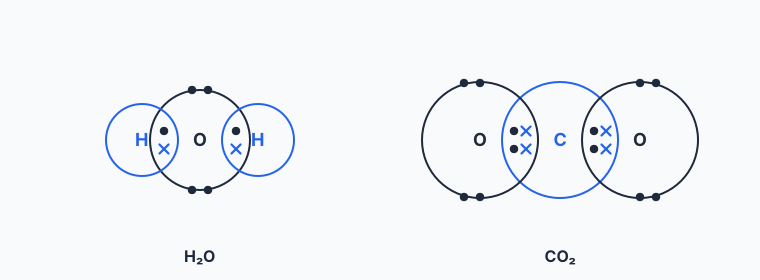
Simple molecular substances (H2O, CO2, CH4…) have low melting and boiling points and do not conduct. EXTENDED The covalent bonds inside each molecule are strong, but the forces between molecules (intermolecular forces) are weak, and only those are overcome on melting or boiling. There are no ions or free electrons to carry charge.
Giant covalent structures
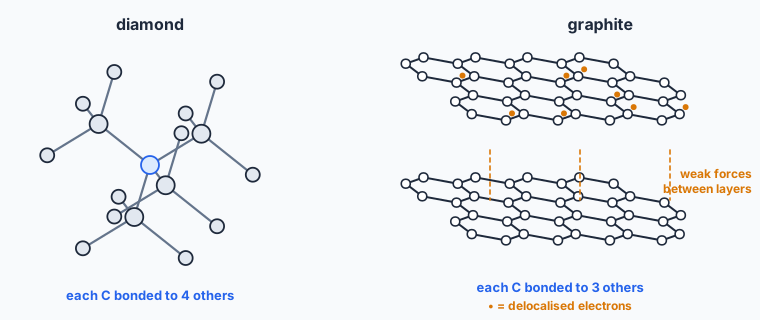
- Diamond: every carbon atom is covalently bonded to four others in a giant 3D network ⇒ very hard, very high melting point, does not conduct ⇒ used in cutting tools.
- Graphite: each carbon bonded to three others in flat layers; the fourth electron is delocalised; weak forces between layers ⇒ the layers slide (used as a lubricant) and it conducts electricity (used as an electrode).
- EXTENDED Silicon(IV) oxide, SiO2: each silicon bonded to four oxygens and each oxygen to two silicons in a giant network ⇒ like diamond, hard, very high melting point and a non-conductor.
Metallic bonding EXTENDED
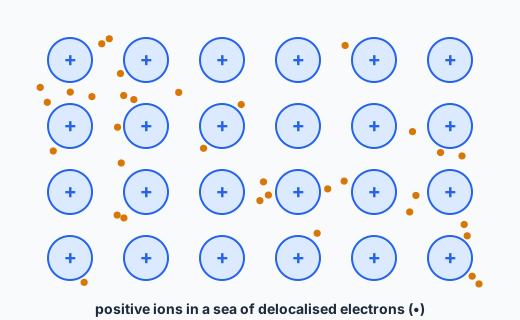
Metallic bonding is the electrostatic attraction between the positive ions in a giant metallic lattice and a ‘sea’ of delocalised electrons. The delocalised electrons can move through the structure, so metals conduct electricity; the layers of ions can slide over each other without breaking the bonding, so metals are malleable and ductile.
✏️Worked example
(a) A sodium atom (2,8,1) loses its outer electron to a chlorine atom (2,8,7), forming Na+ (2,8) and Cl− (2,8,8). The oppositely charged ions are held together by strong electrostatic attraction: an ionic bond.
(b) It is a giant lattice of oppositely charged ions with many strong ionic bonds, which need a lot of energy to break. In the solid the ions cannot move; when molten they are free to move and carry charge.
(c) Boiling only overcomes the weak intermolecular forces between the molecules, not the covalent bonds within them, so little energy is needed.
📝Practise
In the style of the multiple-choice and theory papers. EXTENDED marks Supplement content.
1. (Multiple choice.) Which substance contains ionic bonds? A: HCl. B: CH4. C: MgCl2. D: Cl2.
2. (Theory.) In a molecule of ammonia, NH3, state the number of bonding pairs and non-bonding (lone) pairs of electrons around nitrogen. [2]
3. (Theory.) Explain why diamond is used in cutting tools and graphite is used as a lubricant. [4]
4. (Theory.) EXTENDED Using the charges on the ions, write the formulae of aluminium oxide and calcium chloride. [2]
5. (Theory.) EXTENDED Draw a dot-and-cross diagram for nitrogen, N2, showing outer electrons only. How many shared pairs are there? [2]
6. (Theory.) EXTENDED Explain why copper conducts electricity and can be drawn into wires. [3]
7. (Theory.) EXTENDED Silicon(IV) oxide has a very high melting point and does not conduct electricity. Explain these properties. [3]
8. (Multiple choice.) Which pair of properties describes a simple molecular substance? A: high melting point, conducts when molten. B: low melting point, does not conduct. C: high melting point, conducts when solid. D: low melting point, conducts when molten.
🔗Go deeper — other people’s work
These are external resources, not mine. If one stops working, tell me and everything above it on this page still stands.
- Royal Society of Chemistry — interactive dot-and-cross diagram builders
- ChemTube3D — rotatable 3D structures of NaCl, diamond, graphite and SiO2