Formulae, equations and relative masses
🎯What you need to be able to do
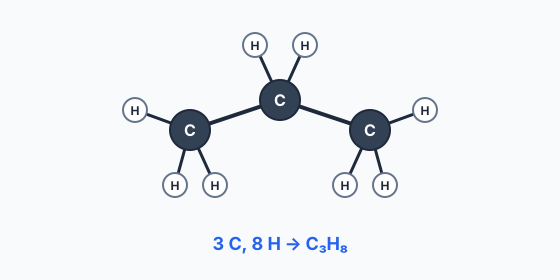
- State the formulae of the elements and compounds in the syllabus, and deduce a formula from a model or diagram.
- Define molecular formula; define empirical formula EXTENDED.
- Deduce the formula of an ionic compound from the charges on its ions EXTENDED.
- Write word equations and balanced symbol equations with state symbols; ionic equations EXTENDED.
- Describe relative atomic mass Ar and define relative molecular (formula) mass Mr.
- Calculate reacting masses in simple proportions (without moles).
📚The chemistry
Formulae
The molecular formula gives the number and type of each atom in one molecule: ethene is C2H4. EXTENDED The empirical formula is the simplest whole-number ratio of the atoms or ions: CH2 for ethene. Ionic compounds are always written as their empirical formula (NaCl, not Na6Cl6). To deduce a formula from a model, count each kind of atom.
Useful ions to know: Na+, K+, NH4+, Mg2+, Ca2+, Cu2+, Zn2+, Fe2+, Fe3+, Al3+; Cl−, OH−, NO3−, O2−, SO42−, CO32−. Balance the charges and use brackets when more than one compound ion is needed: calcium hydroxide is Ca(OH)2, ammonium sulfate (NH4)2SO4.
Equations
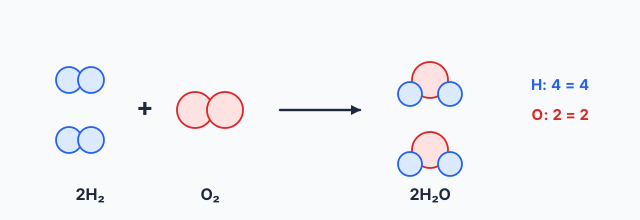
A balanced symbol equation has the same number of each type of atom on both sides. Balance by changing the big numbers in front of the formulae, never the small subscripts. Add state symbols: (s) solid, (l) liquid, (g) gas, (aq) aqueous (dissolved in water).
EXTENDED An ionic equation shows only the particles that change. Write the full equation with state symbols, split every aqueous ionic compound into its ions, and cross out the spectator ions that appear unchanged on both sides:
Relative masses
The relative atomic mass, Ar, is the average mass of the isotopes of an element compared with \( \tfrac{1}{12} \) of the mass of a 12C atom (topic 2a). The relative molecular mass, Mr, is the sum of the relative atomic masses of all the atoms in the formula (for ionic compounds it is called the relative formula mass). For CaCO3: \( 40 + 12 + 3 \times 16 = 100 \).
Reacting masses in proportion. The balanced equation, with Mr values, gives a mass ratio that you can scale up or down. In \( \mathrm{CaCO_3 \rightarrow CaO + CO_2} \), 100 g of calcium carbonate gives 56 g of calcium oxide, so 25 g gives \( \tfrac{25}{100} \times 56 = 14 \) g.
✏️Worked example
(a) \( \mathrm{Fe_2O_3 + 3CO \rightarrow 2Fe + 3CO_2} \): 2 Fe, 6 O and 3 C on each side.
(b) \( 2(14 + 4) + 32 + 4(16) = 36 + 32 + 64 = 132 \).
(c) Mr CaCO3 \( = 100 \), Mr CaO \( = 56 \): 100 g gives 56 g, so 25 g gives 14 g.
(d) \( \mathrm{Zn(s) + CuSO_4(aq) \rightarrow ZnSO_4(aq) + Cu(s)} \); the sulfate ion is a spectator:
📝Practise
In the style of the multiple-choice and theory papers. Use Ar: H 1, C 12, N 14, O 16, Mg 24, Al 27, S 32, Ca 40. EXTENDED marks Supplement content.
1. (Multiple choice.) What is the relative formula mass of magnesium nitrate, Mg(NO3)2? A: 86. B: 110. C: 148. D: 172.
2. (Theory.) Balance \( \mathrm{Al + O_2 \rightarrow Al_2O_3} \). [1]
3. (Theory.) Write the balanced symbol equation, with state symbols, for the complete combustion of propane, C3H8, to carbon dioxide and water (a liquid). [3]
4. (Theory.) In \( \mathrm{2Mg + O_2 \rightarrow 2MgO} \), 48 g of magnesium makes 80 g of magnesium oxide. Calculate the mass of magnesium oxide made from 6 g of magnesium. [2]
5. (Theory.) EXTENDED State the empirical formula of (a) ethene, C2H4, (b) glucose, C6H12O6. [2]
6. (Theory.) EXTENDED Write the ionic equation for the neutralisation of any acid by any alkali, with state symbols. [2]
7. (Theory.) EXTENDED Write the formulae of iron(III) sulfate and ammonium carbonate. [2]
🔗Go deeper — other people’s work
These are external resources, not mine. If one stops working, tell me and everything above it on this page still stands.
- PhET “Balancing Chemical Equations” — balance equations by adjusting coefficients and watch the atoms
- Royal Society of Chemistry — ionic equations and spectator ions