The mole and calculations
Core candidates need only the first objective (concentration units). Everything else on this page is EXTENDED (Supplement) content — and it appears on almost every Paper 4.
🎯What you need to be able to do
- State that concentration can be measured in g/dm³ or mol/dm³.
- State that one mole contains \( 6.02 \times 10^{23} \) particles (the Avogadro constant) EXTENDED.
- Use amount (mol) \( = \) mass (g) \( \div \) molar mass (g/mol), and the molar gas volume of 24 dm³ at r.t.p. EXTENDED.
- Calculate reacting masses, limiting reactants, gas volumes, and concentrations in g/dm³ and mol/dm³ EXTENDED.
- Use titration results to find moles, concentration or volume EXTENDED.
- Calculate empirical and molecular formulae, percentage yield, percentage composition by mass and percentage purity EXTENDED.
📚The chemistry
The mole
A mole is the amount of substance containing \( 6.02 \times 10^{23} \) particles (atoms, molecules or ions) — the Avogadro constant. The mass of one mole is the molar mass: the Ar or Mr in grams. One mole of CO2 (Mr 44) weighs 44 g.
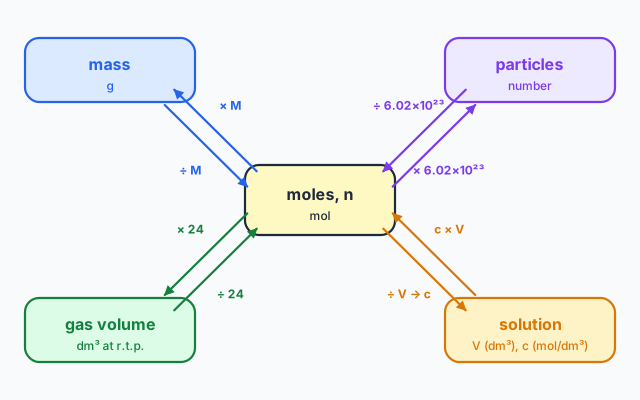
Volumes are often given in cm³: divide by 1000 to get dm³. A concentration in g/dm³ is the mol/dm³ value times the molar mass.
Calculations from equations
- Write the balanced equation.
- Convert the known quantity to moles.
- Use the mole ratio from the equation.
- Convert the answer to the unit asked for (mass, gas volume, concentration…).
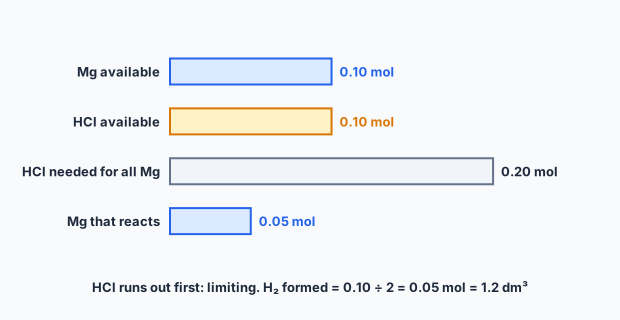
If amounts of two reactants are given, one will run out first: the limiting reactant. Compare the moles you have with the ratio in the equation; the product is calculated from the limiting reactant, and the other is in excess.
Titrations use the same steps: moles of the solution whose concentration is known (\( c \times V \)), then the ratio, then the unknown concentration (\( n \div V \)).
Formulae and percentages
- Empirical formula: divide each mass (or percentage) by Ar, then divide by the smallest to get the whole-number ratio.
- Molecular formula: divide Mr by the empirical formula mass and multiply up.
- Percentage yield \( = \dfrac{\text{actual yield}}{\text{theoretical yield}} \times 100 \).
- Percentage composition of an element \( = \dfrac{\text{total } A_\mathrm{r} \text{ of that element}}{M_\mathrm{r}} \times 100 \).
- Percentage purity \( = \dfrac{\text{mass of pure substance}}{\text{mass of impure sample}} \times 100 \).
✏️Worked example EXTENDED
(a) \( n = \tfrac{8.8}{44} = 0.20 \) mol; molecules \( = 0.20 \times 6.02 \times 10^{23} = 1.2 \times 10^{23} \).
(b) \( n(\mathrm{CaCO_3}) = \tfrac{5.0}{100} = 0.050 \) mol. Ratio 1 : 1, so 0.050 mol CO2. Volume \( = 0.050 \times 24 = 1.2 \) dm³ \( = 1200 \) cm³.
(c) \( n(\mathrm{H_2SO_4}) = 0.100 \times \tfrac{20.0}{1000} = 0.00200 \) mol. Ratio 1 : 2, so \( n(\mathrm{NaOH}) = 0.00400 \) mol. Concentration \( = \dfrac{0.00400}{0.0250} = 0.160 \) mol/dm³.
(d) C: \( \tfrac{85.7}{12} = 7.14 \); H: \( \tfrac{14.3}{1} = 14.3 \). Divide by 7.14: C 1, H 2, so the empirical formula is CH2 (mass 14). \( 56 \div 14 = 4 \): molecular formula C4H8.
📝Practise
All Supplement unless stated. Ar: H 1, C 12, N 14, O 16, Na 23, Mg 24, Cl 35.5, K 39, Ca 40. Molar gas volume 24 dm³ at r.t.p.
1. (Multiple choice.) How many moles are in 4.0 g of sodium hydroxide, NaOH? A: 0.010. B: 0.10. C: 1.0. D: 10.
2. (Theory.) Calculate the volume of 3.2 g of oxygen gas, O2, at r.t.p. [2]
3. (Theory.) 5.85 g of sodium chloride is dissolved to make 250 cm³ of solution. Calculate the concentration in mol/dm³ and in g/dm³. [3]
4. (Theory.) 22.50 cm³ of 0.200 mol/dm³ hydrochloric acid neutralises 25.0 cm³ of aqueous potassium hydroxide. Calculate the concentration of the potassium hydroxide. [3]
5. (Theory.) A compound contains 0.72 g of carbon, 0.12 g of hydrogen and 0.96 g of oxygen. Its Mr is 180. Find its empirical and molecular formulae. [3]
6. (Theory.) Calculate the percentage by mass of nitrogen in ammonium nitrate, NH4NO3. [2]
7. (Theory.) Heating 10.0 g of calcium carbonate produced 5.0 g of calcium oxide. Calculate the percentage yield. [3]
8. (Theory.) A 5.0 g sample of impure calcium carbonate reacts with excess acid to give 1.056 dm³ of carbon dioxide at r.t.p. Calculate the percentage purity of the sample. [3]
9. (Theory.) 2.4 g of magnesium is added to 50.0 cm³ of 2.00 mol/dm³ hydrochloric acid: \( \mathrm{Mg + 2HCl \rightarrow MgCl_2 + H_2} \). Identify the limiting reactant and calculate the volume of hydrogen made at r.t.p. [4]
🔗Go deeper — other people’s work
These are external resources, not mine. If one stops working, tell me and everything above it on this page still stands.
- Royal Society of Chemistry — moles and titration calculation practice sheets
- Your calculator — use the standard-form key (×10x) for Avogadro calculations