Electrochemistry
🎯What you need to be able to do
- Define electrolysis, and identify the anode (+), cathode (−) and electrolyte.
- Identify the products and observations for molten lead(II) bromide, concentrated aqueous sodium chloride and dilute sulfuric acid, with inert electrodes.
- Predict the products from a molten binary compound; state that metals or hydrogen form at the cathode and non-metals at the anode.
- Describe electroplating and why it is used.
- Describe the transfer of charge; electrolysis of aqueous copper(II) sulfate with carbon and with copper electrodes; halides in dilute or concentrated solution EXTENDED.
- Write ionic half-equations at the anode (oxidation) and cathode (reduction) EXTENDED.
- State what a hydrogen–oxygen fuel cell does; compare fuel cells with petrol engines EXTENDED.
📚The chemistry
What electrolysis is
Electrolysis is the decomposition of an ionic compound, when molten or in aqueous solution, by passing an electric current through it. The electrolyte is the molten or aqueous substance; the anode is the positive electrode and the cathode the negative one. Solid ionic compounds cannot be electrolysed because their ions cannot move. Inert electrodes (graphite or platinum) do not react.
Positive ions are attracted to the cathode and negative ions to the anode. Metals or hydrogen form at the cathode; non-metals (other than hydrogen) form at the anode. For a molten binary compound (two elements) the products are simply those two elements: molten zinc chloride gives zinc and chlorine.
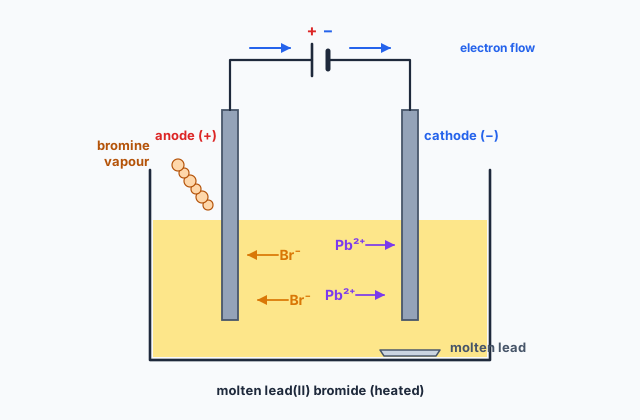
EXTENDED Charge transfer: electrons travel through the external circuit to the cathode, where positive ions gain electrons (reduction); negative ions lose electrons at the anode (oxidation), and those electrons return round the circuit. Half-equations show this:
Aqueous solutions
Water provides H+ and OH− ions as well, so there is competition at each electrode:
- Cathode: hydrogen forms unless the metal is less reactive than hydrogen (copper, silver, gold), in which case the metal forms.
- Anode: from a concentrated halide solution the halogen forms; EXTENDED from a dilute halide, or from sulfates and nitrates, oxygen forms (from OH−).
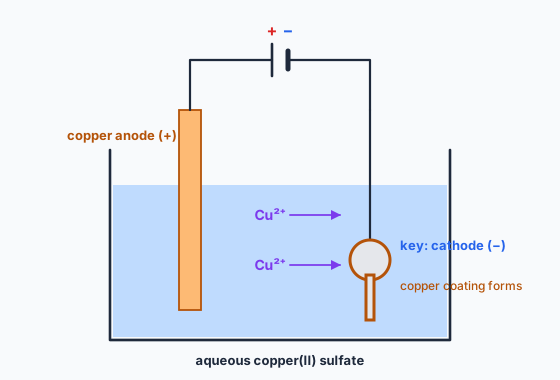
EXTENDED Copper(II) sulfate: with graphite electrodes, copper is deposited on the cathode (pink-brown), oxygen bubbles off the anode, and the blue colour fades as Cu2+ ions are removed. With copper electrodes, the anode dissolves (\( \mathrm{Cu \rightarrow Cu^{2+} + 2e^{-}} \)) as fast as copper deposits on the cathode, so the blue colour stays the same and the anode loses exactly the mass the cathode gains — the basis of copper purification.
Electroplating
Metal objects are electroplated to improve their appearance and resistance to corrosion. Make the object the cathode, the plating metal the anode, and use an electrolyte containing ions of the plating metal.
Hydrogen–oxygen fuel cells
A hydrogen–oxygen fuel cell uses hydrogen and oxygen to produce electricity, with water as the only chemical product. EXTENDED Compared with a petrol engine: no carbon dioxide or other pollutants from the vehicle, and more efficient; but hydrogen is hard to store (a flammable gas needing high-pressure tanks), there are few refuelling stations, and hydrogen is often made from fossil fuels or with electricity that may itself produce CO2.
✏️Worked example
(a) Cathode: lead — a silvery liquid collects under the cathode. Anode: bromine — red-brown vapour (gas) is seen.
(b) \( \mathrm{Pb^{2+} + 2e^{-} \rightarrow Pb} \) at the cathode; \( \mathrm{2Br^{-} \rightarrow Br_2 + 2e^{-}} \) at the anode. The anode reaction is oxidation (loss of electrons).
(c) Oxygen is formed instead of chlorine.
📝Practise
In the style of the multiple-choice and theory papers. EXTENDED marks Supplement content.
1. (Multiple choice.) Concentrated aqueous potassium bromide is electrolysed with inert electrodes. What forms at the cathode? A: potassium. B: hydrogen. C: bromine. D: oxygen.
2. (Theory.) Name the products at the cathode and anode when molten zinc chloride is electrolysed. [2]
3. (Theory.) Explain why solid sodium chloride cannot be electrolysed but molten sodium chloride can. [2]
4. (Theory.) Describe how a steel spoon could be electroplated with silver. [3]
5. (Theory.) EXTENDED Write the half-equation for the reaction at the anode when concentrated aqueous sodium chloride is electrolysed, and state whether it is oxidation or reduction. [2]
6. (Theory.) EXTENDED Aqueous copper(II) sulfate is electrolysed with copper electrodes. Describe what happens to the mass of each electrode and to the colour of the solution. [3]
7. (Theory.) EXTENDED Give one advantage and two disadvantages of hydrogen–oxygen fuel cells compared with petrol engines in vehicles. [3]
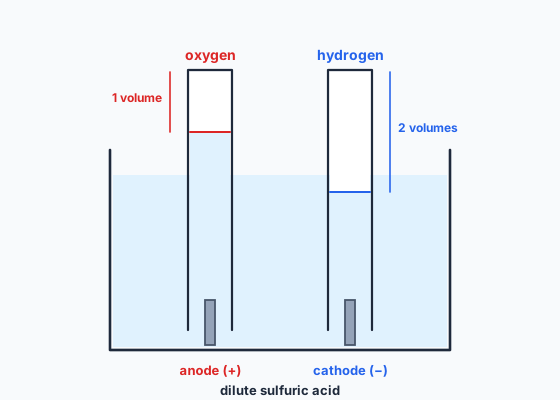
8. (Multiple choice.) In the electrolysis of dilute sulfuric acid, 40 cm³ of gas collects at the cathode. What volume collects at the anode? A: 10 cm³. B: 20 cm³. C: 40 cm³. D: 80 cm³.
🔗Go deeper — other people’s work
These are external resources, not mine. If one stops working, tell me and everything above it on this page still stands.
- Royal Society of Chemistry — electrolysis of copper(II) sulfate class practical
- Chemistry LibreTexts — background on fuel cells