The Periodic Table
🎯What you need to be able to do
- Describe the Periodic Table as elements in order of proton number, in periods and groups; describe the change from metal to non-metal across a period.
- Relate group number to ion charge and explain similar chemical properties in a group by electronic configuration.
- Describe the trends in Group I (lithium, sodium, potassium) and Group VII (chlorine, bromine, iodine), and predict the properties of other members.
- Describe and explain halogen displacement reactions.
- Describe the properties of the transition elements, and their variable oxidation numbers EXTENDED.
- Explain why the noble gases are unreactive; identify trends from given data EXTENDED.
📚The chemistry
Arrangement
Elements are arranged in order of increasing proton number. A row is a period; a column is a group. Across a period the elements change from metals on the left to non-metals on the right.
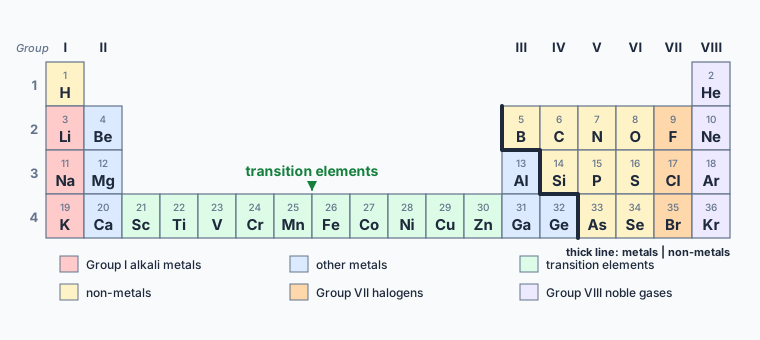
Elements in the same group have the same number of outer electrons, so they react in similar ways. Metals lose their outer electrons: Group I forms 1+ ions, Group II 2+ ions, Group III 3+. Non-metals gain electrons to fill the shell: Group VI forms 2− ions and Group VII 1− ions. So you can predict an unfamiliar element’s properties from its position.
Group I: the alkali metals
Lithium, sodium and potassium are relatively soft metals that are stored under oil. Going down the group:
They all react with cold water to make an alkaline hydroxide solution and hydrogen:
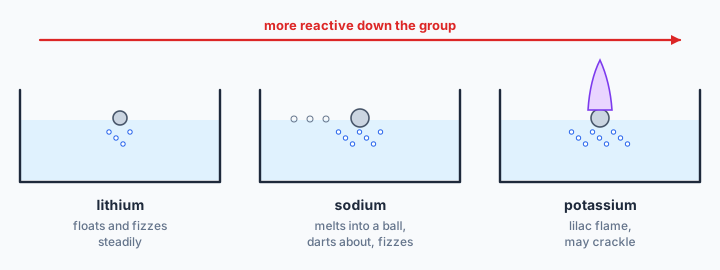
Reactivity increases because the outer electron is further from the nucleus, so it is lost more easily.
Group VII: the halogens
The halogens are diatomic non-metals (Cl2, Br2, I2). At room temperature and pressure: chlorine is a pale yellow-green gas, bromine a red-brown liquid, iodine a grey-black solid. Going down the group, density increases and reactivity decreases (it gets harder to gain an electron as the outer shell gets further from the nucleus).
A more reactive halogen displaces a less reactive one from a solution of its halide ions:
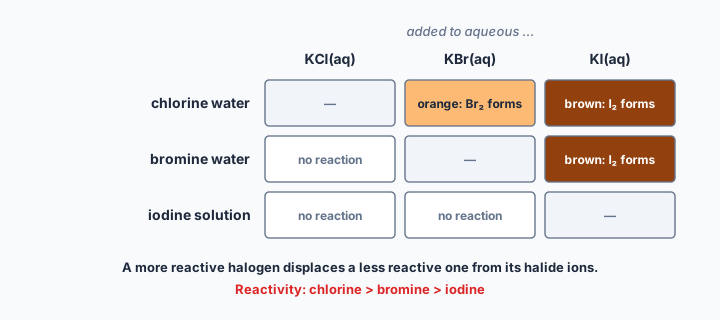
EXTENDED Displacement is redox: in \( \mathrm{Cl_2 + 2I^{-} \rightarrow 2Cl^{-} + I_2} \) chlorine gains electrons (reduced) and the iodide ions lose them (oxidised).
Transition elements
The block between Groups II and III. Compared with Group I metals, transition elements have high densities and high melting points, they form coloured compounds (copper(II) sulfate is blue, iron(III) compounds are orange-brown), and they and their compounds often act as catalysts (iron in the Haber process, vanadium(V) oxide in the Contact process).
EXTENDED Their ions have variable oxidation numbers: iron forms iron(II), Fe2+, and iron(III), Fe3+, so it has two chlorides, FeCl2 and FeCl3. The Roman numeral in the name tells you which.
Noble gases
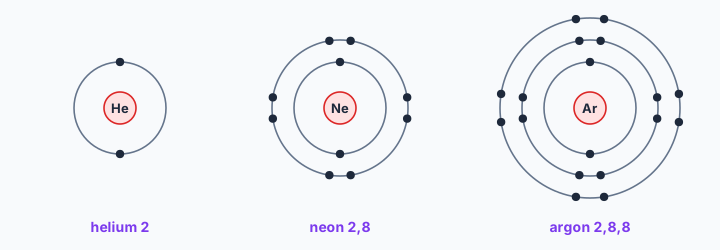
Group VIII elements are unreactive, monatomic gases. Their atoms already have a full outer shell (a stable electronic configuration), so they have no tendency to gain, lose or share electrons.
✏️Worked example
(a) Orange to brown. bromine + potassium iodide → potassium bromide + iodine.
(b) Bromine is more reactive than iodine, so it displaces iodine from its compound.
(c) \( \mathrm{Br_2(aq) + 2I^{-}(aq) \rightarrow 2Br^{-}(aq) + I_2(aq)} \). The iodide ions are oxidised: each loses an electron.
(d) A solid (the trend runs gas → liquid → solid down the group, and astatine is below solid iodine). Yes: iodine is more reactive than astatine, so it would displace astatine.
📝Practise
In the style of the multiple-choice and theory papers. EXTENDED marks Supplement content.
1. (Multiple choice.) Which element is in Period 3 and Group II? A: beryllium. B: calcium. C: magnesium. D: aluminium.
2. (Theory.) A small piece of potassium is added to water containing universal indicator. Give two observations and name both products. [4]
3. (Theory.) Explain why sodium and potassium have similar chemical properties. [2]
4. (Theory.) EXTENDED The boiling points of the halogens are: fluorine −188 °C, chlorine −34 °C, bromine 59 °C, iodine 184 °C. (a) Describe the trend, and predict a boiling point for astatine. (b) Chlorine melts at −101 °C. State its physical state at −50 °C. [3]
5. (Theory.) Name one transition element used as a catalyst, and state the process it is used in. Give one other property that distinguishes transition elements. [2]
6. (Theory.) Explain, in terms of electrons, why argon is unreactive, and state one use that depends on this. [2]
7. (Theory.) EXTENDED Iron reacts with chlorine to give an orange-brown solid, but with hydrochloric acid to give a pale green solution. What does this show about the ions of iron? Give the formula of each iron compound formed. [3]
8. (Theory.) Predict one observation when aqueous chlorine is added to aqueous sodium bromide, and explain it. [2]
🔗Go deeper — other people’s work
These are external resources, not mine. If one stops working, tell me and everything above it on this page still stands.
- Royal Society of Chemistry — the interactive Periodic Table, with data for every element
- Royal Society of Chemistry — halogen displacement microscale practical