Metals
🎯What you need to be able to do
- Compare the physical properties of metals and non-metals, and describe the reactions of metals with dilute acids, water, steam and oxygen.
- Explain uses of aluminium and copper, and of alloys (brass, stainless steel), from their properties; identify an alloy from a structure diagram.
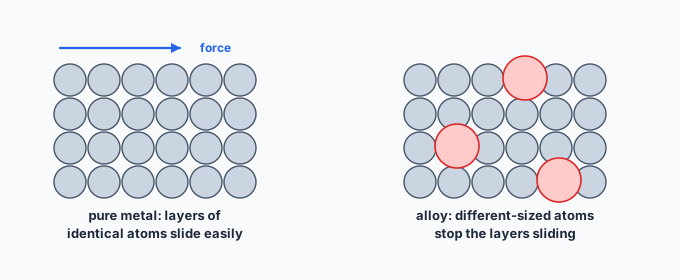
- Explain why alloys are harder than pure metals, in terms of structure EXTENDED.
- State the reactivity series and deduce an order of reactivity from results; use displacement reactions and the aluminium oxide layer EXTENDED.
- State the conditions for rusting and barrier methods; explain galvanising and sacrificial protection EXTENDED.
- Relate extraction to reactivity; describe the blast furnace (equations EXTENDED) and the extraction of aluminium (electrode reactions EXTENDED).
📚The chemistry
Properties and uses
Metals are good thermal and electrical conductors, malleable (can be hammered into shape) and ductile (can be drawn into wires), and most have high melting and boiling points. Non-metals are generally poor conductors, brittle when solid, and have lower melting and boiling points. Chemically, many metals react with dilute acids (salt + hydrogen), with water or steam (hydroxide or oxide + hydrogen) and with oxygen (metal oxide).
Alloys
An alloy is a mixture of a metal with other elements. Brass is copper and zinc; stainless steel is iron with chromium, nickel and carbon, used for cutlery because it is hard and does not rust. Alloys can be harder and stronger than the pure metals, which makes them more useful.
The reactivity series
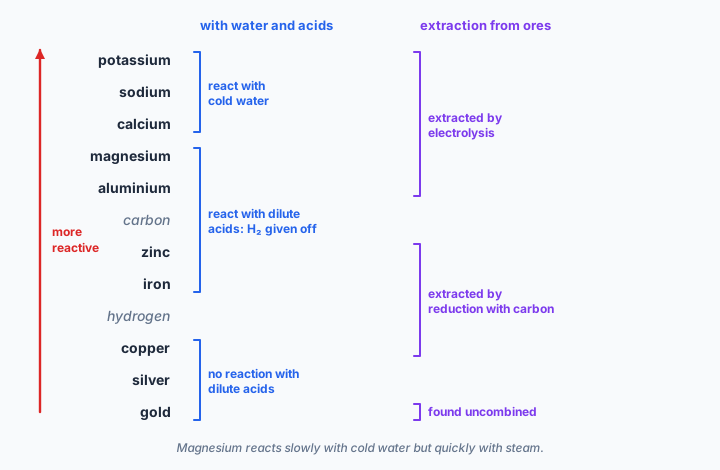
Magnesium reacts very slowly with cold water but quickly with steam, giving magnesium oxide and hydrogen:
EXTENDED Reactivity is the tendency of a metal to form positive ions. A more reactive metal displaces a less reactive one from its aqueous ions: magnesium displaces zinc, iron, copper and silver; copper displaces only silver.
EXTENDED Aluminium seems less reactive than its position suggests because it is covered by a thin, tough layer of aluminium oxide that stops water and acids reaching the metal. The same layer is why aluminium resists corrosion.
Rusting
Iron and steel rust when they are in contact with both water and oxygen. Rust is hydrated iron(III) oxide.
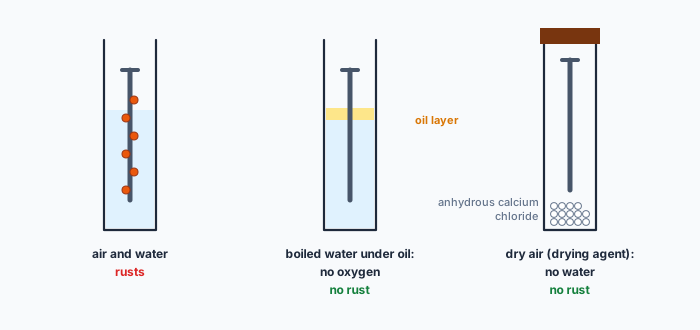
Barrier methods — painting, greasing, coating with plastic — keep out oxygen and water. EXTENDED Galvanising coats iron with zinc. The zinc is a barrier, and it also gives sacrificial protection: zinc is more reactive than iron, so if the coating is scratched the zinc loses electrons (is oxidised) in preference to the iron. Blocks of zinc or magnesium bolted to ships’ hulls work the same way.
Extracting metals
The more reactive a metal, the harder it is to extract from its ore. Metals below carbon are extracted by heating the oxide with carbon; metals above carbon need electrolysis. Gold is unreactive enough to be found as the element.
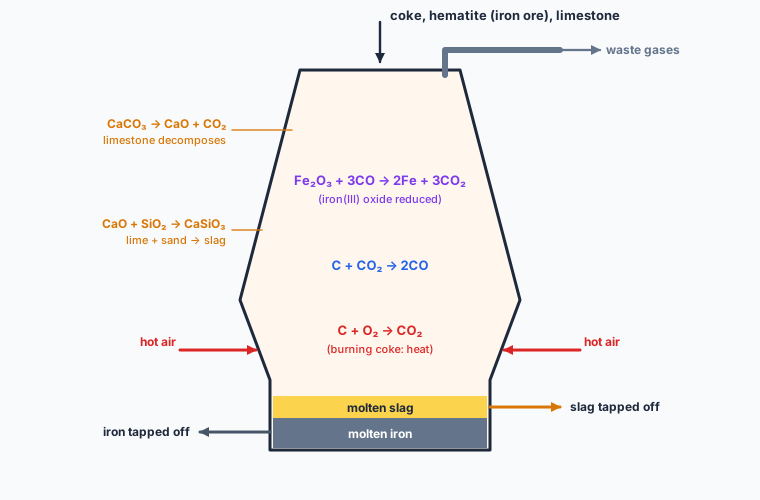
Iron is extracted from hematite (mainly iron(III) oxide) in the blast furnace:
- Coke (carbon) burns in hot air, producing heat and carbon dioxide.
- The carbon dioxide is reduced by more coke to carbon monoxide.
- Carbon monoxide reduces the iron(III) oxide to molten iron.
- Limestone (calcium carbonate) decomposes to calcium oxide, which reacts with sandy impurities (silicon dioxide) to form slag, calcium silicate.
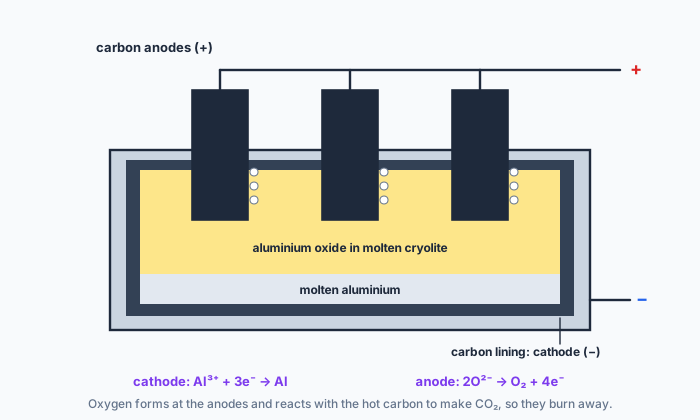
Aluminium’s main ore is bauxite, and aluminium is extracted by electrolysis. EXTENDED Purified aluminium oxide is dissolved in molten cryolite, which lowers the operating temperature (saving energy) and improves the conductivity.
✏️Worked example
(a) W, Y, X, silver. W and Y react with acid (W faster); X does not, so it is below hydrogen; X displaces silver, so X is above silver.
(b) X: copper is below hydrogen (no reaction with dilute acid) but above silver (it displaces silver from silver nitrate).
(c) \( \mathrm{Zn(s) + Fe^{2+}(aq) \rightarrow Zn^{2+}(aq) + Fe(s)} \). Zinc has a greater tendency to form positive ions than iron, so zinc atoms lose electrons to become Zn2+ and the Fe2+ ions gain them to become iron atoms.
📝Practise
In the style of the multiple-choice and theory papers. EXTENDED marks Supplement content.
1. (Multiple choice.) Which two properties make aluminium suitable for overhead power cables? A: high density and good conductor. B: low density and good conductor. C: low density and high melting point. D: resists corrosion and is malleable.
2. (Theory.) Name the metals in brass, and give one reason why stainless steel is used for cutlery. [2]
3. (Theory.) State the two substances needed for iron to rust, and explain how painting a bicycle frame prevents rusting. [3]
4. (Theory.) Write the word equation for the reaction of calcium with cold water, and predict whether copper reacts with steam. [2]
5. (Theory.) Explain why aluminium cannot be extracted from its oxide by heating with carbon. [1]
6. (Theory.) EXTENDED A steel bucket is galvanised. The zinc coating is scratched, exposing the steel, but the steel does not rust. Explain, in terms of electrons. [3]
7. (Theory.) EXTENDED In the blast furnace, write the equations for (a) the formation of carbon monoxide from carbon dioxide, (b) the formation of slag. [2]
8. (Theory.) EXTENDED Aluminium is high in the reactivity series, yet it is used for food containers. Explain. [2]
9. (Theory.) EXTENDED State the role of cryolite in the extraction of aluminium, and write the half-equation at the cathode. [2]
🔗Go deeper — other people’s work
These are external resources, not mine. If one stops working, tell me and everything above it on this page still stands.
- Royal Society of Chemistry — the rusting nail experiment with controls
- BBC Bitesize — the blast furnace and aluminium extraction, animated