Types of number, sets, powers and standard form
🎯What you need to be able to do
- Identify natural numbers, integers, primes, squares, cubes, factors, multiples, rational and irrational numbers and reciprocals.
- Write a number as a product of its prime factors, and use that to find the HCF and LCM.
- Use set notation and Venn diagrams: two sets for Core, up to three sets and the full notation for Extended EXTENDED.
- Recall squares up to 15² and cubes of 1, 2, 3, 4, 5 and 10, with their roots.
- Convert between fractions, decimals and percentages; order quantities; calculate with fractions and negative numbers.
- Convert recurring decimals to fractions EXTENDED.
- Use the rules of indices — integer indices for Core, fractional indices too for Extended EXTENDED.
- Convert to and from standard form and calculate with it.
📚The mathematics
Types of number
- Natural numbers: 1, 2, 3, … Integers: …, −2, −1, 0, 1, 2, …
- Prime: exactly two factors, 1 and itself. 1 is not prime; 2 is the only even prime.
- Rational: can be written as \( \tfrac{a}{b} \) with integers \(a, b\) — includes every terminating and recurring decimal. Irrational: cannot, e.g. \( \sqrt{2} \), \( \pi \), \( \sqrt{7} \).
- The reciprocal of \(x\) is \( \tfrac{1}{x} \): the reciprocal of \( \tfrac{3}{5} \) is \( \tfrac{5}{3} \), and of 0.4 is 2.5.
Prime factors, HCF and LCM
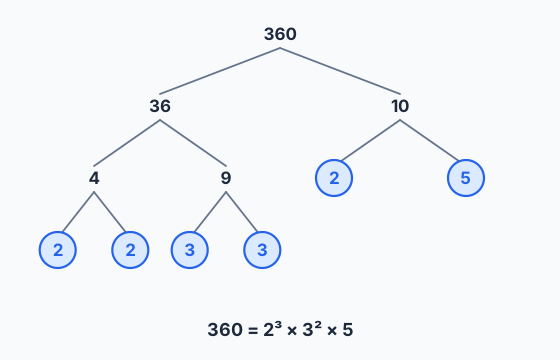
Split a number with a factor tree until every branch ends in a prime, then write the primes in index form. From two such products:
Sets and Venn diagrams
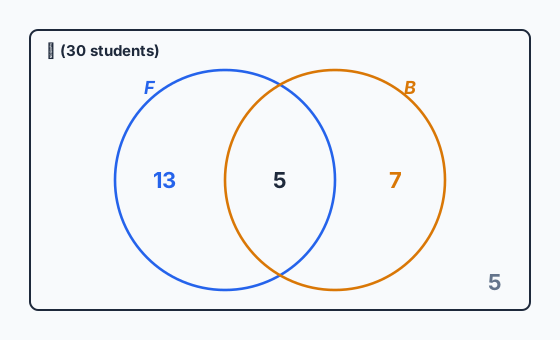
Extended adds \( \in \) (“is an element of”), \( \notin \), \( \varnothing \) (the empty set), \( A \subseteq B \) (subset) and \( A \not\subseteq B \), and Venn diagrams with three sets EXTENDED. When filling a Venn diagram from totals, start in the middle (the intersection) and work outwards, subtracting as you go.
Fractions, decimals and recurring decimals
To divide by a fraction, multiply by its reciprocal; turn mixed numbers into improper fractions first. To order a mix of fractions, decimals and percentages, convert everything to decimals.
EXTENDED A recurring decimal becomes a fraction by multiplying so that the repeating part lines up, then subtracting. For \( x = 0.\dot{4}\dot{7} = 0.4747\ldots \): \( 100x = 47.4747\ldots \), so \( 99x = 47 \) and \( x = \tfrac{47}{99} \). If the repeat starts later, as in \( 0.1\dot{3} = 0.1333\ldots \), use two multipliers: \( 100x - 10x = 13.3\ldots - 1.3\ldots = 12 \), so \( x = \tfrac{12}{90} = \tfrac{2}{15} \).
Indices
For a fractional power, take the root first — the numbers stay small: \( 27^{\frac{2}{3}} = (\sqrt[3]{27})^{2} = 3^{2} = 9 \). A negative power means “reciprocal”, not “negative”: \( 5^{-2} = \tfrac{1}{25} \).
Standard form
\( A \times 10^{n} \) with \( 1 \le A < 10 \) and \(n\) an integer. To multiply, multiply the \(A\)s and add the powers; to divide, divide and subtract. Then re-adjust so that \(A\) is between 1 and 10: \( 14.4 \times 10^{3} = 1.44 \times 10^{4} \). (Core candidates calculate with standard form only on the calculator paper.)
✏️Worked example (non-calculator)
(a) \( 360 = 2^{3} \times 3^{2} \times 5 \) and \( 84 = 2^{2} \times 3 \times 7 \). HCF: lowest powers of the shared primes, \( 2^{2} \times 3 = 12 \). LCM: highest powers of all the primes, \( 2^{3} \times 3^{2} \times 5 \times 7 = 2520 \).
(b) \( 4.8 \times 3 = 14.4 \) and \( 10^{5} \times 10^{-2} = 10^{3} \), so \( 14.4 \times 10^{3} = 1.44 \times 10^{4} \).
(c) \( x = 0.1333\ldots \). \( 10x = 1.333\ldots \) and \( 100x = 13.333\ldots \), so \( 90x = 12 \) and \( x = \tfrac{12}{90} = \tfrac{2}{15} \).
📝Practise
Questions in the style of the current papers. EXTENDED marks Extended-only content.
1. (Non-calculator.) Write 252 as a product of its prime factors. Hence find the HCF and the LCM of 252 and 90. [4]
2. (Non-calculator.) Work out \( 2\tfrac{1}{3} \div 1\tfrac{3}{4} \), giving your answer as a mixed number in its simplest form. [3]
3. (Non-calculator.) Write these in order of size, smallest first: \( \tfrac{5}{8} \), 0.6, 62%, \( \tfrac{2}{3} \). [2]
4. (Non-calculator.) In a class of 30 students, 18 play football (F), 12 play basketball (B) and 5 play neither. Find \( n(F \cap B) \) and \( n(F \cap B') \). [3]
5. (Non-calculator.) Find the value of (a) \( 5^{-2} \), (b) \( 27^{\frac{2}{3}} \) EXTENDED, (c) \( 16^{-\frac{3}{4}} \) EXTENDED. [3]
6. (Non-calculator.) Work out \( (2.4 \times 10^{7}) \div (8 \times 10^{-3}) \), giving your answer in standard form. [2]
7. (Non-calculator.) EXTENDED Write (a) \( 0.\dot{2}\dot{7} \) and (b) \( 0.5\dot{8} \) as fractions in their simplest form. [4]
8. (Non-calculator.) EXTENDED \( A = \{x : x \text{ is a factor of } 12\} \) and \( B = \{x : x \text{ is a prime number less than } 12\} \). List \( A \cap B \) and find \( n(A \cup B) \). [3]
🔗Go deeper — other people’s work
These are external resources, not mine. If one stops working, tell me and everything above it on this page still stands.
- Corbettmaths — short videos and worksheets on HCF/LCM, recurring decimals and standard form
- Khan Academy — exponent rules and fractional exponents