Vectors
EXTENDED Everything on this page is Extended content only. Core uses column vectors only to describe translations (7a).
🎯What you need to be able to do
- Use vectors written as \( \begin{pmatrix} x \\ y \end{pmatrix} \), \( \overrightarrow{AB} \) or \( \mathbf{a} \); add, subtract and multiply them by a scalar.
- Find the magnitude \( \sqrt{x^{2} + y^{2}} \) of a vector.
- Use position vectors, and express vectors in terms of two given vectors.
- Use vectors to show that lines are parallel, that three points are collinear, and to solve problems with ratio and similarity.
📚The mathematics
Column vectors
Add and subtract component by component; multiply every component by a scalar:
The vector from \(A\) to \(B\) is \( \overrightarrow{AB} = \overrightarrow{OB} - \overrightarrow{OA} \): “end minus start”. The position vector of a point is its vector from the origin.
Vector geometry
To find a vector in terms of \( \mathbf{a} \) and \( \mathbf{c} \), walk along known edges from start to finish, adding a vector for each step (and subtracting when you walk against an arrow). For a point dividing \(AB\) in the ratio \( m : n \), go from \(A\) a fraction \( \tfrac{m}{m + n} \) of the way along \( \overrightarrow{AB} \).
- Parallel: one vector is a scalar multiple of the other, e.g. \( 4\mathbf{a} - 2\mathbf{c} = 2(2\mathbf{a} - \mathbf{c}) \).
- Collinear (on one straight line): \( \overrightarrow{PQ} \) and \( \overrightarrow{QR} \) are parallel and share the point \(Q\). Say both in the answer.
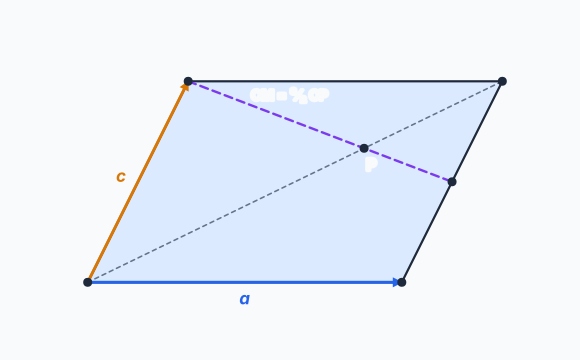
✏️Worked example (non-calculator)
(a) \( \begin{pmatrix} 6 \\ -8 \end{pmatrix} - \begin{pmatrix} -3 \\ 6 \end{pmatrix} = \begin{pmatrix} 9 \\ -14 \end{pmatrix} \); \( |\mathbf{a}| = 5 \).
(b) \( \overrightarrow{OB} = \mathbf{a} + \mathbf{c} \), so \( \overrightarrow{OP} = \tfrac{2}{3}(\mathbf{a} + \mathbf{c}) \) and
\( \overrightarrow{AB} = \mathbf{c} \), so \( \overrightarrow{OM} = \mathbf{a} + \tfrac{1}{2}\mathbf{c} \) and \( \overrightarrow{CM} = -\mathbf{c} + \mathbf{a} + \tfrac{1}{2}\mathbf{c} = \mathbf{a} - \tfrac{1}{2}\mathbf{c} \). Then \( \overrightarrow{CM} = \tfrac{3}{2}\left(\tfrac{2}{3}\mathbf{a} - \tfrac{1}{3}\mathbf{c}\right) = \tfrac{3}{2}\overrightarrow{CP} \). The vectors are parallel and share the point \(C\), so \(C\), \(P\) and \(M\) are collinear.
📝Practise
All Extended, non-calculator style.
1. \( \mathbf{a} = \begin{pmatrix} 2 \\ 5 \end{pmatrix} \) and \( \mathbf{b} = \begin{pmatrix} -3 \\ 1 \end{pmatrix} \). Find \( \mathbf{a} + \mathbf{b} \) and \( 3\mathbf{a} - 2\mathbf{b} \). [3]
2. Find the magnitude of \( \begin{pmatrix} -5 \\ 12 \end{pmatrix} \). [2]
3. \(A\) is \( (1, 2) \) and \(B\) is \( (7, -6) \). Find \( \overrightarrow{AB} \) and \( |\overrightarrow{AB}| \). [3]
4. The vectors \( \begin{pmatrix} k \\ 6 \end{pmatrix} \) and \( \begin{pmatrix} 2 \\ 3 \end{pmatrix} \) are parallel. Find \(k\). [2]
5. \( \overrightarrow{OA} = \mathbf{a} \) and \( \overrightarrow{OB} = \mathbf{b} \). \(X\) lies on \(AB\) with \( AX : XB = 1 : 3 \). Find \( \overrightarrow{OX} \) in terms of \( \mathbf{a} \) and \( \mathbf{b} \), in its simplest form. [3]
6. \( \overrightarrow{OP} = \mathbf{a} + 2\mathbf{b} \), \( \overrightarrow{OQ} = 3\mathbf{a} + 4\mathbf{b} \) and \( \overrightarrow{OR} = 7\mathbf{a} + 8\mathbf{b} \). Show that \(P\), \(Q\) and \(R\) lie on a straight line. [3]
7. In triangle \(OAB\), \( \overrightarrow{OA} = \mathbf{a} \) and \( \overrightarrow{OB} = \mathbf{b} \). \(N\) lies on \(OB\) with \( ON : NB = 1 : 2 \). Find \( \overrightarrow{AN} \). [2]
🔗Go deeper — other people’s work
These are external resources, not mine. If one stops working, tell me and everything above it on this page still stands.
- GeoGebra — drag the vertices of a parallelogram and watch vector expressions stay true
- Corbettmaths — vector proof, parallel vectors and collinear points