Algebraic manipulation and indices
🎯What you need to be able to do
- Substitute numbers into expressions and formulas; simplify by collecting like terms.
- Expand brackets — two brackets for Core, three or more for Extended EXTENDED.
- Factorise by taking out a common factor.
- Factorise by grouping, the difference of two squares, perfect squares and quadratics \( ax^{2} + bx + c \) EXTENDED.
- Complete the square EXTENDED.
- Add, subtract, multiply, divide and simplify algebraic fractions EXTENDED.
- Use the laws of indices with integer powers, and fractional powers for Extended EXTENDED; solve equations such as \( 2^{x} = 32 \).
📚The mathematics
Expanding brackets
Every term in one bracket multiplies every term in the other. A grid keeps the bookkeeping honest, and shows why \( (a + b)^{2} \ne a^{2} + b^{2} \): the two middle rectangles are the \( 2ab \) that people forget.
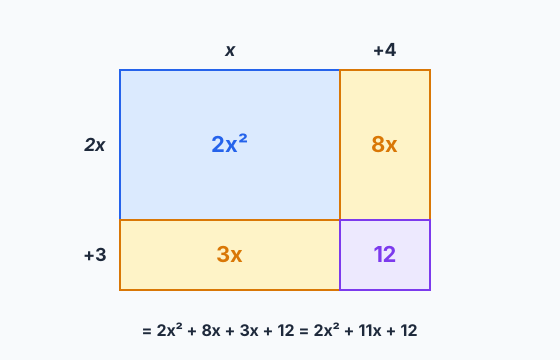
For three brackets EXTENDED, expand two first, simplify, then multiply by the third.
Factorising
“Factorise” means fully: always take out the highest common factor first.
- Common factor: \( 9x^{2}y + 15xy^{2} = 3xy(3x + 5y) \).
- EXTENDED Grouping: \( ax + bx + 2ay + 2by = x(a + b) + 2y(a + b) = (a + b)(x + 2y) \).
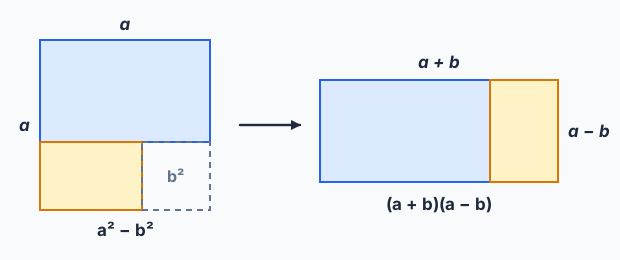
- EXTENDED Difference of two squares: \( a^{2} - b^{2} = (a - b)(a + b) \), so \( 25x^{2} - 49y^{2} = (5x - 7y)(5x + 7y) \).
- EXTENDED Quadratics \( ax^{2} + bx + c \): find two numbers that multiply to \( ac \) and add to \(b\), split the middle term, then group. For \( 6x^{2} - x - 12 \): \( ac = -72 \), and \( 8 \times (-9) = -72 \), \( 8 + (-9) = -1 \), so \( 6x^{2} + 8x - 9x - 12 = 2x(3x + 4) - 3(3x + 4) = (2x - 3)(3x + 4) \).
- EXTENDED Cubics such as \( x^{3} - 5x^{2} + 6x \): take out \(x\), then factorise the quadratic: \( x(x - 2)(x - 3) \).
Completing the square EXTENDED
Halve the coefficient of \(x\): \( x^{2} + bx + c = \left(x + \tfrac{b}{2}\right)^{2} - \left(\tfrac{b}{2}\right)^{2} + c \). So \( x^{2} - 6x + 11 = (x - 3)^{2} - 9 + 11 = (x - 3)^{2} + 2 \). The turning point of \( y = x^{2} - 6x + 11 \) is then \( (3, 2) \) — used again in 2d.
Algebraic fractions EXTENDED
Treat them exactly like number fractions. To add or subtract, use a common denominator and put every numerator in brackets (the minus sign applies to the whole of the second numerator). To simplify, factorise first, then cancel whole factors — never cancel single terms.
Indices
The rules are the ones from 1a, now with letters: \( (4x^{5})^{2} = 16x^{10} \), \( 18b^{6} \div 6b^{-3} = 3b^{9} \). To solve an equation such as \( 4^{x + 1} = 8^{x} \) EXTENDED, write both sides as powers of the same base, \( 2^{2x + 2} = 2^{3x} \), then equate the powers: \( x = 2 \). Logarithms are not required.
✏️Worked example (non-calculator, Extended)
(a) \( (x - 2)(x + 3) = x^{2} + x - 6 \). Then \( (x^{2} + x - 6)(2x + 1) = 2x^{3} + x^{2} + 2x^{2} + x - 12x - 6 \), which is \( 2x^{3} + 3x^{2} - 11x - 6 \).
(b) \( \dfrac{(x - 3)(x + 3)}{(x + 3)(x - 2)} = \dfrac{x - 3}{x - 2} \).
(c) \( \dfrac{16x^{12}y^{4}}{8x^{5}y^{2}} = 2x^{7}y^{2} \).
📝Practise
Questions in the style of the current papers. EXTENDED marks Extended-only content.
1. (Non-calculator.) Expand and simplify \( (2x + 1)(x - 4) \). [2]
2. (Non-calculator.) Find the value of \( 3a^{2} - 2b \) when \( a = -4 \) and \( b = 5 \). [2]
3. (Non-calculator.) Simplify (a) \( (4x^{5})^{2} \), (b) \( 18b^{6} \div 6b^{-3} \). [2]
4. (Non-calculator.) EXTENDED Factorise completely (a) \( 25x^{2} - 49y^{2} \), (b) \( ax + bx + 2ay + 2by \), (c) \( 3x^{2} + 10x - 8 \). [5]
5. (Non-calculator.) EXTENDED Write \( x^{2} - 6x + 11 \) in the form \( (x - a)^{2} + b \). [2]
6. (Non-calculator.) EXTENDED Write \( \dfrac{3}{x + 2} - \dfrac{1}{x - 1} \) as a single fraction in its simplest form. [3]
7. (Non-calculator.) EXTENDED Simplify \( \dfrac{2x^{2} - 8}{x^{2} + 5x + 6} \). [3]
8. (Non-calculator.) EXTENDED (a) Simplify \( (27x^{6})^{\frac{2}{3}} \). (b) Solve \( 25^{x} = 5^{x + 3} \). [4]
🔗Go deeper — other people’s work
These are external resources, not mine. If one stops working, tell me and everything above it on this page still stands.
- Corbettmaths — factorising quadratics where \( a \ne 1 \), and algebraic fractions
- Desmos — graph an expression and its factorised form together to check they are identical