Estimation, bounds, ratio and rates
🎯What you need to be able to do
- Round to decimal places, significant figures or the nearest 10, 100, 1000; estimate by rounding to 1 significant figure.
- Write down upper and lower bounds of a rounded value.
- Find the bounds of a calculation that uses rounded values EXTENDED.
- Simplify ratios, divide a quantity in a ratio, and use proportion in context (recipes, map scales, best value).
- Use rates: speed, pay, exchange rates, flow rate, fuel consumption, density, pressure, population density.
- Calculate with time (24-hour clock, timetables, time zones) and money; use a calculator efficiently and read its display.
📚The mathematics
Rounding and estimating
Significant figures count from the first non-zero digit: 0.030 649 is 0.0306 to 3 s.f. Keep place-holding zeros: 58 462 to 2 s.f. is 58 000, not 58. To estimate, round every number to 1 significant figure and work out the simpler calculation. Show the rounded values — that is where the mark is.
Upper and lower bounds
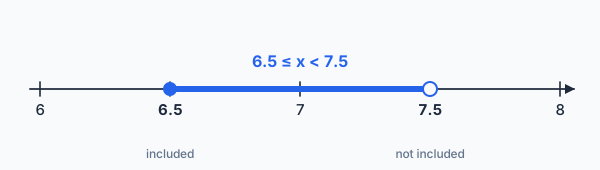
A value rounded to the nearest unit could be up to half a unit either side. A length of 7 cm to the nearest cm lies in \( 6.5 \le x < 7.5 \): the lower bound 6.5 is included, and the upper bound 7.5 is not (it would round up to 8), but it is still written as the upper bound.
EXTENDED For a calculation, choose the bound of each value that pushes the answer the way you want:
Ratio and proportion
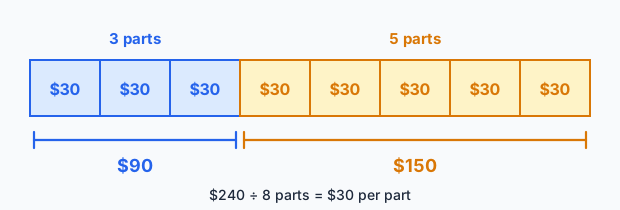
Simplify a ratio by dividing every part by the HCF, after putting the parts in the same units. To share an amount in the ratio \( a : b \), divide it into \( a + b \) equal parts. Combine two ratios through the shared quantity: if red : blue \( = 2 : 3 \) and blue : green \( = 4 : 5 \), scale both so that blue is 12.
Rates
Formulas other than speed are given in the question. Watch the units: convert minutes to hours by dividing by 60 (2 h 15 min is 2.25 h, not 2.15 h), and match cm³ with g, m³ with kg.
Time, money and the calculator
In the 24-hour clock 3.15 p.m. is 15 15. For time zones, work out the arrival time in the departure zone first, then add or subtract the time difference. On a calculator display, 4.8 in money means $4.80, and 3.25 hours means 3 hours 15 minutes. Never round in the middle of a calculation — keep the full value and round only the final answer.
✏️Worked example
(a) \( \dfrac{30 \times 0.5}{5} = \dfrac{15}{5} = 3 \).
(b) \( 3 + 5 = 8 \) parts; \( 240 \div 8 = 30 \). So $90 and $150.
(c) Distance bounds: 145 to 155 km. Time bounds: 2.45 to 2.55 h. Least speed = least distance ÷ greatest time:
📝Practise
Questions in the style of the current papers. EXTENDED marks Extended-only content.
1. (Non-calculator.) Write (a) 0.030 649 correct to 3 significant figures, (b) 58 462 correct to the nearest thousand. [2]
2. (Non-calculator.) Estimate the value of \( \dfrac{48.7 \times 3.12}{0.197} \). Show your working. [2]
3. (Non-calculator.) The ratio of red to blue counters is \( 2 : 3 \) and the ratio of blue to green counters is \( 4 : 5 \). There are 70 counters altogether. How many are green? [3]
4. (Non-calculator.) A cyclist travels 36 km in 2 hours 15 minutes. Find the average speed. [2]
5. (Non-calculator.) A flight leaves Jakarta at 22 45 local time and lasts 7 hours 35 minutes. The local time at the destination is 2 hours ahead of Jakarta. Find the local arrival time. [2]
6. (Calculator.) The exchange rate is $1 = 15 800 rupiah. Change 2 000 000 rupiah into dollars. [2]
7. (Calculator.) A force of 450 N acts on an area of 0.25 m². Find the pressure. [pressure = force ÷ area] [1]
8. (Calculator.) EXTENDED A rectangle measures 8.4 cm by 5.2 cm, each correct to the nearest 0.1 cm. Find the upper bound of its area, and the lower bound of the difference between its length and width. [4]
🔗Go deeper — other people’s work
These are external resources, not mine. If one stops working, tell me and everything above it on this page still stands.
- Corbettmaths — upper and lower bounds, including bounds of calculations
- Your calculator manual — how to enter hours, minutes and seconds with the ° ′ ″ key