Units, perimeter, area and circles
🎯What you need to be able to do
- Convert between metric units of length, area, volume, capacity and mass, including cm² ↔ m² and m³ ↔ litres.
- Find the perimeter and area of rectangles, triangles, parallelograms and trapezia (only the triangle formula is given).
- Find the circumference and area of a circle, and give answers in terms of \( \pi \).
- Find arc lengths and sector areas as fractions of the circle — for Core the angle is a factor of 360°; Extended includes any angle and major sectors EXTENDED.
- Find perimeters and areas of compound shapes and parts of shapes.
📚The mathematics
Units
Areas convert by the square of the length factor and volumes by the cube. A square metre is 100 cm by 100 cm, so it holds 10 000 square centimetres, not 100. Convert before calculating whenever the measurements are in mixed units.
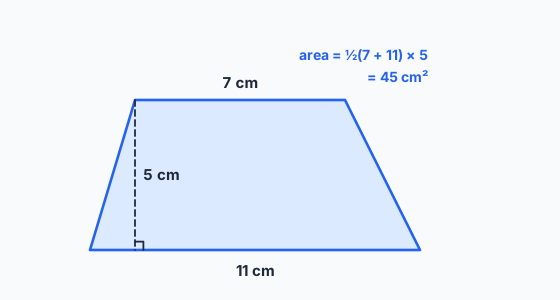
Area formulas
The height is always perpendicular to the base — never the slanted side.
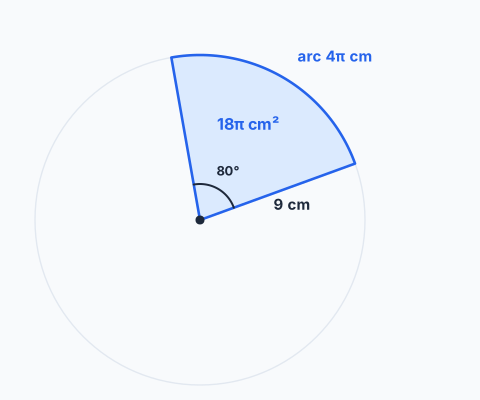
Circles, arcs and sectors
An arc or sector is just the fraction \( \tfrac{\theta}{360} \) of the whole circle. The perimeter of a sector is the arc plus two radii. “In terms of \( \pi \)” means leave \( \pi \) as a symbol: \( 18\pi \), not 56.5.
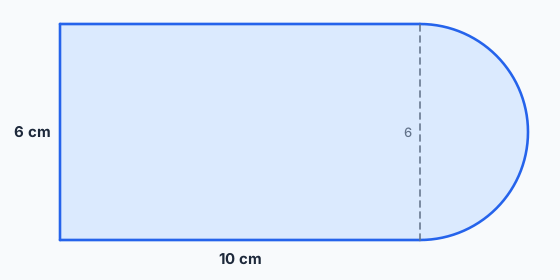
Compound shapes
Split the shape into pieces you know, or subtract a piece from a larger one. For the perimeter, trace round the outside only — edges shared between pieces are not part of it.
✏️Worked example
(a) \( \tfrac{1}{2}(7 + 11) \times 5 = 45 \) cm².
(b) Arc \( = \tfrac{80}{360} \times 2\pi(9) = \tfrac{2}{9} \times 18\pi = 4\pi \) cm. Area \( = \tfrac{2}{9} \times 81\pi = 18\pi \) cm². Perimeter \( = 4\pi + 9 + 9 = 18 + 4\pi \) cm.
(c) \( 3.5 \times 10\,000 = 35\,000 \) cm².
📝Practise
Questions in the style of the current papers. EXTENDED marks Extended-only content.
1. (Non-calculator.) Change (a) 4500 cm³ into litres, (b) 0.6 cm² into mm², (c) 2.4 m² into cm². [3]
2. (Non-calculator.) Find the area of a parallelogram with base 12 cm and perpendicular height 7 cm. [1]
3. (Calculator.) A circle has radius 6.5 cm. Find its circumference and its area. [2]
4. (Non-calculator.) A sector has radius 6 cm and angle \( 120^{\circ} \). Find its area and arc length in terms of \( \pi \). [2]
5. (Calculator.) Find the perimeter of a quarter circle of radius 8 cm. [2]
6. (Calculator.) EXTENDED A sector of radius 8 cm has area 50 cm². Find the angle of the sector. [2]
7. (Calculator.) A shape is a 10 cm by 6 cm rectangle with a semicircle of diameter 6 cm on one short side (see the diagram). Find its area and perimeter. [4]
🔗Go deeper — other people’s work
These are external resources, not mine. If one stops working, tell me and everything above it on this page still stands.
- Corbettmaths — arc length, sector area and compound shapes
- Khan Academy — converting units of area and volume