Similarity, symmetry and angles
🎯What you need to be able to do
- Calculate angles using angles at a point, on a straight line, vertically opposite, and in triangles and quadrilaterals — and give the reasons.
- Use corresponding, alternate and co-interior angles with parallel lines, naming the property.
- Use interior and exterior angles of regular and irregular polygons.
- Recognise line symmetry and the order of rotational symmetry; for Extended, planes and axes of symmetry of solids EXTENDED.
- Calculate lengths in similar shapes.
- Use the area and volume scale factors of similar shapes and solids, and show that two triangles are similar EXTENDED.
📚The mathematics
Angle facts and reasons
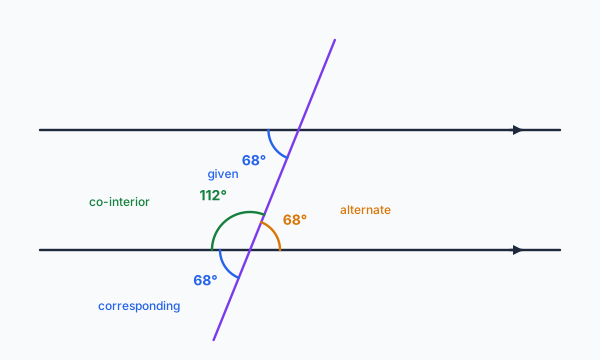
With a pair of parallel lines cut by a transversal: corresponding angles are equal (F-shape), alternate angles are equal (Z-shape), and co-interior angles add up to \( 180^{\circ} \) (C-shape). When a question says “give a reason”, write the property in words; the letters F, Z and C are not accepted as reasons.
Polygons
For a regular polygon, work with the exterior angle: it is the fastest route to \(n\), and to the interior angle.
Symmetry
A line of symmetry is a mirror line; the order of rotational symmetry is how many times the shape looks the same in one full turn (every shape has at least order 1). A regular \(n\)-gon has \(n\) lines and order \(n\). A parallelogram has no lines of symmetry but order 2. EXTENDED Solids have planes of symmetry (a cuboid with three different dimensions has 3) and axes of rotational symmetry (a cone or cylinder has one axis of infinite order).
Similar shapes
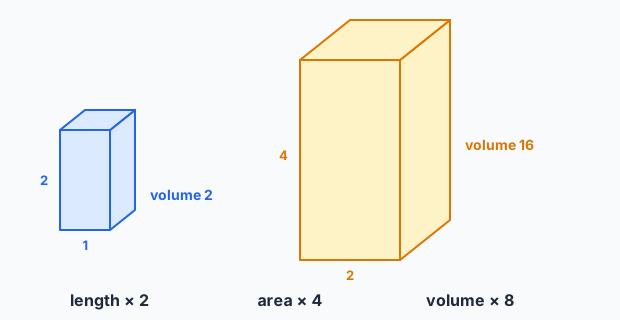
Similar shapes have equal angles and all lengths multiplied by the same scale factor \(k\). Match corresponding sides carefully — redraw the shapes the same way round if necessary. EXTENDED Areas scale by \( k^{2} \) and volumes by \( k^{3} \):
EXTENDED To show two triangles are similar, show two pairs of equal angles, giving a geometric reason for each (for example, “corresponding angles, DE parallel to BC” and “common angle”).
✏️Worked example
(a) \( n = 360 \div 24 = 15 \) sides; interior angle \( = 180 - 24 = 156^{\circ} \).
(b) \( 180 - 68 = 112^{\circ} \), because co-interior angles between parallel lines add up to \( 180^{\circ} \).
(c) Length factor \( k = \tfrac{12}{8} = 1.5 \). Area factor \( 1.5^{2} = 2.25 \): larger surface area \( = 96 \times 2.25 = 216 \) cm². Volume factor \( 1.5^{3} = 3.375 \): smaller volume \( = 540 \div 3.375 = 160 \) cm³.
📝Practise
Questions in the style of the current papers. EXTENDED marks Extended-only content.
1. (Non-calculator.) An isosceles triangle has one angle of \( 40^{\circ} \) between its two equal sides. Find the other two angles. [2]
2. (Non-calculator.) Find the size of each interior angle of a regular 12-sided polygon. [2]
3. (Non-calculator.) Each interior angle of a regular polygon is \( 140^{\circ} \). How many sides does it have? [2]
4. (Non-calculator.) Write down the number of lines of symmetry and the order of rotational symmetry of (a) a regular hexagon, (b) a parallelogram (not a rectangle or rhombus). [2]
5. (Non-calculator.) Triangles \(ABC\) and \(PQR\) are similar, with \( AB = 6 \) cm, \( BC = 9 \) cm and \( PQ = 10 \) cm, where \(PQ\) corresponds to \(AB\). Find \(QR\). [2]
6. (Non-calculator.) EXTENDED In triangle \(ABC\), \(D\) is on \(AB\) and \(E\) is on \(AC\), with \(DE\) parallel to \(BC\). \( AD = 4 \) cm, \( AB = 10 \) cm and \( DE = 6 \) cm. Explain why triangles \(ADE\) and \(ABC\) are similar, and find \(BC\). [4]
7. (Calculator.) EXTENDED Two similar rectangles have lengths in the ratio \( 2 : 5 \). The smaller has area 12 cm². Find the area of the larger. [2]
8. (Non-calculator.) EXTENDED How many planes of symmetry does (a) a cuboid measuring 2 cm by 3 cm by 5 cm have, (b) a prism whose cross-section is an equilateral triangle have? [2]
🔗Go deeper — other people’s work
These are external resources, not mine. If one stops working, tell me and everything above it on this page still stands.
- GeoGebra — drag a transversal across parallel lines and watch the angle pairs stay equal
- Corbettmaths — similar shapes: area and volume