Surface area and volume
🎯What you need to be able to do
- Find the volume and surface area of cuboids, prisms and cylinders.
- Use the given formulas for spheres, pyramids and cones.
- Solve problems with compound solids and parts of solids, such as a hemisphere, and give answers in terms of \( \pi \).
- Find the volume and surface area of a frustum EXTENDED.
- Rearrange a formula to find a missing length from a volume or area.
📚The mathematics
Prisms and cylinders
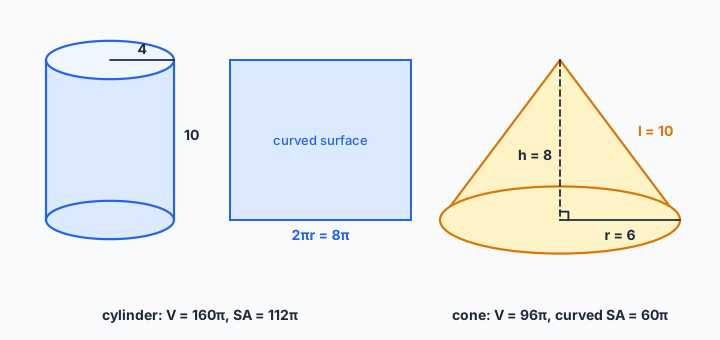
A prism is any solid with a uniform cross-section, and its volume is cross-sectional area × length. A cylinder is a prism with a circular cross-section, and so is a slice of a cylinder (a “cylindrical sector”). Surface area is the area of all the faces: for a closed cylinder, two circles plus the curved surface \( 2\pi rh \) — the curved surface unrolls into a rectangle \( 2\pi r \) long and \(h\) high.
Formulas given in the exam
Two things the list does not do for you: it gives only the curved surface, so add the flat faces yourself; and the cone’s \(l\) is the slant height, which you often find with Pythagoras from \(r\) and the vertical height \(h\).
Parts of solids and compound solids
A hemisphere is half a sphere: volume \( \tfrac{2}{3}\pi r^{3} \), curved surface \( 2\pi r^{2} \), plus a flat circle \( \pi r^{2} \) if it is solid. For a compound solid add the volumes, but for the surface area only count the faces on the outside.
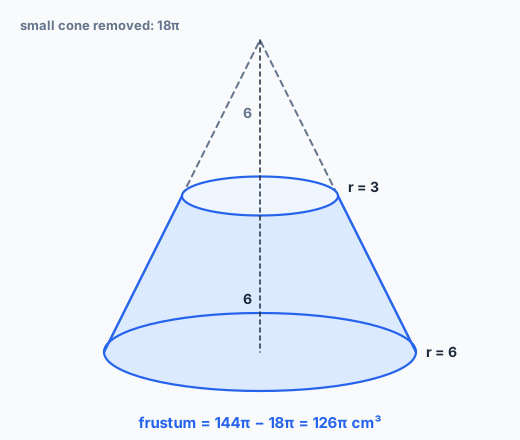
EXTENDED A frustum is a cone with its top cut off parallel to the base: its volume is the large cone minus the small cone. The two cones are similar, which gives the missing dimensions (topic 4b).
✏️Worked example
(a) \( V = \pi(4^{2})(10) = 160\pi \) cm³. SA \( = 2\pi(4^{2}) + 2\pi(4)(10) = 32\pi + 80\pi = 112\pi \) cm².
(b) \( V = \tfrac{1}{3}\pi(36)(8) = 96\pi \) cm³. \( l = \sqrt{36 + 64} = 10 \), so curved SA \( = \pi(6)(10) = 60\pi \) cm².
(c) The small cone is similar with scale factor \( \tfrac{1}{2} \), so its radius is 3 cm. Volume \( = \tfrac{1}{3}\pi(6^{2})(12) - \tfrac{1}{3}\pi(3^{2})(6) = 144\pi - 18\pi = 126\pi = 396 \) cm³ (3 s.f.).
📝Practise
Questions in the style of the current papers. EXTENDED marks Extended-only content.
1. (Non-calculator.) A triangular prism is 15 cm long. Its cross-section is a triangle with base 6 cm and height 4 cm. Find its volume. [2]
2. (Non-calculator.) Find the volume of a cylinder of radius 3 cm and height 7 cm, in terms of \( \pi \). [1]
3. (Non-calculator.) A pyramid has a square base of side 8 cm and a vertical height of 9 cm. Find its volume. [2]
4. (Calculator.) A sphere has radius 4.5 cm. Find its surface area and its volume. [2]
5. (Calculator.) Find the total surface area of a solid hemisphere of radius 5 cm. [3]
6. (Calculator.) A cuboid tank measures 40 cm by 30 cm by 25 cm. How many litres does it hold when full? [2]
7. (Calculator.) EXTENDED A cone has volume 300 cm³ and height 10 cm. Find its radius. [3]
8. (Calculator.) EXTENDED A solid metal sphere of radius 3 cm is melted and recast as a cylinder of radius 2 cm. Find the height of the cylinder. [3]
🔗Go deeper — other people’s work
These are external resources, not mine. If one stops working, tell me and everything above it on this page still stands.
- GeoGebra 3D — unfold a cylinder or cone into its net
- Corbettmaths — volume and surface area of cones, spheres and frustums