Transformations
🎯What you need to be able to do
- Reflect a shape in a vertical or horizontal line; in any straight line such as \( y = x \) for Extended EXTENDED.
- Rotate a shape through a multiple of 90° about the origin, a vertex or a midpoint of an edge; about any centre for Extended EXTENDED.
- Enlarge a shape from a centre by a positive or fractional scale factor; negative scale factors for Extended EXTENDED.
- Translate a shape by a column vector.
- Describe a single transformation fully, and work with combinations of transformations EXTENDED.
📚The mathematics
Describing a transformation fully
“Describe fully” means the name and every piece of information that fixes it. A missing detail usually costs a mark, and naming two transformations (“a rotation and a translation”) when one was asked for scores nothing.
Drawing each one
- Reflection: each image point is the same perpendicular distance from the mirror line, on the other side. For \( y = x \), the coordinates swap: \( (a, b) \to (b, a) \).
- Rotation: tracing paper is allowed — ask for it. About the origin, \( 90^{\circ} \) clockwise sends \( (a, b) \to (b, -a) \); anticlockwise sends \( (a, b) \to (-b, a) \); \( 180^{\circ} \) sends \( (a, b) \to (-a, -b) \).
- Enlargement by scale factor \(k\) from centre \(C\): the image of \(P\) is at \( C + k \times \overrightarrow{CP} \). A fractional \(k\) makes the shape smaller; a EXTENDED negative \(k\) puts the image on the other side of the centre, upside down.
- Translation by \( \begin{pmatrix} x \\ y \end{pmatrix} \): \(x\) right (left if negative), \(y\) up (down if negative).
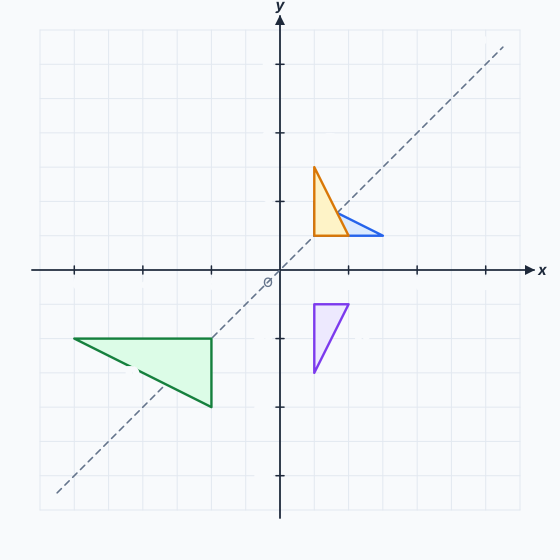
Combinations EXTENDED
Apply the transformations in order, the second to the image of the first. Two reflections in perpendicular lines through the origin make a rotation of \( 180^{\circ} \) about the origin, which is also an enlargement with scale factor \(-1\).
✏️Worked example (non-calculator)
(a) Swap the coordinates: \( (1, 1) \), \( (1, 3) \), \( (2, 1) \).
(b) \( (a, b) \to (b, -a) \): \( (1, -1) \), \( (1, -3) \), \( (2, -1) \).
(c) Multiply every coordinate by \(-2\): \( (-2, -2) \), \( (-6, -2) \), \( (-2, -4) \).
(d) Add \(-4\) to each \(x\) and 3 to each \(y\): \( (-3, 4) \), \( (-1, 4) \), \( (-3, 5) \).
📝Practise
Questions 1–3 refer to the diagram below. EXTENDED marks Extended-only content.
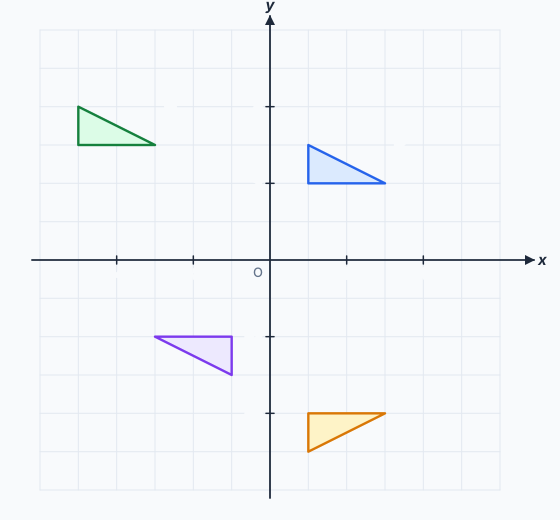
1. (Non-calculator.) Describe fully the single transformation that maps P onto Q. [2]
2. (Non-calculator.) Describe fully the single transformation that maps P onto R. [3]
3. (Non-calculator.) Describe fully the single transformation that maps P onto S. [2]
4. (Non-calculator.) Find the image of the point \( (4, -1) \) after a rotation of \( 90^{\circ} \) anticlockwise about the origin. [1]
5. (Non-calculator.) The point \( (2, 3) \) is enlarged by scale factor 3 with centre \( (1, 1) \). Find its image. [2]
6. (Non-calculator.) EXTENDED Find the image of \( (4, -6) \) under an enlargement with scale factor \( -\tfrac{1}{2} \), centre the origin. [1]
7. (Non-calculator.) EXTENDED A shape is reflected in the \(x\)-axis and then the image is reflected in the \(y\)-axis. Describe the single transformation equivalent to these two. [2]
🔗Go deeper — other people’s work
These are external resources, not mine. If one stops working, tell me and everything above it on this page still stands.
- GeoGebra — transformation tools that show the image as you drag the centre or mirror line
- Corbettmaths — describing transformations, and negative scale factors