Percentages, growth and surds
🎯What you need to be able to do
- Find a percentage of a quantity, and express one quantity as a percentage of another.
- Calculate percentage increase and decrease, profit and loss, discount and deposit.
- Calculate simple and compound interest (no formulas are given).
- Use reverse percentages to find an original amount EXTENDED.
- Use exponential growth and decay, such as depreciation and population change EXTENDED.
- Simplify surds and rationalise denominators EXTENDED.
📚The mathematics
Multipliers
Almost every percentage question is quickest with a multiplier: increasing by 15% is multiplying by 1.15; decreasing by 15% is multiplying by 0.85. Then
Percentage change is always measured against the original amount. For a reverse percentage, never take the percentage of the new amount and add it back: if a price after a 15% discount is $68, the original is \( 68 \div 0.85 = $80 \), not \( 68 \times 1.15 = $78.20 \).
Simple and compound interest
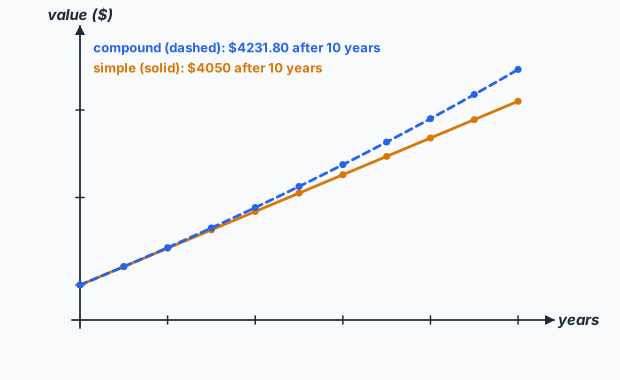
Simple interest is the same amount every year: \( \text{interest} = \text{principal} \times \text{rate} \times \text{years} \). Compound interest adds interest to interest: after \(n\) years the amount is \( P \times \left(1 + \tfrac{r}{100}\right)^{n} \). Questions sometimes ask for the interest (amount minus principal) and sometimes for the amount; read which.
Exponential growth and decay EXTENDED
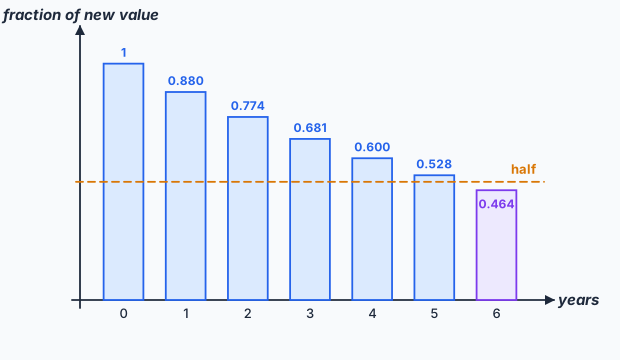
Anything that changes by the same percentage each period follows value \( = \) start \( \times \) multiplier\(^{n}\). For “after how many years” questions, try whole numbers of years on the calculator until the value first crosses the target, and write down the values either side to show why. (Logarithms are not required, and nor is \(e\).)
Surds EXTENDED
Simplify by taking out the largest square factor: \( \sqrt{75} = \sqrt{25 \times 3} = 5\sqrt{3} \). To rationalise \( \dfrac{k}{\sqrt{a}} \), multiply top and bottom by \( \sqrt{a} \); for \( \dfrac{k}{a - \sqrt{b}} \), multiply by \( a + \sqrt{b} \), which removes the surd from the denominator using the difference of two squares.
✏️Worked example
(a) \( 3000 \times 1.035^{4} = 3442.569\ldots \), so $3442.57.
(b) \( 0.88^{5} = 0.528 \) (more than half) and \( 0.88^{6} = 0.464 \) (less than half), so after 6 years.
(c) \( 5\sqrt{3} - 2\sqrt{3} = 3\sqrt{3} \). Then
📝Practise
Questions in the style of the current papers. EXTENDED marks Extended-only content.
1. (Calculator.) Write 45 as a percentage of 360. [1]
2. (Calculator.) The price of a bicycle falls from $250 to $215. Find the percentage decrease. [2]
3. (Calculator.) $5000 is invested at 2.8% per year simple interest. Find the interest earned in 6 years. [2]
4. (Calculator.) A shop buys a jacket for $40 and sells it for $52. Find the percentage profit. [2]
5. (Calculator.) EXTENDED After a 20% pay rise, Rina earns $33 600 a year. Find her salary before the rise. [2]
6. (Calculator.) EXTENDED A town’s population of 12 000 grows by 4% each year. Find the population after 5 years, to the nearest hundred. [2]
7. (Non-calculator.) EXTENDED (a) Simplify \( \sqrt{50} + \sqrt{18} \). (b) Rationalise the denominator of \( \dfrac{10}{\sqrt{5}} \). [3]
8. (Non-calculator.) EXTENDED Expand and simplify \( (2 + \sqrt{3})(5 - \sqrt{3}) \). [2]
🔗Go deeper — other people’s work
These are external resources, not mine. If one stops working, tell me and everything above it on this page still stands.
- Corbettmaths — reverse percentages and compound interest
- Khan Academy — simplifying radicals and rationalising denominators