Equations and inequalities
🎯What you need to be able to do
- Construct expressions, equations and formulas from words, and solve linear equations.
- Solve simultaneous linear equations, including ones you have to set up yourself.
- Change the subject of a formula — including when the subject appears twice or under a power or root EXTENDED.
- Solve fractional equations, quadratic equations (factorising, completing the square, the formula) and one linear with one non-linear equation EXTENDED.
- Show and read inequalities on a number line.
- Solve linear inequalities, and draw and describe regions on a graph EXTENDED.
📚The mathematics
Linear and fractional equations
Do the same to both sides until \(x\) is alone. With fractions EXTENDED, multiply every term by the lowest common denominator first; put brackets round each numerator so a minus sign reaches every term.
Simultaneous linear equations
Elimination: multiply one or both equations so a variable has the same coefficient, then add (different signs) or subtract (same signs). Substitution suits equations where one variable is already, or easily made, the subject. Always substitute back to find the second variable, and check both answers in the equation you did not use.
Quadratic equations EXTENDED
Rearrange to \( ax^{2} + bx + c = 0 \), then:
- Factorise if you can: \( x^{2} - 2x - 15 = (x - 5)(x + 3) = 0 \), so \( x = 5 \) or \( x = -3 \).
- Complete the square for exact (surd) answers: \( x^{2} + 6x - 4 = 0 \Rightarrow (x + 3)^{2} = 13 \Rightarrow x = -3 \pm \sqrt{13} \).
- The formula \( x = \dfrac{-b \pm \sqrt{b^{2} - 4ac}}{2a} \) (on the List of formulas) — usually when a question says “give your answers correct to 2 decimal places”, which is the hint that it will not factorise.
For a linear and a non-linear equation, substitute the linear one into the other to get a quadratic, then pair each \(x\) with its own \(y\).
Changing the subject
Undo operations in reverse order. EXTENDED If the subject appears twice, collect every term containing it on one side and factorise it out; if it is squared, isolate the square then take the square root.
Inequalities
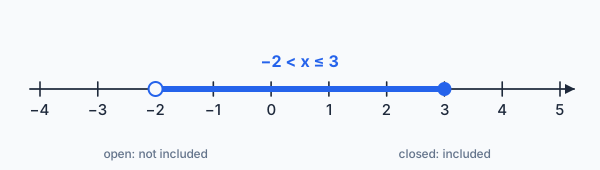
On a number line, a closed circle means included (\( \le, \ge \)), an open circle means not included (\( <, > \)).
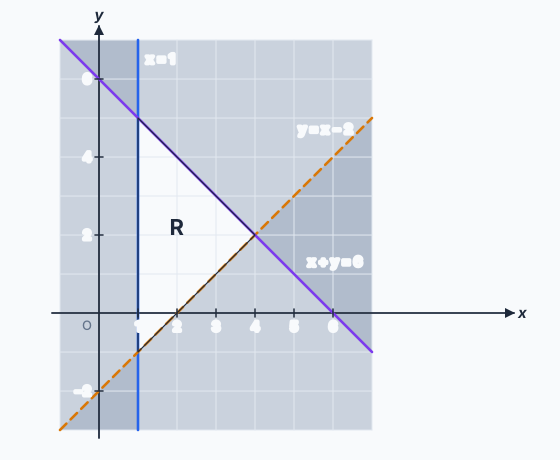
EXTENDED Solve linear inequalities like equations, with one extra rule: multiplying or dividing by a negative number reverses the sign. For regions on a graph, draw each boundary line (solid for \( \le, \ge \), broken for \( <, > \)), and shade the unwanted side unless told otherwise; the region left unshaded is the answer. Test a point such as \( (0, 0) \) to decide which side is wanted.
✏️Worked example
(a) Multiply the first by 3 and the second by 2: \( 9x + 6y = 48 \) and \( 10x - 6y = 28 \). Add: \( 19x = 76 \), \( x = 4 \). Then \( 12 + 2y = 16 \), \( y = 2 \).
(b) Multiply by 10: \( 5(x + 1) - 2(x - 3) = 20 \), so \( 5x + 5 - 2x + 6 = 20 \), \( 3x = 9 \), \( x = 3 \).
(c) \( y(x - 2) = x + a \Rightarrow yx - 2y = x + a \Rightarrow yx - x = a + 2y \Rightarrow x(y - 1) = a + 2y \), so
(d) \( x = \dfrac{5 \pm \sqrt{25 + 8}}{4} = \dfrac{5 \pm \sqrt{33}}{4} \), so \( x = 2.69 \) or \( x = -0.19 \).
📝Practise
Questions in the style of the current papers. EXTENDED marks Extended-only content.
1. (Non-calculator.) Solve \( 4(2x - 3) = 3x + 8 \). [3]
2. (Non-calculator.) Solve \( 2x + y = 7 \) and \( x - y = 5 \). [2]
3. (Non-calculator.) List the integers \(n\) that satisfy \( -1 \le n < 4 \). [1]
4. (Non-calculator.) Make \(a\) the subject of \( v = u + at \). [2]
5. (Non-calculator.) EXTENDED Make \(r\) the subject of \( V = \tfrac{1}{3}\pi r^{2}h \). [3]
6. (Non-calculator.) EXTENDED Solve \( 3x - 5 < 7x + 11 \). [2]
7. (Non-calculator.) EXTENDED Solve \( x^{2} + 6x - 4 = 0 \) by completing the square, giving your answers in surd form. [3]
8. (Non-calculator.) EXTENDED Solve the simultaneous equations \( y = x + 1 \) and \( x^{2} + y^{2} = 13 \). [4]
9. (Non-calculator.) EXTENDED Solve \( \dfrac{3}{x + 1} + \dfrac{2}{x} = 2 \). [4]
🔗Go deeper — other people’s work
These are external resources, not mine. If one stops working, tell me and everything above it on this page still stands.
- Desmos — type inequalities such as
x+y<=6to see the region shaded (it shades the wanted side, the opposite of the exam convention) - Corbettmaths — changing the subject when it appears twice