Sequences and proportion
🎯What you need to be able to do
- Continue a sequence or pattern and describe its term-to-term rule.
- Find and use the \(n\)th term of linear sequences, and of simple quadratic and cubic sequences.
- Find the \(n\)th term of any quadratic, cubic or exponential sequence, and simple combinations of these EXTENDED.
- Express direct and inverse proportion algebraically (including squares, cubes and roots) and use it to find unknowns EXTENDED.
📚The mathematics
Linear sequences
If the terms go up by the same amount \(d\) each time, the \(n\)th term is \( dn + c \): the common difference times \(n\), plus whatever makes the first term right. For 5, 9, 13, 17, …: \( d = 4 \), and \( 4(1) + c = 5 \) gives \( c = 1 \), so the \(n\)th term is \( 4n + 1 \). To test whether a number is in the sequence, set the \(n\)th term equal to it: \(n\) must be a positive whole number.
Quadratic sequences
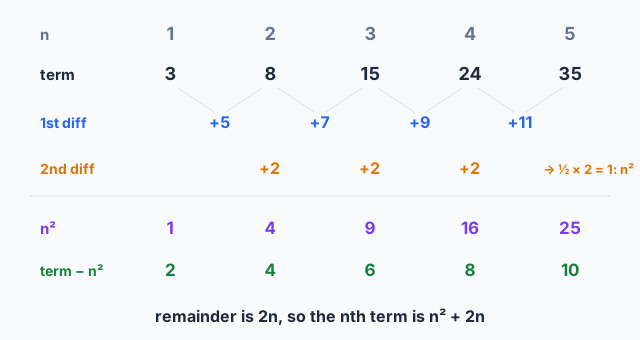
If the second differences are constant, the sequence is quadratic, and the \(n^{2}\) coefficient is half the second difference. Subtract that \(an^{2}\) from each term; what is left is linear.
Cubic and exponential sequences EXTENDED
Recognise the building blocks: cubes 1, 8, 27, 64, … (\(n^{3}\)); powers such as 2, 4, 8, 16, … (\(2^{n}\)). A sequence that multiplies by \(r\) each time, starting at \(a\), has \(n\)th term \( a \times r^{n - 1} \). Many exam sequences are a building block plus a constant or a linear part, so compare the terms with \(n^{2}\), \(n^{3}\) or \(2^{n}\) and look at what is left over.
Proportion EXTENDED
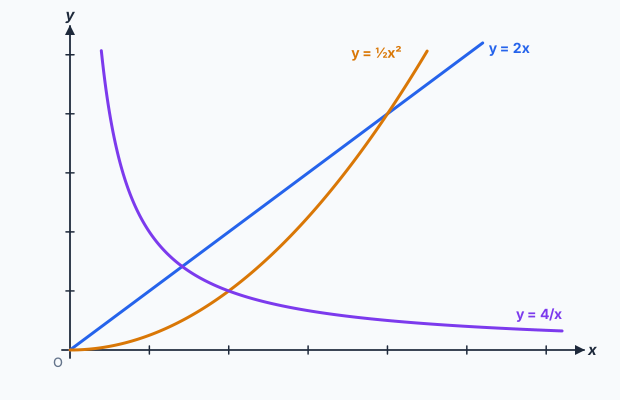
The method is always the same: write the equation with \(k\), find \(k\) from the given pair of values, rewrite the equation with the value of \(k\), then use it. “Inversely” means divide by the quantity; “the square of” applies to the variable, not to \(k\).
✏️Worked example (non-calculator)
(a) \( 4n + 1 \). If \( 4n + 1 = 150 \), then \( n = 37.25 \), which is not a whole number, so 150 is not a term.
(b) Second differences are 2 (see the diagram), so \( n^{2} \); the remainder is \( 2n \). The \(n\)th term is \( n^{2} + 2n \).
(c) \( y = \dfrac{k}{x^{2}} \), and \( 12 = \dfrac{k}{4} \) gives \( k = 48 \), so \( y = \dfrac{48}{x^{2}} \). When \( x = 4 \), \( y = 3 \). When \( y = 0.75 \): \( x^{2} = \dfrac{48}{0.75} = 64 \), so \( x = 8 \).
📝Practise
Questions in the style of the current papers. EXTENDED marks Extended-only content.
1. (Non-calculator.) Write down the next two terms of 2, 6, 12, 20, 30, … [2]
2. (Non-calculator.) Find the \(n\)th term of 20, 17, 14, 11, … [2]
3. (Non-calculator.) Find the \(n\)th term of 0, 3, 8, 15, 24, … [2]
4. (Non-calculator.) EXTENDED Find the \(n\)th term of (a) 3, 10, 29, 66, … (b) 3, 6, 12, 24, … [3]
5. (Non-calculator.) EXTENDED Find the \(n\)th term of 4, 11, 22, 37, 56, … [3]
6. (Calculator.) EXTENDED \(y\) is directly proportional to the square root of \(x\). When \( x = 4 \), \( y = 6 \). Find \(y\) when \( x = 49 \). [3]
7. (Calculator.) EXTENDED The distance \(d\) m an object falls is proportional to the square of the time \(t\) s. It falls 20 m in 2 s. How long does it take to fall 125 m? [3]
8. (Non-calculator.) EXTENDED The brightness \(B\) of a lamp is inversely proportional to the square of the distance \(d\) from it. Describe what happens to \(B\) when \(d\) is tripled. [1]
🔗Go deeper — other people’s work
These are external resources, not mine. If one stops working, tell me and everything above it on this page still stands.
- Corbettmaths — the \(n\)th term of quadratic sequences
- Desmos — plot \( y = kx^{2} \) and \( y = k/x^{2} \) with a slider on \(k\)