Differentiation and functions
EXTENDED Everything on this page is Extended content only. Core candidates are not examined on it.
🎯What you need to be able to do
- Differentiate \( ax^{n} \) (with \(n\) a positive integer or zero), and sums of up to three such terms, using \( \dfrac{dy}{dx} \) notation.
- Use the derivative to find the gradient of a curve at a point, and stationary (turning) points.
- Decide whether a turning point is a maximum or a minimum, by any valid method.
- Use function notation, and find domains and ranges.
- Find the inverse function \( f^{-1}(x) \) and composite functions such as \( gf(x) = g(f(x)) \).
📚The mathematics
Differentiation
\( \dfrac{dy}{dx} \) is the gradient function: put in an \(x\)-value and it gives the gradient of the curve (the gradient of the tangent) there. The one rule you need:
Multiply by the power, then reduce the power by one. A term in \(x\) becomes a constant (\( 7x \to 7 \)), and a constant disappears. Differentiate a sum term by term.
Stationary points
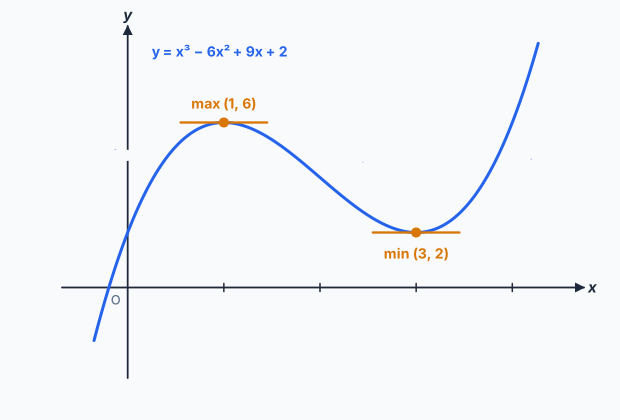
At a turning point the gradient is zero, so solve \( \dfrac{dy}{dx} = 0 \), then substitute each \(x\) back into the original equation for \(y\). To decide the nature, use any one of:
- Second derivative: differentiate again. \( \dfrac{d^{2}y}{dx^{2}} < 0 \) ⇒ maximum; \( > 0 \) ⇒ minimum.
- Gradient either side: \( + \) then \( - \) is a maximum; \( - \) then \( + \) is a minimum.
- An accurate sketch of the curve.
Functions
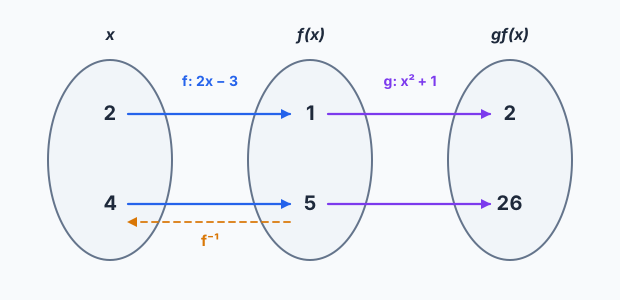
\( f(x) = 2x - 3 \) means “double, then subtract 3”; \( f(4) \) is the output when the input is 4. The domain is the set of inputs, the range the set of outputs.
- Composite \( gf(x) = g(f(x)) \): do \(f\) first, then \(g\) — read from the right. Usually \( fg \ne gf \).
- Inverse \( f^{-1} \) undoes \(f\): write \( y = f(x) \), rearrange for \(x\), then swap \(x\) and \(y\). A useful check: \( f^{-1}(f(a)) = a \).
✏️Worked example (non-calculator)
(a) \( \dfrac{dy}{dx} = 3x^{2} - 12x + 9 = 3(x - 1)(x - 3) = 0 \), so \( x = 1 \) or \( x = 3 \). \( y(1) = 1 - 6 + 9 + 2 = 6 \) and \( y(3) = 27 - 54 + 27 + 2 = 2 \). Then \( \dfrac{d^{2}y}{dx^{2}} = 6x - 12 \): at \( x = 1 \) it is \( -6 < 0 \), so \( (1, 6) \) is a maximum; at \( x = 3 \) it is \( 6 > 0 \), so \( (3, 2) \) is a minimum.
(b) \( g(2) = 5 \), so \( fg(2) = f(5) = 7 \). \( gf(x) = (2x - 3)^{2} + 1 \). For the inverse, \( y = 2x - 3 \Rightarrow x = \dfrac{y + 3}{2} \), so \( f^{-1}(x) = \dfrac{x + 3}{2} \).
📝Practise
All Extended. Questions in the style of the current Paper 2 (non-calculator) and Paper 4 (calculator).
1. (Non-calculator.) Find \( \dfrac{dy}{dx} \) when \( y = 4x^{3} - 5x^{2} + 7x - 2 \). [2]
2. (Non-calculator.) Find the gradient of \( y = x^{2} - 5x + 1 \) at the point where \( x = 4 \). [2]
3. (Non-calculator.) The curve \( y = x^{2} + kx \) has gradient 1 when \( x = 3 \). Find \(k\). [2]
4. (Non-calculator.) Find the turning points of \( y = x^{3} - 12x \) and determine their nature. [5]
5. (Non-calculator.) Find the equation of the tangent to \( y = 2x^{2} - 3x + 1 \) at the point where \( x = 1 \). [3]
6. (Non-calculator.) \( f(x) = 5 - 3x \). Find \( f(-2) \) and \( f^{-1}(x) \). [3]
7. (Non-calculator.) \( f(x) = \dfrac{3}{x + 2} \) and \( g(x) = 2x - 1 \). Find \( fg(x) \), and write \( gf(x) \) as a single fraction. [4]
8. (Non-calculator.) \( h(x) = x^{2} + 3 \) with domain \( \{-2, -1, 0, 1, 2\} \). Write down the range of \(h\). [1]
🔗Go deeper — other people’s work
These are external resources, not mine. If one stops working, tell me and everything above it on this page still stands.
- Desmos — plot a curve and its derivative; the derivative is zero exactly where the curve turns
- Corbettmaths — composite and inverse functions