Coordinate geometry
🎯What you need to be able to do
- Plot and read coordinates, and draw straight-line graphs such as \( y = 7 - 4x \) and \( 3x + 2y = 5 \).
- Find the gradient of a line, from a graph or from two points.
- Find and interpret the equation of a line in the forms \( y = mx + c \), \( ax + by = c \) and \( x = k \).
- Find the equation of a line parallel to a given line.
- Find the length and midpoint of a line segment EXTENDED.
- Find the equation of a line perpendicular to a given line, including a perpendicular bisector EXTENDED.
📚The mathematics
Gradient and \( y = mx + c \)
Uphill left to right is a positive gradient, downhill negative. To read \(m\) and \(c\) from an equation such as \( 3x + 2y = 12 \), make \(y\) the subject first: \( y = -1.5x + 6 \). To find the equation through a point with a known gradient, substitute the point into \( y = mx + c \) to find \(c\). The syllabus expects equations in a fully simplified form.
To draw a line, work out three points (three, so a mistake shows up as a point off the line), or use the intercepts.
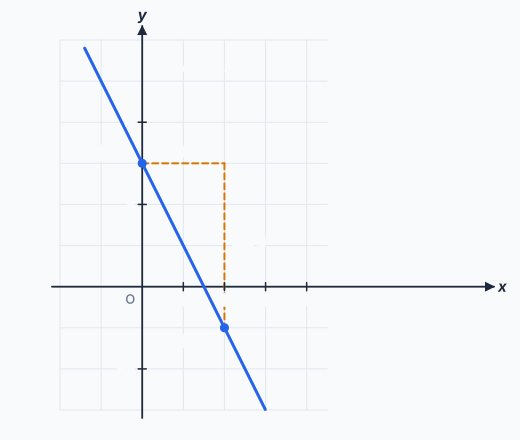
Parallel and perpendicular lines
Parallel lines have equal gradients. EXTENDED Perpendicular lines have gradients that multiply to \(-1\): the perpendicular gradient is the negative reciprocal, so \( \tfrac{4}{3} \) becomes \( -\tfrac{3}{4} \) and \(-2\) becomes \( \tfrac{1}{2} \).
Length and midpoint EXTENDED
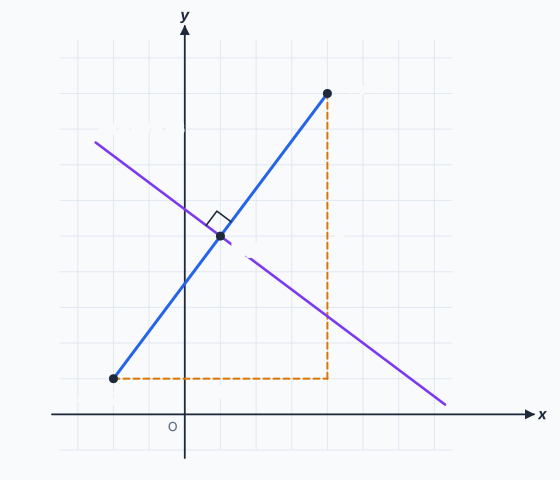
A perpendicular bisector of \(AB\) goes through the midpoint of \(AB\) with the perpendicular gradient.
✏️Worked example (non-calculator)
(a) \( m = \dfrac{9 - 1}{4 - (-2)} = \dfrac{8}{6} = \dfrac{4}{3} \). Substituting \( (4, 9) \) into \( y = \tfrac{4}{3}x + c \): \( 9 = \tfrac{16}{3} + c \), so \( c = \tfrac{11}{3} \). The line is \( y = \tfrac{4}{3}x + \tfrac{11}{3} \), or \( 4x - 3y = -11 \).
(b) Same gradient, intercept \(-2\): \( y = \tfrac{4}{3}x - 2 \).
(c) \( AB = \sqrt{6^{2} + 8^{2}} = 10 \). Midpoint \( (1, 5) \); perpendicular gradient \( -\tfrac{3}{4} \). \( y - 5 = -\tfrac{3}{4}(x - 1) \Rightarrow 4y - 20 = -3x + 3 \Rightarrow 3x + 4y = 23 \).
📝Practise
Questions in the style of the current papers. EXTENDED marks Extended-only content.
1. (Non-calculator.) Find the gradient of the line through \( (1, 7) \) and \( (5, -1) \). [2]
2. (Non-calculator.) Find the gradient and the \(y\)-intercept of the line \( 3x + 2y = 12 \). [2]
3. (Non-calculator.) Find the equation of the line parallel to \( y = 3x - 2 \) that passes through \( (2, 1) \). [2]
4. (Non-calculator.) A straight line crosses the \(y\)-axis at \( (0, 3) \) and passes through \( (2, -1) \). Find its equation. [2]
5. (Non-calculator.) Does the point \( (4, 10) \) lie on the line \( y = 2x + 3 \)? Show how you decide. [1]
6. (Non-calculator.) EXTENDED \(P\) is \( (-3, 4) \) and \(Q\) is \( (5, -2) \). Find the length of \(PQ\) and the coordinates of its midpoint. [3]
7. (Non-calculator.) EXTENDED Find the gradient of a line perpendicular to \( 2y = 5x + 1 \). [2]
8. (Non-calculator.) EXTENDED Find the equation of the perpendicular bisector of the line joining \( (1, 7) \) and \( (7, -1) \). [4]
🔗Go deeper — other people’s work
These are external resources, not mine. If one stops working, tell me and everything above it on this page still stands.
- Desmos — plot a line and its perpendicular to see the right angle (use equal axis scales)
- Corbettmaths — equations of straight lines, parallel and perpendicular