Geometrical terms, constructions and scale drawings
🎯What you need to be able to do
- Use the vocabulary of points, lines, angles (acute, obtuse, reflex, interior, exterior), parallel and perpendicular lines, similar and congruent shapes.
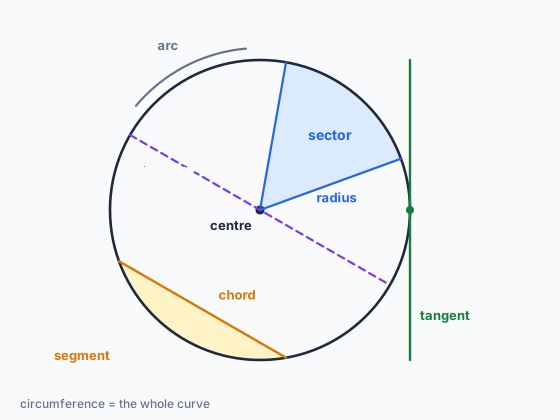
- Name and describe triangles, special quadrilaterals, polygons, solids and the parts of a circle.
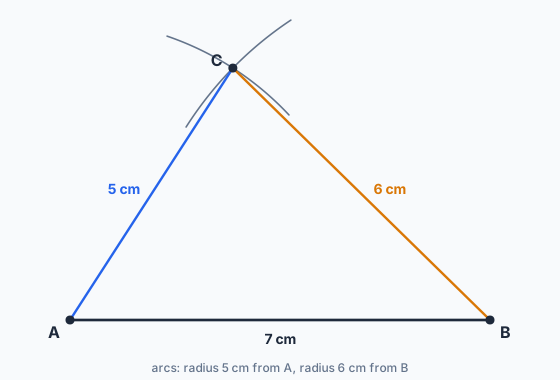
- Measure and draw lines and angles; construct a triangle from three sides with a ruler and compasses, showing the arcs.
- Draw, use and interpret nets, including to find surface area and volume.
- Draw and interpret scale drawings, and use three-figure bearings.
📚The mathematics
The vocabulary
- Angles: acute (less than 90°), right (90°), obtuse (between 90° and 180°), reflex (between 180° and 360°).
- Triangles: equilateral (3 equal sides), isosceles (2), scalene (none), right-angled.
- Quadrilaterals: square, rectangle, rhombus (4 equal sides), parallelogram (2 pairs of parallel sides), trapezium (1 pair), kite (2 pairs of equal adjacent sides). Be ready to state properties of sides, angles, diagonals and symmetry.
- Polygons: pentagon (5), hexagon (6), octagon (8), decagon (10); regular means all sides and angles equal.
- Similar shapes are enlargements of each other; congruent shapes are identical in shape and size.
- Solids: cube, cuboid, prism, cylinder, pyramid, cone, sphere, hemisphere, frustum; faces, edges and vertices.
Constructing a triangle from three sides
- Draw the longest side with a ruler, and label its ends.
- Set the compasses to the second length and draw an arc from one end.
- Set them to the third length and draw an arc from the other end.
- Join the crossing point to both ends. Leave the arcs showing — they are the evidence the method was used.
Scale drawings and bearings
A scale such as \( 1 : 50\,000 \) means 1 cm on the map is 50 000 cm = 500 m in real life. Convert units at the end: 100 cm = 1 m, 1000 m = 1 km.
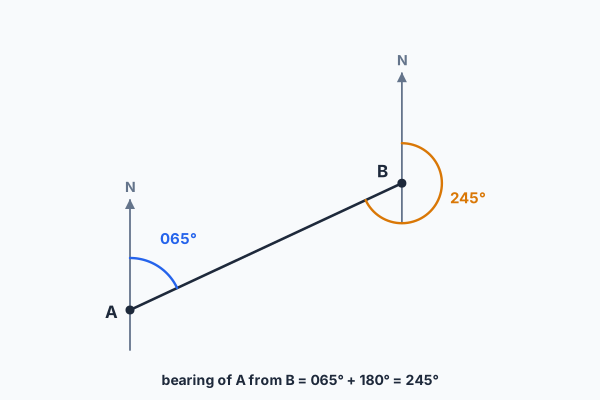
A bearing is an angle measured clockwise from north, written with three figures (\( 065^{\circ} \), not \( 65^{\circ} \)). “The bearing of \(B\) from \(A\)” means stand at \(A\), face north, turn clockwise to face \(B\). The back bearing (of \(A\) from \(B\)) differs by \( 180^{\circ} \).
✏️Worked example (non-calculator)
(a) \( 65 + 180 = 245 \): bearing \( 245^{\circ} \).
(b) \( 7.4 \times 50\,000 = 370\,000 \) cm \( = 3700 \) m \( = 3.7 \) km.
(c) The net is the surface: \( 2(5 \times 3 + 5 \times 2 + 3 \times 2) = 2(15 + 10 + 6) = 62 \) cm².
📝Practise
Questions in the style of the current papers.
1. (Non-calculator.) A quadrilateral has four equal sides, and its diagonals cross at right angles, but its angles are not all 90°. What is it? Write down one more property. [2]
2. (Non-calculator.) The bearing of \(Q\) from \(P\) is \( 310^{\circ} \). Find the bearing of \(P\) from \(Q\). [1]
3. (Non-calculator.) On a map with scale \( 1 : 25\,000 \), how many centimetres represent 2.5 km? [2]
4. (Non-calculator.) Write down the number of faces, edges and vertices of a triangular prism. [2]
5. (Non-calculator.) Describe the steps to construct triangle \(PQR\) with \( PQ = 8 \) cm, \( PR = 6 \) cm and \( QR = 5 \) cm. [3]
6. (Calculator.) A ship sails 12 km due east, then 5 km due south. Find its distance from the start, and the bearing of its final position from the start. [4]
🔗Go deeper — other people’s work
These are external resources, not mine. If one stops working, tell me and everything above it on this page still stands.
- GeoGebra — practise ruler-and-compass constructions interactively
- Corbettmaths — bearings and scale drawings