Circle theorems
🎯What you need to be able to do
- Use the angle in a semicircle (\( 90^{\circ} \)) and the angle between a tangent and a radius (\( 90^{\circ} \)), giving reasons.
- Use the angle at the centre, angles in the same segment, opposite angles of a cyclic quadrilateral and the alternate segment theorem EXTENDED.
- Use the symmetry properties: equal chords are equidistant from the centre, the perpendicular bisector of a chord passes through the centre, and tangents from an external point are equal EXTENDED.
- Give each reason using the wording of the property.
📚The mathematics
The theorems
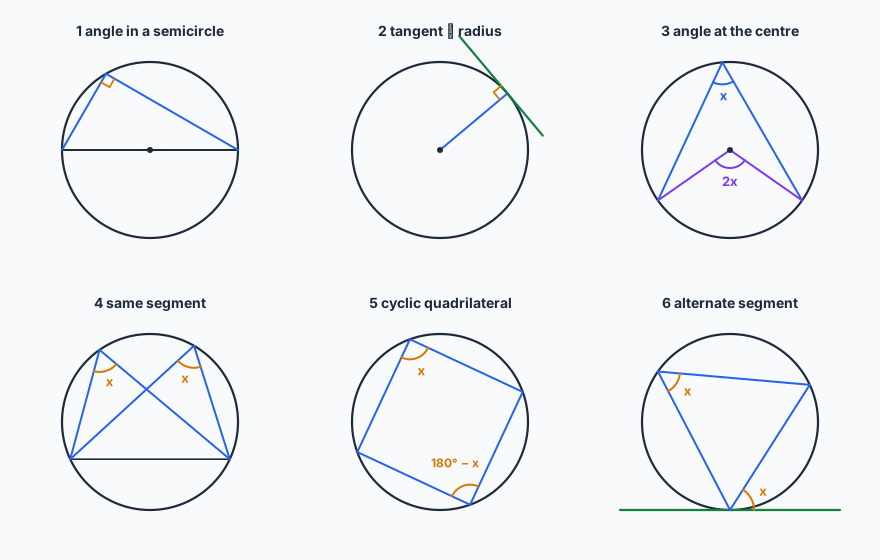
- Angle in a semicircle \( = 90^{\circ} \): the angle at the circumference standing on a diameter.
- Tangent and radius meet at \( 90^{\circ} \).
- EXTENDED Angle at the centre is twice the angle at the circumference standing on the same arc.
- EXTENDED Angles in the same segment are equal.
- EXTENDED Opposite angles of a cyclic quadrilateral add up to \( 180^{\circ} \).
- EXTENDED Alternate segment theorem: the angle between a tangent and a chord equals the angle in the alternate segment.
EXTENDED Three symmetry facts complete the list: equal chords are equidistant from the centre; the perpendicular bisector of a chord passes through the centre (so the perpendicular from the centre bisects the chord, which gives a right-angled triangle for Pythagoras); and tangents from an external point are equal in length (so they make an isosceles triangle).
Almost every circle question also uses ordinary angle facts: radii are equal, so a triangle with two radii as sides is isosceles. Spotting those isosceles triangles is usually the key step. Name angles with three letters (angle \(ABC\)).
✏️Worked example
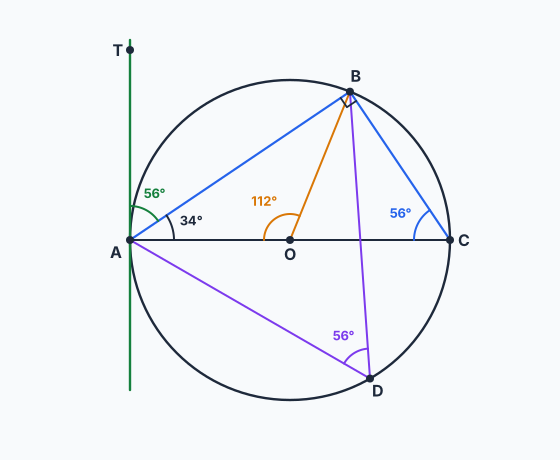
(a) \( 90^{\circ} \) — angle in a semicircle.
(b) \( 180 - 90 - 34 = 56^{\circ} \) — angles in a triangle add up to \( 180^{\circ} \).
(c) Angle \( TAC = 90^{\circ} \) (tangent and radius), so angle \( TAB = 90 - 34 = 56^{\circ} \).
(d) \( 56^{\circ} \) — angles in the same segment (angle \(ADB\) and angle \(ACB\) stand on the same chord \(AB\)).
(e) \( 2 \times 56 = 112^{\circ} \) — angle at the centre is twice the angle at the circumference.
📝Practise
All non-calculator style. Give a reason for every step. EXTENDED marks Extended-only content.
1. \(PQ\) is a diameter of a circle and \(R\) is a point on the circle. Angle \( QPR = 27^{\circ} \). Find angle \(PQR\). [2]
2. \(PT\) is a tangent to a circle with centre \(O\), touching it at \(T\). Angle \( TOP = 58^{\circ} \). Find angle \(OPT\). [2]
3. EXTENDED An angle at the circumference is \( 47^{\circ} \). Find the angle at the centre standing on the same arc. [1]
4. EXTENDED In a cyclic quadrilateral, two opposite angles are \( (2x + 10)^{\circ} \) and \( (3x - 5)^{\circ} \). Find \(x\) and both angles. [3]
5. EXTENDED Two tangents from \(P\) touch a circle, centre \(O\), at \(A\) and \(B\). Angle \( APB = 40^{\circ} \). Find angle \(PAB\) and angle \(AOB\). [3]
6. EXTENDED A tangent at \(A\) makes an angle of \( 64^{\circ} \) with the chord \(AB\). \(C\) is a point on the major arc \(AB\). Find angle \(ACB\). [1]
7. (Calculator.) EXTENDED A chord of length 16 cm is in a circle of radius 10 cm. Find the distance of the chord from the centre. [2]
🔗Go deeper — other people’s work
These are external resources, not mine. If one stops working, tell me and everything above it on this page still stands.
- GeoGebra — drag points round a circle and watch the angle at the centre stay twice the angle at the circumference
- Corbettmaths — circle theorems, with the reasons written out