Pythagoras and right-angled triangles
🎯What you need to be able to do
- Use Pythagoras’ theorem to find a missing side of a right-angled triangle.
- Use sine, cosine and tangent to find sides and angles in right-angled triangles, including in bearings problems.
- Solve problems with angles of elevation and depression, and know the perpendicular is the shortest distance to a line EXTENDED.
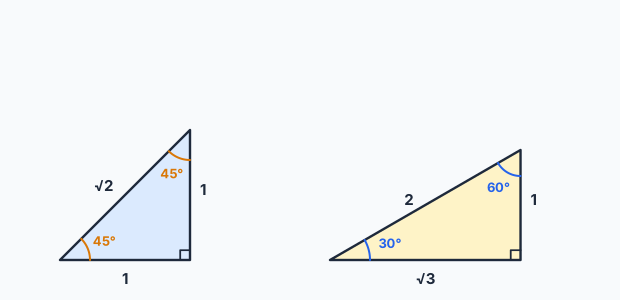
- Know the exact values of sin and cos of 0°, 30°, 45°, 60°, 90° and tan of 0°, 30°, 45°, 60° EXTENDED.
📚The mathematics
Pythagoras’ theorem
In a right-angled triangle with hypotenuse \(c\) (the longest side, opposite the right angle): \( a^{2} + b^{2} = c^{2} \). To find the hypotenuse, add the squares; to find a shorter side, subtract. A quick check: the hypotenuse must be the longest side.
Sine, cosine and tangent
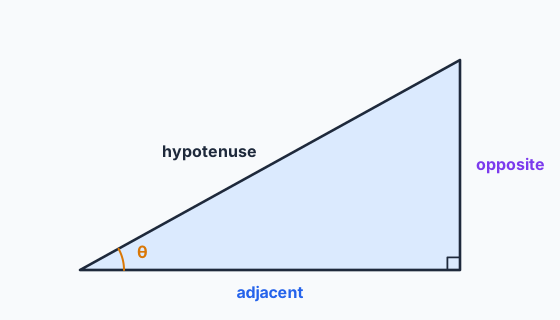
Label the sides, pick the ratio that uses the two sides involved (one known, one wanted), then rearrange. To find an angle, use the inverse: \( \theta = \tan^{-1}\left(\tfrac{\text{opp}}{\text{adj}}\right) \). Give angles to 1 decimal place, and make sure the calculator is in degrees.
Elevation, depression and bearings
EXTENDED The angle of elevation is measured up from the horizontal; the angle of depression down from the horizontal. Because the two horizontals are parallel, the angle of depression from \(A\) to \(B\) equals the angle of elevation from \(B\) to \(A\) (alternate angles). The shortest distance from a point to a line is along the perpendicular.
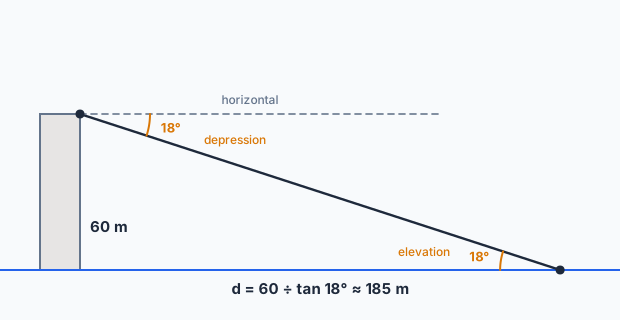
In bearings problems, draw a north line at each point and look for right-angled triangles: a journey of \(d\) km on a bearing \( \theta \) moves \( d\cos\theta \) north and \( d\sin\theta \) east.
Exact values EXTENDED
✏️Worked example
(a) \( h = \sqrt{6.5^{2} - 2.5^{2}} = \sqrt{42.25 - 6.25} = \sqrt{36} = 6 \) m.
(b) \( \text{opp} = 12\sin 38^{\circ} = 7.39 \) cm.
(c) The smallest angle is opposite the smallest side: \( \tan^{-1}\left(\tfrac{5}{9}\right) = 29.1^{\circ} \).
(d) \( \tfrac{\sqrt{3}}{2} \times \tfrac{1}{\sqrt{3}} = \tfrac{1}{2} \).
📝Practise
Questions in the style of the current papers. EXTENDED marks Extended-only content.
1. (Calculator.) The shorter sides of a right-angled triangle are 7.2 cm and 9.6 cm. Find the hypotenuse. [2]
2. (Calculator.) A right-angled triangle has an angle of \( 52^{\circ} \), with the adjacent side 8 cm. Find the opposite side. [2]
3. (Calculator.) In a right-angled triangle the hypotenuse is 10 cm and the side adjacent to angle \(x\) is 7 cm. Find \(x\). [2]
4. (Calculator.) A ship sails 8 km on a bearing of \( 040^{\circ} \). How far north and how far east of its start is it? [3]
5. (Calculator.) EXTENDED From the top of a 60 m cliff, the angle of depression of a boat is \( 18^{\circ} \). How far is the boat from the foot of the cliff? [2]
6. (Non-calculator.) EXTENDED Find the exact value of \( \cos 30^{\circ} \times \tan 60^{\circ} \). [2]
7. (Calculator.) EXTENDED Triangle \(ABC\) has a right angle at \(C\), \( AC = 6 \) cm and \( BC = 8 \) cm. Find the shortest distance from \(C\) to the line \(AB\). [3]
🔗Go deeper — other people’s work
These are external resources, not mine. If one stops working, tell me and everything above it on this page still stands.
- Corbettmaths — SOHCAHTOA, elevation and depression
- Your calculator manual — check it is in degree mode (a small D or DEG on the display)