Trig graphs, sine and cosine rules, 3D
EXTENDED Everything on this page is Extended content only. Core trigonometry stops at right-angled triangles (6a).
🎯What you need to be able to do
- Recognise, sketch and use the graphs of \( y = \sin x \), \( y = \cos x \) and \( y = \tan x \) for \( 0^{\circ} \le x \le 360^{\circ} \).
- Solve equations such as \( \sin x = k \) for \( 0^{\circ} \le x \le 360^{\circ} \), finding every solution.
- Use the sine rule and the cosine rule for sides and angles in any triangle, including obtuse angles and the ambiguous case.
- Use area \( = \tfrac{1}{2}ab\sin C \).
- Use Pythagoras and trigonometry in three dimensions, including the angle between a line and a plane.
📚The mathematics
The graphs and their symmetry
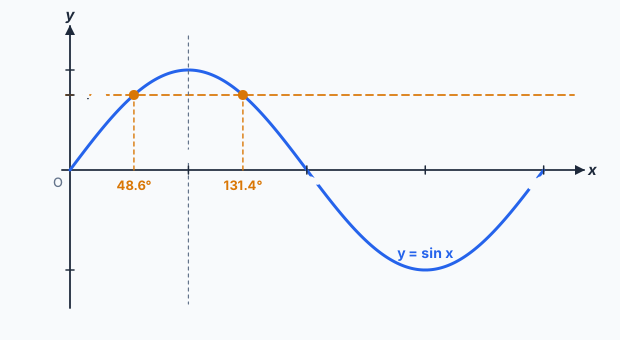
\( \sin x \) and \( \cos x \) repeat every \( 360^{\circ} \) and stay between \(-1\) and 1; \( \tan x \) repeats every \( 180^{\circ} \) and has asymptotes at \( 90^{\circ} \) and \( 270^{\circ} \). The calculator gives one solution of \( \sin x = k \); the graph’s symmetry gives the other:
The sine rule, the cosine rule and the area
All three are on the List of formulas. Side \(a\) is opposite angle \(A\). Choose the rule by what you know:
- Cosine rule: two sides and the angle between them (find the third side), or all three sides (find an angle — rearrange to \( \cos A = \dfrac{b^{2} + c^{2} - a^{2}}{2bc} \)).
- Sine rule: any other combination with a matching side-and-opposite-angle pair.
The ambiguous case. When the sine rule gives an angle, \( \sin C = k \) also has the obtuse solution \( 180^{\circ} - C \). Both are possible if the angles still add up to less than \( 180^{\circ} \); the cosine rule never has this problem, because \( \cos \) is negative for obtuse angles.
Three dimensions
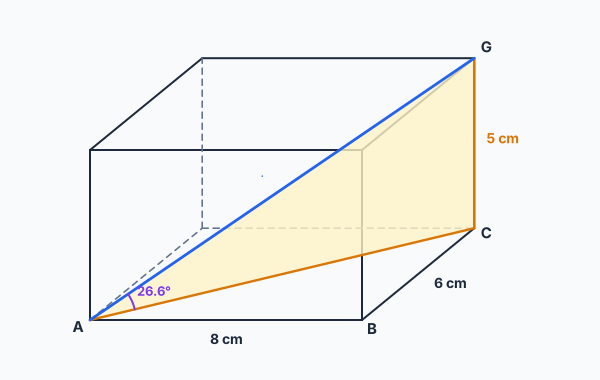
Find a right-angled triangle that lies in a flat plane inside the solid, draw it separately, and solve it. The angle between a line and a plane is the angle between the line and its projection onto the plane (the “shadow” directly beneath it): drop a perpendicular from the top of the line to the plane to make the right angle.
✏️Worked example (calculator)
(a) \( \sin x = 0.75 \Rightarrow x = 48.6^{\circ} \) or \( 180 - 48.6 = 131.4^{\circ} \).
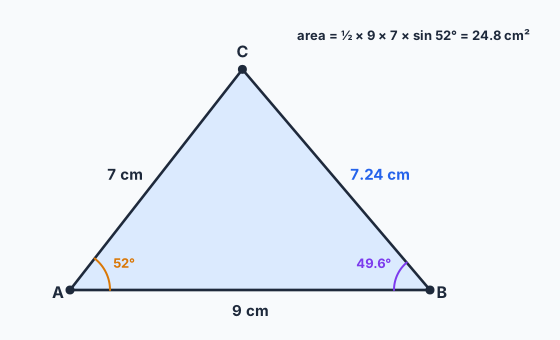
(b) \( BC^{2} = 9^{2} + 7^{2} - 2(9)(7)\cos 52^{\circ} = 52.43\ldots \), so \( BC = 7.24 \) cm. Sine rule: \( \sin B = \dfrac{7\sin 52^{\circ}}{7.241\ldots} = 0.7618 \), so \( B = 49.6^{\circ} \) (it must be acute, because it is opposite the shortest side). Area \( = \tfrac{1}{2}(9)(7)\sin 52^{\circ} = 24.8 \) cm².
(c) Base diagonal \( \sqrt{8^{2} + 6^{2}} = 10 \); space diagonal \( \sqrt{10^{2} + 5^{2}} = 11.2 \) cm. Angle with the base: \( \tan^{-1}\tfrac{5}{10} = 26.6^{\circ} \).
📝Practise
All Extended, calculator style unless stated.
1. Solve \( \tan x = 2.5 \) for \( 0^{\circ} \le x \le 360^{\circ} \). [2]
2. Solve \( \cos x = -0.4 \) for \( 0^{\circ} \le x \le 360^{\circ} \). [2]
3. A triangle has sides 5 cm, 7 cm and 9 cm. Find its largest angle. [3]
4. In triangle \(ABC\), angle \( A = 40^{\circ} \), angle \( B = 65^{\circ} \) and \( a = 12 \) cm. Find \(b\). [2]
5. Find the area of a triangle with sides 8 cm and 11 cm and an included angle of \( 120^{\circ} \). [2]
6. In triangle \(ABC\), \( AB = 10 \) cm, \( BC = 7 \) cm and angle \( A = 35^{\circ} \). Find the two possible values of angle \(C\). [3]
7. A cone has base radius 5 cm and slant height 13 cm. Find its vertical height, and the angle between the slant edge and the base. [3]
🔗Go deeper — other people’s work
These are external resources, not mine. If one stops working, tell me and everything above it on this page still stands.
- Desmos — graph \( y = \sin x \) in degree mode with a horizontal line to see both solutions
- Corbettmaths — sine rule, cosine rule and 3D trigonometry