Probability
🎯What you need to be able to do
- Use the probability scale from 0 to 1, the notation \( \text{P}(A) \) and \( \text{P}(A') = 1 - \text{P}(A) \).
- Use relative frequency to estimate a probability, calculate expected frequencies, and understand fair, biased and random.
- Calculate probabilities of combined events with sample space diagrams, Venn diagrams and tree diagrams (with replacement for Core).
- Handle events without replacement, three-set Venn diagrams and \( \text{P}(A \cap B) \), \( \text{P}(A \cup B) \) notation EXTENDED.
- Calculate conditional probabilities from Venn diagrams, tree diagrams and tables EXTENDED.
📚The mathematics
Single events
For equally likely outcomes, \( \text{P}(A) = \dfrac{\text{number of outcomes in } A}{\text{total number of outcomes}} \). Give probabilities as a fraction, decimal or percentage — never as a ratio or “3 in 10”. Since something must happen, \( \text{P}(\text{not } A) = 1 - \text{P}(A) \).
Relative frequency \( = \dfrac{\text{number of times it happened}}{\text{number of trials}} \) estimates the probability, and gets more reliable with more trials. Expected frequency \( = \text{probability} \times \text{number of trials} \). A fair spinner or dice has equally likely outcomes; a biased one does not.
Sample spaces
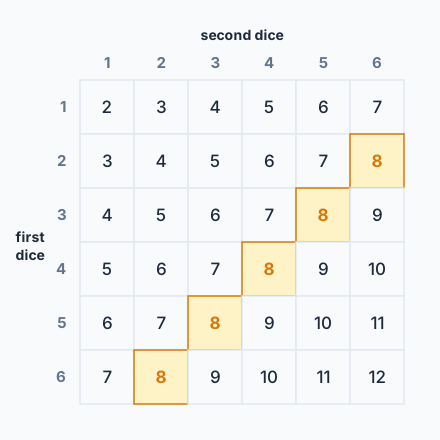
When two things happen (two dice, two spinners), list every combination in a grid. Each cell is equally likely, so count the ones you want.
Tree diagrams
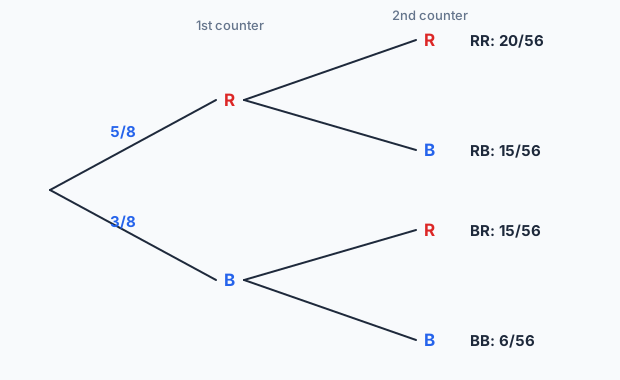
Write outcomes at the ends of branches and probabilities on them. Multiply along a path for “this and then that”, and add the results of different paths for “either way”. The branches from any one point add up to 1.
EXTENDED Without replacement, the second set of branches changes: one item fewer in total, and one fewer of the colour already taken.
Venn diagrams and conditional probability
With a Venn diagram of counts, \( \text{P}(A \cap B) \) uses the overlap and \( \text{P}(A \cup B) \) everything inside either circle. EXTENDED A conditional probability (“given that…”) restricts the total to the given group: the denominator is the number in that group, not the grand total. The notation \( \text{P}(A \mid B) \) and its formula are not required — reason from the diagram or table.
✏️Worked example (non-calculator)
(a) \( \text{P}(RR) + \text{P}(BB) = \tfrac{5}{8} \times \tfrac{4}{7} + \tfrac{3}{8} \times \tfrac{2}{7} = \tfrac{20}{56} + \tfrac{6}{56} = \tfrac{26}{56} = \tfrac{13}{28} \).
(b) “At least one blue” is everything except \(RR\): \( 1 - \tfrac{20}{56} = \tfrac{36}{56} = \tfrac{9}{14} \).
(c) Of the \( \tfrac{26}{56} \) “same colour” outcomes, \( \tfrac{20}{56} \) are \(RR\): \( \dfrac{20}{26} = \dfrac{10}{13} \).
📝Practise
All non-calculator style. EXTENDED marks Extended-only content.
1. \( \text{P}(B) = 0.35 \). Find \( \text{P}(B') \). [1]
2. Two fair dice are thrown. Find the probability that the total is 8. [2]
3. A spinner lands on 4 in 36 of 150 spins. Estimate the probability of landing on 4, and the number of 4s expected in 400 spins. [2]
4. A spinner numbered 1 to 4 and a spinner numbered 1 to 3 are spun, and the two numbers are multiplied. Find the probability that the product is even. [2]
5. The probability that it rains on any day is 0.3, independently. Find the probability that it rains on exactly one of two days. [3]
6. EXTENDED A box has 4 green and 6 yellow pens. Two are taken without replacement. Find the probability of one of each colour. [3]
7. EXTENDED Of 40 students, 22 like tea, 18 like coffee and 7 like both. A student who likes tea is chosen at random. Find the probability that they also like coffee. [2]
8. EXTENDED Of the students who take the bus, 12 are boys and 18 are girls; of those who walk, 20 are boys and 10 are girls. A bus user is chosen at random. Find the probability that it is a girl. [2]
🔗Go deeper — other people’s work
These are external resources, not mine. If one stops working, tell me and everything above it on this page still stands.
- Corbettmaths — tree diagrams with and without replacement
- Khan Academy — conditional probability from two-way tables