Deformation of solids
🎯What you need to be able to do
- Understand that deformation is caused by tensile or compressive forces, and that these forces always act in pairs on a body.
- Describe the behaviour of springs in terms of load, extension, elastic limit, Hooke’s law and the spring constant.
- Define and use stress, strain and the Young modulus, and describe an experiment to determine the Young modulus of a metal in the form of a wire.
- Distinguish between elastic and plastic deformation.
- Understand that the area under a force–extension graph is the work done by the deforming force.
- Derive and use \( E_p = \tfrac{1}{2}Fx = \tfrac{1}{2}kx^{2} \) for a material obeying Hooke’s law.
📚The physics
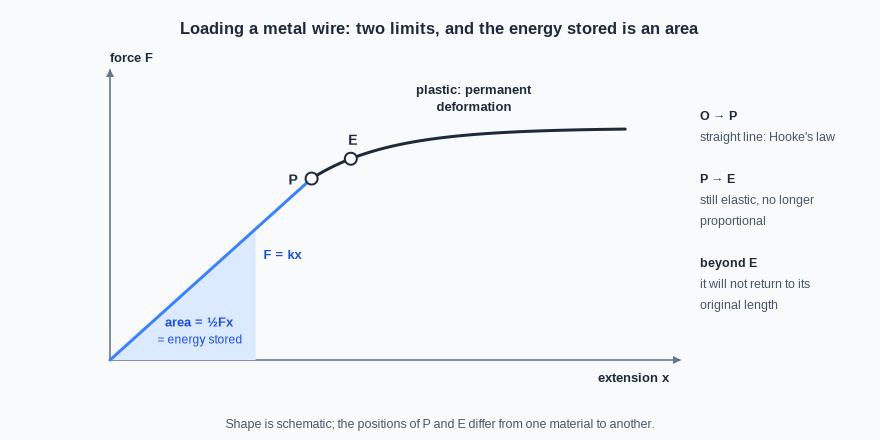
Hooke’s law says the extension is proportional to the load, up to the limit of proportionality: \( F = kx \), where \(x\) is the extension, not the length. The elastic limit is a separate and slightly later point on the graph: beyond it the material does not return to its original length when the load is removed. Between the limit of proportionality and the elastic limit the behaviour is still elastic but no longer linear.
Stress, strain, modulus. Stress \( \sigma = F/A \) (units Pa), strain \( \varepsilon = x/L \) (no units), and the Young modulus \( E = \sigma/\varepsilon \) (units Pa). The point of these three is that \(k\) depends on the object — a longer wire of the same material has a smaller \(k\) — while \(E\) depends only on the material. Combining the definitions gives \( k = EA/L \), which explains that dependence in one line.
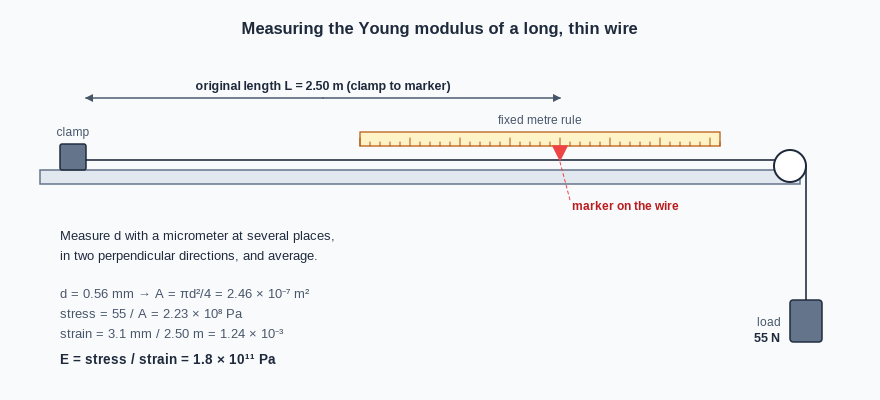
The experiment. A long, thin wire is used because both length and thinness make the extension large enough to measure. The diameter is measured with a micrometer at several places and in two perpendicular directions, and the mean is used, because wires are not perfectly circular or uniform. The uncertainty in \(A\) is twice the percentage uncertainty in \(d\), since \( A = \pi d^{2}/4 \) — which is why the diameter is almost always the dominant uncertainty in the final answer. Plotting stress against strain and taking the gradient is better than a single calculation, because the graph reveals a false origin due to the wire straightening at low loads.
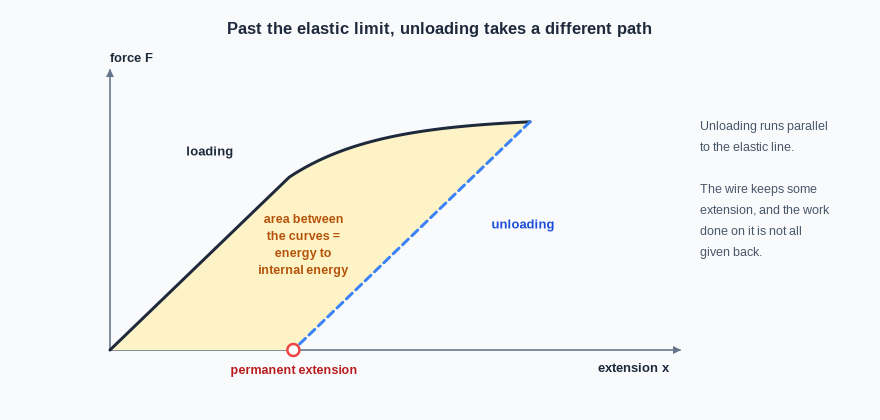
Energy. The work done in stretching is the area under the force–extension graph. For a linear material that area is a triangle: \( E_p = \tfrac{1}{2}Fx = \tfrac{1}{2}kx^{2} \). Beyond the elastic limit the loading and unloading curves differ, and the area between them is energy transferred to internal energy in the material — permanent deformation costs energy.
✏️Worked example
\( A = \pi d^{2}/4 = \pi \times (0.56 \times 10^{-3})^{2}/4 = 2.46 \times 10^{-7} \) m\(^{2}\).
Stress \( = 55/2.46 \times 10^{-7} = 2.23 \times 10^{8} \) Pa.
Strain \( = 3.1 \times 10^{-3}/2.50 = 1.24 \times 10^{-3} \).
🔭See it happen
Load a copper wire past its elastic limit in front of the class and mark the length after each unloading. Copper is ideal because the plastic region is long and obvious, and because the wire visibly thins before it breaks. Compare with a rubber band, whose loading and unloading curves enclose a large area that you can feel as warmth if you stretch and release it rapidly against your lip.
🗺️Concept map: the topic on one page
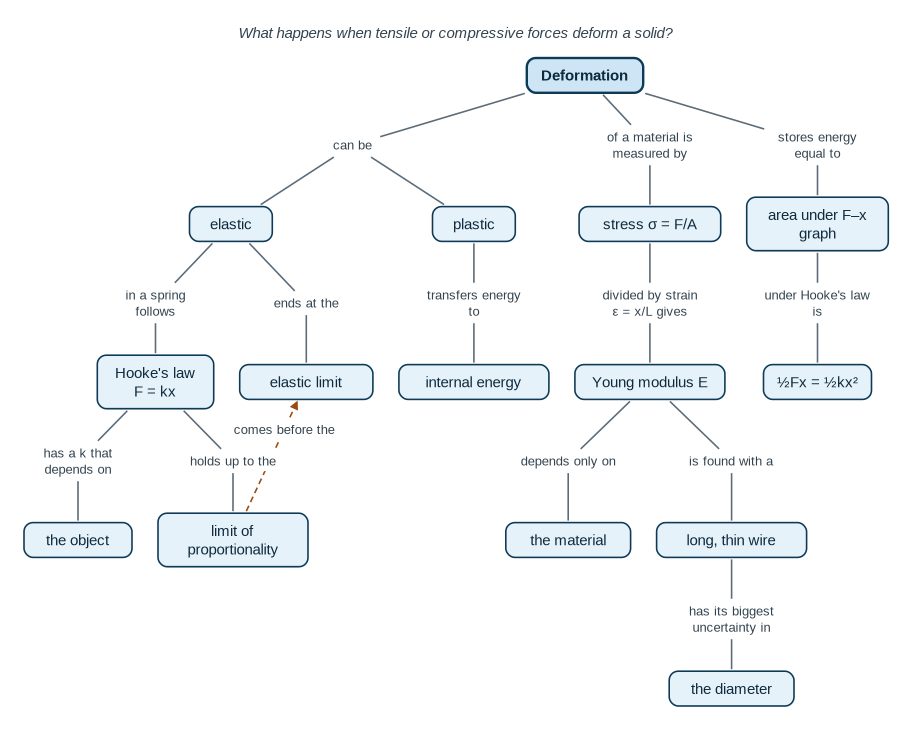
Read every link as a sentence, from the top down: stress σ = F/A — divided by strain ε = x/L gives — Young modulus E. The dashed arrow is a cross-link between two branches. To revise, cover the map, redraw it from memory and then check it against this one.
🔗Go deeper — other people’s work
The links below are not mine. They are here because they are good, and they may move or disappear without warning.
- PhET, Hooke’s Law (embedded above) — springs in series and parallel, with the energy shown as an area.
- The Physics Classroom and Isaac Physics both carry material on stress, strain and the Young modulus.
📝Exam-style questions
17 questions on this topic in the style of Paper 1, Paper 2 and Paper 5, each written by our teaching team to test the same skill as a question on the May/June 2026 papers, with a full mark scheme.
They are for members — sign in or join.
🖨️Print the questions (PDF)
The 17 exam-style questions as an A4 PDF with space to write, and the mark scheme as a separate PDF. Members can print them to practise on paper, and a member who teaches may hand printed copies to their own students as homework (terms).
🃏Flash cards
18 flash cards on this topic (6 definitions, 2 equations, 4 explanations, 3 exam traps and 3 practical cards), written from these notes. Spaced repetition brings back the cards you find hard until you know them.
They are for members — become a member or sign in.