Characteristics and classification of life
🎯What you need to be able to do
- List and explain the seven characteristics of living organisms.
- Explain why viruses are usually not classified as living.
- Describe the hierarchy of classification from kingdom to species, and the binomial system.
- Describe the main features of the five kingdoms and of the vertebrate classes.
- Use and construct a dichotomous key.
- Explain how DNA evidence has changed classification.
🌱The characteristics of life
All living organisms carry out seven life processes. The mnemonic MRS GREN helps:
- Movement — an action that changes position or place (plants move too, slowly: leaves turn to the light).
- Respiration — chemical reactions in cells that release energy from food.
- Sensitivity — detecting and responding to changes in the environment (stimuli).
- Growth — a permanent increase in size and dry mass.
- Reproduction — making more of the same kind of organism.
- Excretion — removing the waste products of metabolism, such as carbon dioxide and urea.
- Nutrition — taking in or making materials for energy, growth and repair.
Something is alive only if it shows all seven. A car moves, “respires” fuel and excretes gases, but it cannot grow or reproduce. All living things are also made of one or more cells, and they keep their internal conditions stable (homeostasis).
Are viruses alive?
Viruses are tiny particles of genetic material (DNA or RNA) in a protein coat. They have no cells, do not respire, feed or grow, and can only reproduce by entering a host cell and hijacking it to make copies of themselves. Most biologists therefore do not classify them as living, though they share some features of life, such as genes that mutate and evolve.
🗂️Classification
Classification sorts organisms into groups based on shared features. Each group is placed inside a larger one:
kingdom → phylum → class → order → family → genus → species
mnemonic: King Philip Came Over For Good Soup
A species is a group of organisms that can interbreed to produce fertile offspring. A horse and a donkey can breed, but their offspring (a mule) is infertile, so they are separate species.
The binomial system
Carl Linnaeus gave every species a two-part Latin name: the genus (capital letter) and the species (lower case), written in italics or underlined when handwritten. The Bali starling is Leucopsar rothschildi; humans are Homo sapiens. Common names vary between languages and regions; the scientific name is the same everywhere, so scientists can be sure they mean the same organism. Species in the same genus are closely related — the tiger (Panthera tigris) and leopard (Panthera pardus).
🌳The five kingdoms
| Kingdom | Cells | Nutrition | Examples |
|---|---|---|---|
| Prokaryotes (bacteria) | single cell, no nucleus | varied | E. coli, Lactobacillus |
| Protoctists | mostly single-celled, with nucleus | some photosynthesize, some feed | Amoeba, Plasmodium (malaria), algae |
| Fungi | cells with chitin walls; often thread-like hyphae | feed on dead or living matter by external digestion | mushrooms, yeast, mould |
| Plants | many cells; cellulose walls; chloroplasts | photosynthesis | ferns, mosses, flowering plants |
| Animals | many cells; no cell walls | eat other organisms | insects, fish, mammals |
Animals with a backbone are vertebrates, divided into five classes: fish (scales, gills, fins), amphibians (moist skin, eggs in water, e.g. frogs), reptiles (dry scales, leathery eggs on land, e.g. the Komodo dragon), birds (feathers, beaks, hard-shelled eggs) and mammals (hair, milk for their young, most give birth to live young). Animals without a backbone are invertebrates — arthropods such as insects (three body parts, six legs), arachnids (eight legs), crustaceans and myriapods, as well as molluscs and worms.
🔑Dichotomous keys
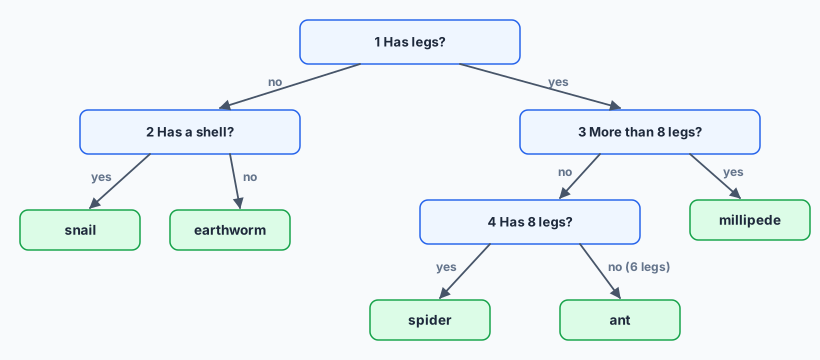
A dichotomous key identifies an organism by a series of questions, each with two choices (“di-” = two). Good questions use features that are easy to see and do not change — not size, colour that varies, or behaviour.
✏️Worked example: using a key and naming
(a) 1: has legs → go to 3. 3: not more than 8 legs → go to 4. 4: not 8 legs → ant (an insect).
(b) They share the genus Rhinoceros, so they are closely related and share a recent common ancestor; they are different species (sondaicus, unicornis), so they cannot interbreed to produce fertile offspring.
🧬Classification and DNA
Classification used to rely on visible features (morphology), which can mislead: dolphins look like fish but are mammals. Comparing DNA sequences shows how closely species are related — the more similar the DNA, the more recently they shared a common ancestor. DNA evidence led to the three-domain system (Bacteria, Archaea and Eukarya) and has moved many species between groups. Classification is therefore a model that changes with new evidence.
🌎Science in context: naming and protecting species
Indonesia is one of the most biodiverse countries on Earth, and new species — frogs, orchids, even a new orangutan species (Pongo tapanuliensis, described in 2017) — are still being named. A species that has not been formally described cannot be listed as endangered or protected by law. Classification is therefore not just bookkeeping; it is the first step in conservation.
🧠Quick check
1. Why is a car not alive, even though it moves and uses fuel?
It does not show all seven characteristics: it cannot grow, reproduce or respond to stimuli by itself, and it is not made of cells.
2. Define a species.
A group of organisms that can interbreed to produce fertile offspring.
3. Which is the larger group: a family or a genus?
A family. A family contains one or more genera; a genus contains one or more species.
4. Name two features that distinguish fungi from plants.
Fungi have no chloroplasts and do not photosynthesize; they feed by digesting food outside their cells; their cell walls are made of chitin, not cellulose.
5. Why do biologists use scientific names rather than common names?
Common names differ between languages and regions and can refer to different organisms; the binomial name is unique and used worldwide.
6. Why is "large or small" a poor question in a dichotomous key?
Size varies with age and between individuals, and is relative; keys should use clear, fixed features such as number of legs.
📝Worksheet
Test yourself on the whole topic with a printable worksheet: questions for all four criteria, from recall to a design task, a data-analysis question and a short reflection, with a full mark scheme.