Inheritance and variation
🎯What you need to be able to do
- Define allele, dominant, recessive, homozygous, heterozygous, genotype and phenotype.
- Use Punnett squares to predict the outcome of a monohybrid cross, as ratios and probabilities.
- Explain how sex is determined by the X and Y chromosomes.
- Interpret family pedigree diagrams.
- Describe genetic and environmental causes of variation, and continuous and discontinuous variation.
- Explain how mutations produce new alleles.
📚The language of genetics
- Allele — a different version of the same gene (e.g. for attached or free earlobes). We carry two alleles of each gene, one on each chromosome of a pair.
- Dominant allele (capital letter, e.g. B) — shows its effect even if only one copy is present.
- Recessive allele (lower case, e.g. b) — only shows its effect when two copies are present.
- Genotype — the alleles an organism has (BB, Bb or bb). Phenotype — the characteristic that results (e.g. brown or blue).
- Homozygous — two identical alleles (BB or bb). Heterozygous — two different alleles (Bb); such a person is a carrier of the recessive allele.
🧮Monohybrid crosses
A Punnett square shows all the possible combinations of alleles from two parents. Each parent’s gametes carry one allele of the gene, and each gamete has an equal chance of fertilization.
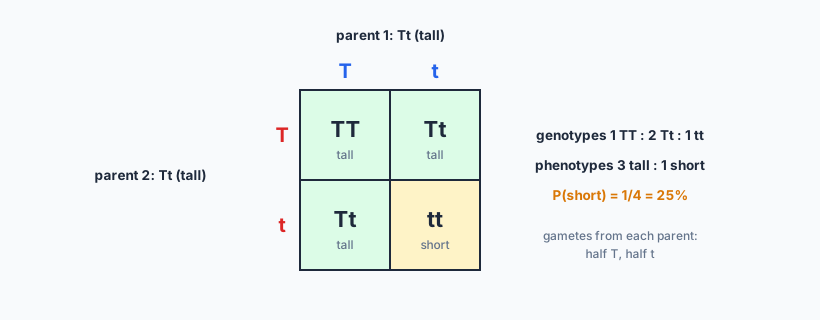
Remember that these are probabilities: a 3 : 1 ratio means each child has a 75% chance of the dominant phenotype. In a family of four children, all four could be short, just as four coin tosses can all be heads. Ratios show clearly only in large numbers of offspring.
✏️Worked example: cystic fibrosis
(a) The child has cystic fibrosis, so is ff and received an f from each parent. The parents do not have the disease, so each has an F: both are Ff (carriers).
(b) Ff × Ff gives FF : Ff : Ff : ff. Probability of ff = 1 in 4 (25%) — for every pregnancy, independently.
(c) Of the three unaffected outcomes (FF, Ff, Ff), two are carriers: 2/3.
♂️Sex determination
One of the 23 pairs of human chromosomes, the sex chromosomes, determines sex: females are XX and males XY. All eggs carry an X; half of the sperm carry an X and half a Y. So there is a 50% chance at each fertilization of a boy or a girl, and the father’s sperm determines the sex.
👪Pedigrees
A pedigree (family tree) shows how a characteristic is inherited: squares are males, circles females, shaded symbols affected individuals. If two unaffected parents have an affected child, the condition must be recessive, and both parents are carriers.
🌈Variation
Variation is the differences between individuals of the same species. It can be caused by genes (blood group, eye colour), by the environment (scars, language, a plant’s height in shade), or most often by both (height, body mass, skin colour).
- Discontinuous variation — a few distinct categories, usually controlled by one or a few genes: blood groups A, B, AB, O; tongue rolling. Shown on a bar chart.
- Continuous variation — a smooth range of values, controlled by many genes plus the environment: height, hand span. Shown on a histogram, often a bell-shaped (normal) distribution.
New alleles arise from mutations: random changes in the DNA base sequence. Most have no effect; some are harmful (the allele for cystic fibrosis); a few are beneficial. Mutation rates are increased by ionizing radiation (X-rays, gamma, UV) and some chemicals, such as those in tobacco smoke.
🌎Science in context: thalassaemia screening
Thalassaemia, an inherited blood disorder caused by recessive alleles, is common in parts of Indonesia, and many people are carriers without knowing it. Carrier screening before marriage or pregnancy, together with genetic counselling, lets couples understand their 1-in-4 risk. Some countries have greatly reduced the number of babies born with severe thalassaemia this way, but screening raises questions about privacy, stigma and reproductive choices — ideal material for a Criterion D discussion.
🧠Quick check
1. Define genotype and phenotype.
Genotype: the combination of alleles an organism has. Phenotype: the observable characteristic that results.
2. What does heterozygous mean?
Having two different alleles of a gene, e.g. Bb.
3. Cross BB × bb. What are the offspring genotypes and phenotypes (B dominant)?
All Bb, so all show the dominant phenotype.
4. What is the probability that a baby will be a girl? Explain.
50%: the mother gives an X; half the father’s sperm carry X (girl) and half Y (boy).
5. Is human height an example of continuous or discontinuous variation? Why?
Continuous: it takes any value within a range, because it is controlled by many genes and by the environment (diet).
6. What is a mutation?
A random change in the base sequence of DNA, which can create a new allele.
📝Worksheet
Test yourself on the whole topic with a printable worksheet: questions for all four criteria, from recall to a design task, a data-analysis question and a short reflection, with a full mark scheme.
Worksheets are for members — sign in or join. The topic 1 worksheet is a free sample.