Photosynthesis and plant nutrition
🎯What you need to be able to do
- Write the word and balanced symbol equations for photosynthesis.
- Describe how a leaf is adapted for photosynthesis.
- Describe how plants use the glucose they make.
- Explain the effects of light intensity, carbon dioxide and temperature, and the idea of limiting factors.
- Describe experiments that measure the rate of photosynthesis and test leaves for starch.
- Explain why plants need nitrate and magnesium ions.
🌿The reaction
Photosynthesis happens in chloroplasts, which contain the green pigment chlorophyll. Chlorophyll absorbs light, mainly red and blue, and the energy is used to split water and combine the hydrogen with carbon dioxide to make glucose. Oxygen is a by-product. The reaction is endothermic: light energy is transferred into the chemical store of glucose.
What the plant does with glucose
- respiration to release energy;
- converted to insoluble starch for storage (it does not affect osmosis);
- converted to cellulose for cell walls;
- converted to sucrose for transport in the phloem;
- combined with nitrate ions to make amino acids and proteins; also made into fats and oils for seeds.
🍃The leaf: a solar-powered factory
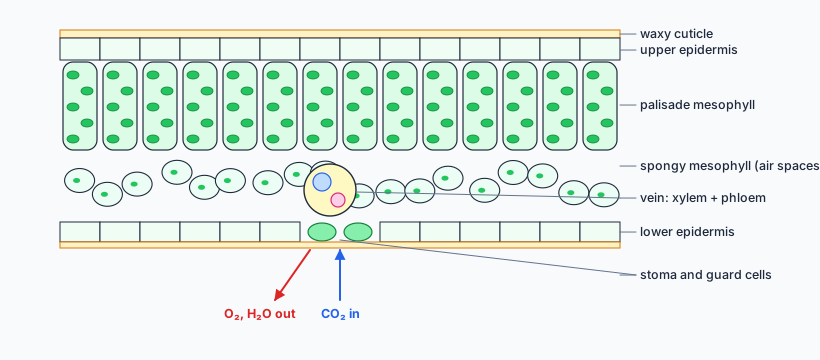
- Broad, flat and thin — a large surface area to absorb light, and a short distance for gases to diffuse.
- Waxy cuticle and transparent epidermis — reduces water loss while letting light through.
- Palisade mesophyll — tall cells near the upper surface, packed with chloroplasts.
- Spongy mesophyll — air spaces let CO2 reach every cell.
- Stomata — pores, mostly on the lower surface, opened and closed by guard cells to let CO2 in and O2 out.
- Veins — xylem brings water; phloem carries sugars away.
📈Limiting factors
The rate of photosynthesis depends on light intensity, carbon dioxide concentration and temperature (which affects the enzymes involved). The factor in shortest supply is the limiting factor: increasing it increases the rate, while increasing the others has no effect.
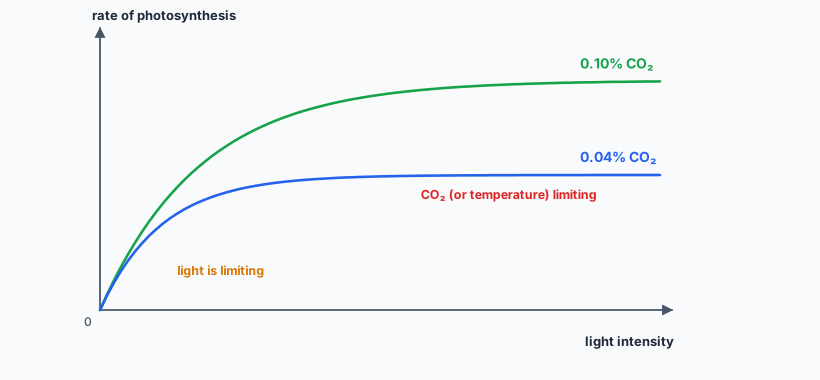
Greenhouse growers use this: they add CO2 (sometimes from burning paraffin, which also heats the air), use artificial lighting and control the temperature, so that no factor stays limiting — as long as the extra yield is worth the extra cost.
✏️Worked example: pondweed and a lamp
Explanation: closer to the lamp, the light intensity is greater, so more light energy is absorbed by chlorophyll and the rate of photosynthesis (and so of oxygen production) is higher. Light is the limiting factor in this range.
Distance and intensity: light spreads out, so intensity follows an inverse square law: doubling the distance cuts the intensity to a quarter. From 20 to 40 cm the bubble rate fell from 30 to 8, close to a quarter (7.5), as expected while light is limiting.
🧪Testing a leaf for starch
Boil the leaf in water (kills it, breaks membranes), then in ethanol in a hot water bath (removes chlorophyll — no naked flames), rinse and soften it in water, then add iodine. Blue-black areas contain starch. Using a variegated leaf (green and white) shows chlorophyll is needed; covering part of a leaf with foil shows light is needed; a plant kept in the dark first is destarched, so any starch found was made during the experiment.
🪴Mineral ions
Plants absorb mineral ions from the soil through root hair cells. Nitrate ions provide nitrogen for amino acids and proteins — a deficiency causes stunted growth and yellow older leaves. Magnesium ions are needed to make chlorophyll — a deficiency causes yellowing between the veins (chlorosis). Fertilizers replace these ions (Topic 15 covers the risks).
🌎Science in context: feeding more people
Rice is Indonesia’s staple food, and its yield depends on how efficiently the plants photosynthesize. Scientists are researching crops with more efficient photosynthesis, while farmers use fertilizers, irrigation and better varieties. Rising CO2 might increase photosynthesis in some crops, but higher temperatures and droughts may reduce yields. Food security is a classic Criterion D topic because it combines biology with economics and fairness.
🧠Quick check
1. Write the word equation for photosynthesis.
carbon dioxide + water → glucose + oxygen (in light, with chlorophyll).
2. Why is glucose stored as starch?
Starch is insoluble, so it does not affect the water potential of cells (osmosis), and it is compact.
3. Give two ways a leaf is adapted to absorb light.
Large, flat surface area; thin; palisade cells near the top packed with chloroplasts; transparent epidermis.
4. What is a limiting factor?
The factor in shortest supply, which stops the rate increasing; increasing it increases the rate.
5. Why does the rate of photosynthesis fall at very high temperatures?
The enzymes that control photosynthesis are denatured, and stomata may close to save water, reducing CO2 uptake.
6. A plant has yellow leaves between green veins. Which mineral is probably lacking?
Magnesium, which is needed to make chlorophyll.
📝Worksheet
Test yourself on the whole topic with a printable worksheet: questions for all four criteria, from recall to a design task, a data-analysis question and a short reflection, with a full mark scheme.
Worksheets are for members — sign in or join. The topic 1 worksheet is a free sample.