Evolution, natural selection and adaptation
🎯What you need to be able to do
- Describe structural, behavioural and physiological adaptations.
- Explain natural selection step by step, using the words variation, competition, survival and inheritance.
- Describe the evidence for evolution: fossils, comparative anatomy, DNA, and evolution observed today.
- Explain how new species form (speciation) and why species become extinct.
- Explain antibiotic resistance as an example of natural selection.
- Distinguish natural selection from selective breeding.
🦎Adaptations
An adaptation is a feature that helps an organism survive and reproduce in its environment.
- Structural — body features: the thick fur and small ears of an Arctic fox; the long, sticky tongue of a chameleon; the spines of a cactus; the webbed feet of a duck.
- Behavioural — actions: migration, hibernation, hunting in packs, nocturnal activity in hot deserts.
- Physiological — body processes: camels producing very concentrated urine; snake venom; plants in hot, dry places opening stomata only at night.
Mangrove trees along Indonesian coasts are a good example: they have roots that stick up above the mud to take in air, and they can get rid of excess salt.
🔄Natural selection
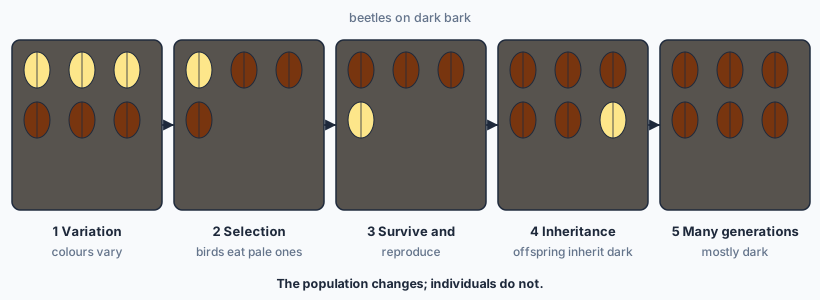
- Variation: individuals in a population vary, partly because of different alleles (from mutation and sexual reproduction).
- Overproduction and competition: more offspring are produced than can survive; they compete for food, space and mates, and face predators and disease.
- Survival of the better adapted: individuals whose variations suit the environment are more likely to survive (the environment exerts a selection pressure).
- Reproduction and inheritance: survivors reproduce and pass on their advantageous alleles.
- Change over time: over many generations these alleles become more common in the population — the population evolves.
Individuals do not evolve during their lifetime, and organisms do not change “because they need to”. The variation already exists; the environment selects among it.
✏️Worked example: antibiotic resistance
Variation: by chance, a mutation in a few bacteria made them less affected by the antibiotic.
Selection: the antibiotic killed most of the non-resistant bacteria; the resistant ones survived, especially as the course was stopped early before they were all killed.
Reproduction and inheritance: the survivors divided rapidly (every 20 minutes or so) and passed the resistance allele to all their offspring.
Result: the population causing the returning infection is mostly resistant, so the antibiotic does not work.
🦴Evidence for evolution
- Fossils — the preserved remains of ancient organisms, in rock layers ordered by age, show how organisms changed over time (for example the evolution of whales from land mammals, or of the horse). The fossil record is incomplete, because fossils form only in special conditions.
- Comparative anatomy — the forelimbs of humans, bats, whales and birds share the same basic bone pattern (the pentadactyl limb), suggesting a common ancestor.
- DNA and proteins — the more similar the DNA of two species, the more recently they shared a common ancestor. Humans share about 97% of their DNA with orangutans.
- Evolution observed today — antibiotic-resistant bacteria, insecticide-resistant mosquitoes, and the peppered moth in industrial Britain.
🏝️New species and extinction
A new species forms (speciation) when populations of one species become isolated, for example by sea, mountains or rivers. Each population meets different conditions, mutations and selection pressures, so they evolve differently until they can no longer interbreed to produce fertile offspring.
Wallace noticed that the animals of Bali and Lombok, only 35 km apart across a deep sea strait, are strikingly different: Asian species to the west, Australasian species to the east. This boundary, now called the Wallace Line, is evidence that populations separated for millions of years evolve independently.
Extinction happens when no individuals of a species remain. Causes include new predators or diseases, competition, climate change, and above all human activity: habitat destruction, hunting and pollution.
🌎Science in context: Darwin, Wallace and credit
In 1858, working in the Maluku islands, Wallace wrote to Darwin describing natural selection — the same theory Darwin had been developing for twenty years. Their ideas were presented together, but Darwin’s 1859 book made him famous. Today Wallace is increasingly recognised. The theory of evolution was controversial because it challenged religious and cultural beliefs; it is accepted by scientists because of the overwhelming evidence from fossils, anatomy and DNA.
🧠Quick check
1. Give one structural and one behavioural adaptation of a polar bear.
Structural: thick fur/fat layer, white colour for camouflage. Behavioural: hunting seals at breathing holes, hibernating in dens (pregnant females).
2. What is a selection pressure?
A factor in the environment (predators, disease, climate, competition) that affects which individuals survive and reproduce.
3. Why is the fossil record incomplete?
Fossils only form in special conditions; soft-bodied organisms rarely fossilize; many fossils have been destroyed by geological activity or not yet found.
4. How does DNA evidence support evolution?
Species that are closely related, by other evidence, have very similar DNA sequences, showing they share a recent common ancestor.
5. What must happen for a new species to form?
Populations must be isolated so they cannot interbreed; they then evolve differently until they can no longer produce fertile offspring together.
6. How is selective breeding different from natural selection?
In selective breeding, humans choose which individuals reproduce, for traits people want; in natural selection, the environment determines which survive.
📝Worksheet
Test yourself on the whole topic with a printable worksheet: questions for all four criteria, from recall to a design task, a data-analysis question and a short reflection, with a full mark scheme.
Worksheets are for members — sign in or join. The topic 1 worksheet is a free sample.