DNA, cell division and reproduction
🎯What you need to be able to do
- Describe the relationship between chromosomes, DNA, genes and proteins.
- Describe the structure of DNA, including base pairing.
- Describe mitosis and meiosis and compare them.
- Explain the terms diploid, haploid, gamete and zygote.
- Compare asexual and sexual reproduction, with advantages and disadvantages.
- Describe the discovery of DNA’s structure and the ethical questions it raised.
🧬Chromosomes, DNA and genes
The nucleus contains chromosomes, long threads of DNA wound around proteins. A gene is a section of DNA that codes for a particular protein — and proteins (enzymes, structural proteins, hormones) determine an organism’s characteristics. Human body cells contain 46 chromosomes in 23 pairs; one of each pair came from each parent. All of an organism’s DNA is its genome.
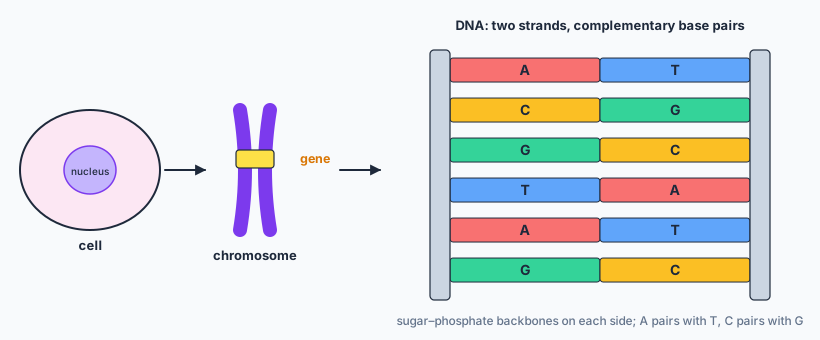
The structure of DNA
DNA is a double helix: two strands twisted around each other like a spiral ladder. Each strand is a chain of nucleotides, each with a sugar, a phosphate and one of four bases: adenine (A), thymine (T), cytosine (C) and guanine (G). The two strands are held together by pairs of bases, and pairing is always complementary: A with T, and C with G. The order of bases along a gene is a code that the cell reads, three bases at a time, to put amino acids in the right order to build a protein.
The structure was worked out in 1953 by James Watson and Francis Crick, using X-ray images made by Rosalind Franklin and Maurice Wilkins. Franklin’s key image was shown to Watson without her knowledge, and she died before the 1962 Nobel Prize was awarded. Her story is now widely discussed as an example of how credit is shared in science.
➗Mitosis
Mitosis is cell division that produces two genetically identical daughter cells, each with the full number of chromosomes (diploid, 46 in humans). Before dividing, the cell copies all of its DNA; each chromosome then consists of two identical halves, which are pulled apart to opposite ends of the cell. Mitosis is used for growth, repair of damaged tissue, replacing cells, and asexual reproduction. Uncontrolled mitosis produces a tumour; a cancer is a tumour that invades other tissues.
➗Meiosis
Meiosis is the cell division that makes gametes (sperm and egg cells in animals; pollen and ova in plants). It happens in the testes and ovaries. The DNA is copied, then the cell divides twice, producing four cells, each with half the number of chromosomes (one from each pair) — haploid, 23 in humans. The cells are genetically different from each other and from the parent, because the chromosome pairs are shuffled.
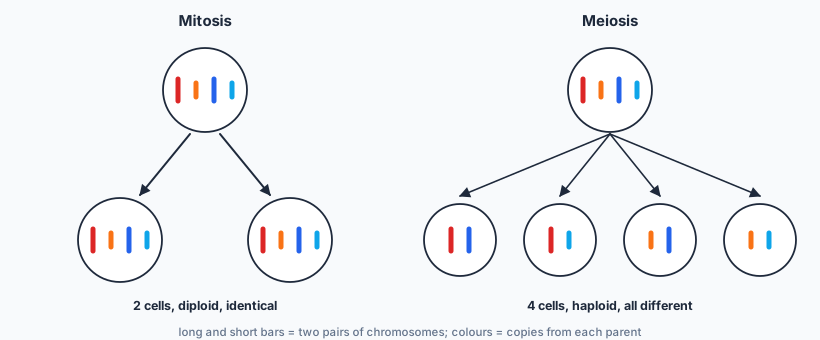
At fertilization a haploid sperm fuses with a haploid egg, forming a diploid zygote with 46 chromosomes, which then divides by mitosis to form an embryo. Halving the number in meiosis keeps the chromosome number constant from one generation to the next.
✏️Worked example: base pairing and chromosome numbers
(a) A–T, T–A, G–C, C–G: T A C G G T.
(b) A pairs with T, so T is also 30%; A + T = 60%, leaving 40% for C + G, split equally: guanine = 20%.
(c) Sperm are haploid: 78 ÷ 2 = 39. The zygote is diploid: 39 + 39 = 78.
🌸Asexual and sexual reproduction
| Asexual | Sexual | |
|---|---|---|
| Parents | one | usually two |
| Gametes | none; mitosis only | yes: made by meiosis, then fertilization |
| Offspring | genetically identical clones | genetically varied |
| Examples | bacteria dividing, yeast budding, strawberry runners, potato tubers, cuttings | humans, most animals, flowering plants |
| Advantages | fast; no mate needed; good traits kept | variation helps a species survive changes and disease; basis of natural selection |
| Disadvantages | no variation: one disease or change can wipe out all | slower; needs a mate; uses more energy |
🌎Science in context: bananas and clones
Almost all bananas sold worldwide belong to one variety, Cavendish, propagated asexually from suckers — every plant is a clone. A fungal disease, Tropical Race 4, is spreading through Cavendish plantations, including in Indonesia, and because the plants are genetically identical, none are resistant. Indonesia is home to many wild and local banana varieties whose genetic diversity may hold the key to resistant crops — a strong argument for conserving local varieties.
🧠Quick check
1. What is a gene?
A section of DNA that codes for a specific protein.
2. Name the base that pairs with cytosine.
Guanine.
3. Give two uses of mitosis in the body.
Growth and repair of tissues (also replacing worn-out cells, and asexual reproduction in some organisms).
4. Why must gametes be haploid?
So that when two gametes fuse at fertilization, the zygote has the normal diploid number and the chromosome number stays constant each generation.
5. How many cells does meiosis produce, and are they identical?
Four haploid cells, all genetically different.
6. Give one advantage and one disadvantage of asexual reproduction.
Advantage: fast, no mate needed. Disadvantage: no genetic variation, so a new disease or environmental change could kill every individual.
📝Worksheet
Test yourself on the whole topic with a printable worksheet: questions for all four criteria, from recall to a design task, a data-analysis question and a short reflection, with a full mark scheme.
Worksheets are for members — sign in or join. The topic 1 worksheet is a free sample.