Biological molecules and enzymes
🎯What you need to be able to do
- Name the chemical elements and building blocks of carbohydrates, proteins and lipids.
- Describe the food tests for starch, reducing sugar, protein and fat.
- Explain what an enzyme is and how the lock-and-key model works.
- Explain the effect of temperature and pH on enzyme activity, including denaturation.
- Interpret graphs of enzyme activity and design enzyme investigations.
🍞The molecules of life
| Molecule | Elements | Made from | Roles |
|---|---|---|---|
| carbohydrates | C, H, O | simple sugars (e.g. glucose) join to form starch, glycogen and cellulose | energy source (glucose); storage (starch in plants, glycogen in animals); structure (cellulose walls) |
| proteins | C, H, O, N (some S) | amino acids, about 20 kinds, in a specific order | enzymes, antibodies, haemoglobin, muscle, hormones such as insulin |
| lipids (fats and oils) | C, H, O | glycerol + three fatty acids | energy store (twice as much per gram as carbohydrate), insulation, cell membranes |
Large molecules like starch and proteins are polymers: long chains of smaller units. The order of amino acids decides how a protein folds, and its shape decides its function. Water is also vital: it makes up about 70% of a cell, dissolves substances so they can react and be transported, and helps regulate temperature.
🧪Food tests
| Test for | Method | Positive result |
|---|---|---|
| starch | add iodine solution | orange-brown → blue-black |
| reducing sugar (e.g. glucose) | add Benedict’s solution, heat in a water bath (~80 °C) | blue → green, yellow or brick-red (more sugar = further along) |
| protein | add biuret solution | blue → purple/lilac |
| fat | shake with ethanol, then pour into water | cloudy white emulsion |
🔑Enzymes
Enzymes are biological catalysts: proteins that speed up chemical reactions in living things without being used up. Without them, reactions such as digesting starch or copying DNA would be far too slow at 37 °C. Each enzyme has an active site, a region with a precise shape that fits only one type of molecule, its substrate.
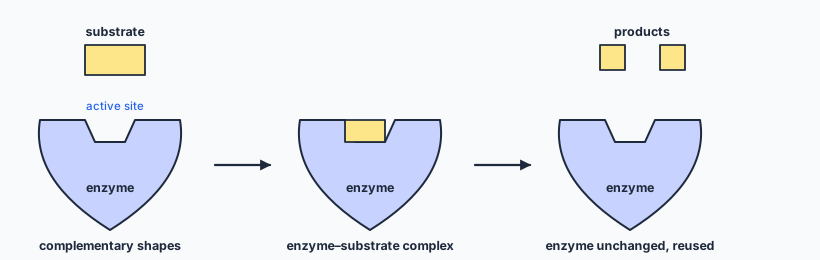
In the lock-and-key model, the substrate fits the active site like a key in a lock, forming an enzyme–substrate complex. The reaction happens, the products leave, and the enzyme is free to catalyse again. Because each active site fits one substrate, enzymes are specific: amylase breaks down starch but not protein.
🌡️Temperature and pH
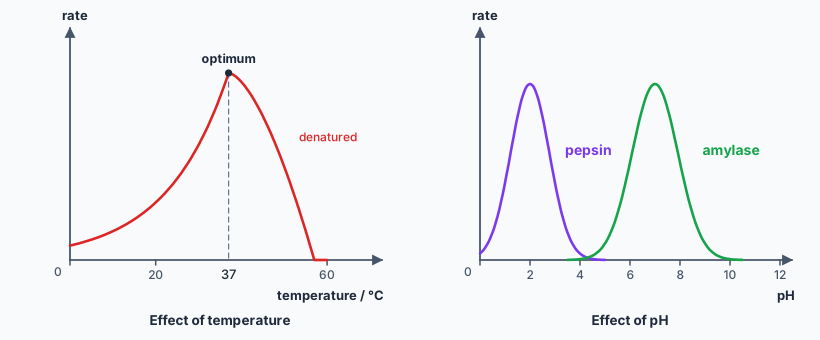
- Temperature: as temperature rises, molecules move faster and collide more often, so the rate increases up to the optimum (about 37 °C for human enzymes). Above it, the enzyme’s bonds start to break and the active site changes shape: the substrate no longer fits. The enzyme is denatured — a permanent change. At low temperatures enzymes are inactive but not denatured, which is why fridges slow food decay.
- pH: each enzyme has an optimum pH. Pepsin in the acidic stomach works best at about pH 2; amylase in the mouth and small intestine at about pH 7. Too far from the optimum and the active site changes shape, denaturing the enzyme.
✏️Worked example: amylase and temperature
Rate = 1 ÷ time = 1 ÷ 60 = 0.017 s−1 (the shorter the time, the higher the rate).
Pattern: from 20 to 40 °C the time halves with each 10 °C rise: molecules have more kinetic energy, so there are more frequent successful collisions between starch and active sites. The optimum is near 40 °C. At 50 °C the enzyme begins to denature, and at 60 °C it is fully denatured: the active site has changed shape so starch is not broken down at all.
🌎Science in context: enzymes in industry
Enzymes are used to make biological washing powders work at low temperatures (saving energy), to turn starch into sugar syrups, to soften leather, and to produce lactose-free milk. Tempeh and other fermented foods depend on the enzymes of fungi. Industrial enzymes save energy because they work at moderate temperatures, but they must be kept in their narrow working range of temperature and pH.
🧠Quick check
1. Which element is found in proteins but not in carbohydrates or lipids?
Nitrogen (and sometimes sulfur).
2. Describe the test for protein.
Add biuret solution to the food sample (in solution); a colour change from blue to purple shows protein.
3. What is an active site?
The region of an enzyme with a specific shape into which its substrate fits.
4. Why can an enzyme only catalyse one type of reaction?
Its active site has a specific shape that is complementary to only one substrate (enzymes are specific).
5. What happens to an enzyme at 70 °C?
It is denatured: bonds holding its shape break, the active site changes shape and the substrate no longer fits. The change is permanent.
6. Why does pepsin work in the stomach but not in the small intestine?
Pepsin’s optimum pH is about 2, matching the acidic stomach. The small intestine is neutral to slightly alkaline, which changes pepsin’s active site.
📝Worksheet
Test yourself on the whole topic with a printable worksheet: questions for all four criteria, from recall to a design task, a data-analysis question and a short reflection, with a full mark scheme.
Worksheets are for members — sign in or join. The topic 1 worksheet is a free sample.