Respiration and gas exchange
🎯What you need to be able to do
- Write equations for aerobic respiration and for anaerobic respiration in animals and in yeast.
- Compare aerobic and anaerobic respiration and explain oxygen debt.
- Describe the structure of the breathing system and how gases are exchanged in the alveoli.
- Explain the mechanism of breathing in terms of volume and pressure.
- Describe the effect of exercise on breathing and the effects of smoking.
- Explain the difference between respiration and gas exchange (breathing).
⚡Aerobic respiration
Respiration is the set of chemical reactions in cells that release energy from glucose. It happens in every living cell, all the time — in plants as well as animals. Aerobic respiration uses oxygen and takes place mainly in the mitochondria:
The energy is used for muscle contraction, making large molecules (such as proteins), active transport, sending nerve impulses, cell division, and keeping warm-blooded animals at a constant temperature. Notice that the equation is the reverse of photosynthesis.
🏃Anaerobic respiration
When oxygen is in short supply, cells can release a little energy without it:
- In muscles: glucose → lactic acid. During hard exercise, lactic acid builds up and causes fatigue and cramp. Afterwards you keep breathing hard to supply the extra oxygen needed to break down the lactic acid — the oxygen debt.
- In yeast and plants: glucose → ethanol + carbon dioxide. This is fermentation, used to make bread rise (CO2) and to make alcoholic drinks and biofuel ethanol.
Anaerobic respiration releases much less energy per glucose molecule than aerobic, because the glucose is only partly broken down (lactic acid and ethanol still contain a lot of chemical energy).
🫁The gas exchange system
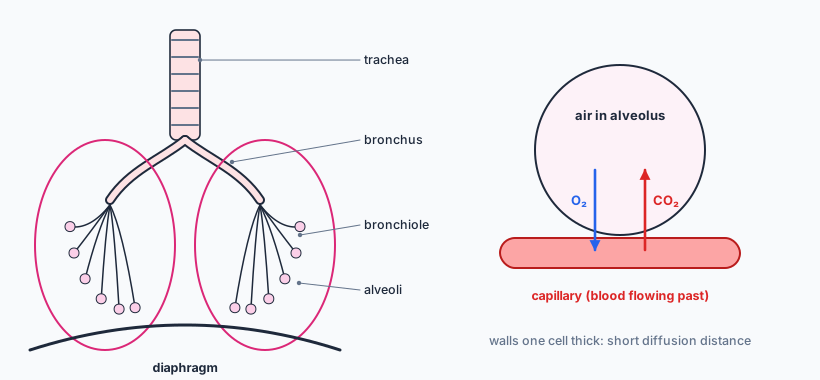
Air passes through the nose (where it is warmed, moistened and filtered), the trachea (held open by C-shaped rings of cartilage), two bronchi, smaller bronchioles, and finally about 300 million alveoli. Cells lining the airways make mucus to trap dust and microbes, and cilia sweep it up to the throat.
Gas exchange in the alveoli happens by diffusion. The alveoli are adapted to make it fast:
- a huge total surface area (about the size of a tennis court);
- thin walls — one cell thick, as are the capillary walls, so the diffusion distance is short;
- a rich blood supply and constant ventilation, which keep the concentration gradients steep;
- a moist lining in which gases dissolve.
💨Breathing
Breathing in (inhaling): the external intercostal muscles contract, moving the ribs up and out; the diaphragm contracts and flattens. The volume of the chest increases, so the pressure inside falls below atmospheric pressure, and air flows in. Breathing out (exhaling): the muscles relax, the ribs move down and in, the diaphragm domes up; the volume decreases, pressure rises, and air is pushed out.
Inhaled air contains about 21% oxygen and 0.04% carbon dioxide; exhaled air about 16% oxygen and 4% carbon dioxide, and more water vapour.
✏️Worked example: breathing during exercise
Rest: 12 × 0.5 = 6.0 dm3/min. Exercise: 30 × 2.0 = 60 dm3/min — ten times more.
Explanation: contracting muscles respire faster, so they need more oxygen and produce more carbon dioxide. The rise in CO2 in the blood is detected by the brain, which increases the rate and depth of breathing. The heart also beats faster, so oxygen reaches the muscles and CO2 is removed more quickly.
🚬Smoking
Tobacco smoke contains tar (carcinogens that cause lung and throat cancer, and damage cilia so mucus builds up, leading to “smoker’s cough” and bronchitis), nicotine (addictive; raises heart rate and blood pressure), and carbon monoxide (binds to haemoglobin, reducing the blood’s oxygen-carrying capacity). Smoking also causes emphysema, where alveolar walls break down, reducing the surface area for gas exchange.
🌎Science in context: smoking in Indonesia
Indonesia has one of the highest rates of male smoking in the world, including kretek (clove) cigarettes, and cigarette advertising has been widespread. Tobacco farming and factories employ many people, and cigarette taxes bring in government revenue, but smoking-related diseases cost far more in healthcare and lost lives. Weighing jobs and tax income against public health — and deciding how far governments should restrict advertising — is a strong Criterion D debate.
🧠Quick check
1. Where in the cell does aerobic respiration take place?
Mainly in the mitochondria.
2. Write the word equation for anaerobic respiration in yeast.
glucose → ethanol + carbon dioxide (+ a little energy).
3. Why does anaerobic respiration release less energy than aerobic?
Glucose is only partly broken down; the products (lactic acid or ethanol) still contain a lot of chemical energy.
4. Give three features of alveoli that make gas exchange efficient.
Large surface area, walls one cell thick (short diffusion distance), good blood supply, moist surface, ventilation keeps gradients steep.
5. Explain how air is drawn into the lungs.
The intercostal muscles and diaphragm contract, increasing the volume of the chest; the pressure inside falls below atmospheric pressure, so air flows in.
6. How does carbon monoxide in cigarette smoke affect the body?
It binds to haemoglobin in red blood cells, so less oxygen can be carried to the tissues.
📝Worksheet
Test yourself on the whole topic with a printable worksheet: questions for all four criteria, from recall to a design task, a data-analysis question and a short reflection, with a full mark scheme.
Worksheets are for members — sign in or join. The topic 1 worksheet is a free sample.