Health, disease and immunity
🎯What you need to be able to do
- Distinguish communicable (infectious) and non-communicable diseases.
- Name the four types of pathogen and describe how diseases are transmitted.
- Describe the body’s barriers and the roles of phagocytes and lymphocytes.
- Explain how vaccination gives immunity, and the idea of herd immunity.
- Explain how antibiotics work, why they do not work on viruses, and how resistance develops.
- Discuss how living conditions and lifestyle affect health.
🦠Pathogens and how disease spreads
A pathogen is a microorganism that causes disease. Communicable diseases are caused by pathogens and can spread from one person to another; non-communicable diseases (heart disease, most cancers, type 2 diabetes) cannot.
| Pathogen | Examples of disease | Transmission |
|---|---|---|
| bacteria | tuberculosis (TB), cholera, typhoid | droplets in air (TB); contaminated water and food (cholera, typhoid) |
| viruses | influenza, COVID-19, measles, HIV, dengue | droplets; body fluids (HIV); mosquito vector (dengue) |
| protoctists | malaria | Anopheles mosquito vector |
| fungi | athlete’s foot, ringworm | direct contact, shared surfaces |
A vector is an organism that carries a pathogen between hosts without having the disease itself. The Aedes mosquito spreads dengue fever, which is common in Indonesia in the rainy season. Controlling vectors — removing standing water where mosquitoes breed (the “3M” campaign: drain, cover, recycle), bed nets and repellents — breaks the chain of transmission.
🛡️Defences against disease
First line — barriers: skin; mucus and cilia in the airways; stomach acid; tears and saliva containing enzymes that kill bacteria; blood clotting seals wounds.
Second line — white blood cells:
- Phagocytes engulf and digest pathogens (phagocytosis). They attack any pathogen — non-specific.
- Lymphocytes make antibodies. Every pathogen carries molecules called antigens on its surface. Each type of antibody has a shape that fits one antigen, so it is specific. Antibodies clump pathogens together, mark them for phagocytes, or neutralize their toxins. Some lymphocytes become memory cells.
💉Vaccination
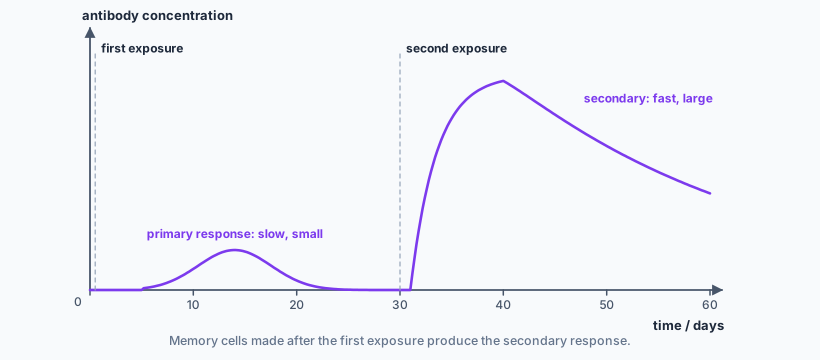
A vaccine contains dead or weakened pathogens, or harmless parts of them (such as their antigens or mRNA instructions to make them). Lymphocytes respond by making antibodies and memory cells without the person becoming ill. If the real pathogen enters later, the memory cells trigger a fast, strong secondary response that destroys it before symptoms develop. This is active immunity.
When a large proportion of a population is vaccinated, a pathogen struggles to find new hosts, which protects people who cannot be vaccinated (babies, people with weak immune systems): herd immunity. Smallpox was eradicated worldwide in 1980 by vaccination; polio has almost gone.
✏️Worked example: explaining a booster
First dose: lymphocytes meet the antigen for the first time; there is a delay while the right lymphocytes multiply, then a small rise in antibodies — the primary response. Some memory cells are made.
Booster: memory cells recognise the antigen at once and produce a secondary response: faster, larger and longer-lasting antibody production, and many more memory cells.
Result: if the real pathogen enters later, there are enough memory cells to destroy it before it can multiply and cause disease.
💊Antibiotics and resistance
Antibiotics (such as penicillin, discovered by Alexander Fleming in 1928) kill bacteria or stop them growing, without harming human cells. They do not work on viruses, because viruses live inside our cells and do not have the structures that antibiotics target. Colds and flu should not be treated with antibiotics.
Bacteria reproduce rapidly and mutate. If a mutation makes one bacterium resistant, it survives an antibiotic treatment while the others die, and it multiplies — natural selection in action (Topic 13). Resistant strains such as MRSA and drug-resistant TB are spreading. To slow resistance: only use antibiotics when necessary, complete the full course, and cut their routine use in farming.
🏠Health, lifestyle and living conditions
Health depends on more than pathogens. Clean water and sanitation prevent cholera and typhoid; overcrowded housing spreads TB; air pollution causes lung disease. For non-communicable diseases, risk factors include smoking, alcohol, a poor diet, lack of exercise and obesity. Access to healthcare, vaccines and education differs greatly between and within countries, which is why health is also a question of fairness.
🌎Science in context: dengue and Wolbachia
In Yogyakarta, scientists released Aedes mosquitoes carrying Wolbachia, a natural bacterium that stops the dengue virus multiplying inside them. A large trial published in 2021 found around 77% fewer dengue cases in treated areas. The project needed community consent, because it involved deliberately releasing mosquitoes. It is an excellent Criterion D case study: strong evidence, a new technology, and questions of consent and trust.
🧠Quick check
1. What is a pathogen? Name the four types.
A microorganism that causes disease: bacteria, viruses, protoctists and fungi.
2. What is a vector? Give an example.
An organism that carries a pathogen from one host to another, e.g. the Aedes mosquito (dengue) or Anopheles mosquito (malaria).
3. How do phagocytes and lymphocytes differ in how they destroy pathogens?
Phagocytes engulf and digest any pathogen (non-specific); lymphocytes produce antibodies specific to one antigen.
4. Why can't antibiotics cure a cold?
Colds are caused by viruses, which live inside our cells; antibiotics only affect bacteria.
5. What is herd immunity?
When enough of a population is immune that a pathogen cannot spread easily, protecting those who are not immune.
6. Why should patients finish the full course of antibiotics?
To kill all the bacteria, including the more resistant ones; stopping early can leave resistant bacteria to survive and multiply.
📝Worksheet
Test yourself on the whole topic with a printable worksheet: questions for all four criteria, from recall to a design task, a data-analysis question and a short reflection, with a full mark scheme.
Worksheets are for members — sign in or join. The topic 1 worksheet is a free sample.