Biotechnology
🎯What you need to be able to do
- Describe selective breeding and its advantages and risks.
- Describe the main steps of genetic modification, with examples such as human insulin and Golden Rice.
- Describe cloning by cuttings, tissue culture and embryo or adult cell cloning.
- Describe uses of microorganisms in food production and medicine.
- Discuss the potential of stem cells and gene editing.
- Evaluate the ethical, economic and environmental issues raised by biotechnology.
🌾Selective breeding
In selective breeding (artificial selection), humans choose individuals with desired characteristics and breed them together, then choose the best offspring and repeat over many generations. Examples: high-yielding rice varieties such as those of the Green Revolution, cattle that produce more milk, disease-resistant crops, and every breed of dog. It is slow and imprecise, and it reduces genetic variation: inbreeding can bring out harmful recessive alleles, and a uniform crop can be wiped out by one new disease.
🧬Genetic modification
Genetic modification (genetic engineering) transfers a gene from one organism into another, even of a different species, giving it a new characteristic. The result is a genetically modified organism (GMO).
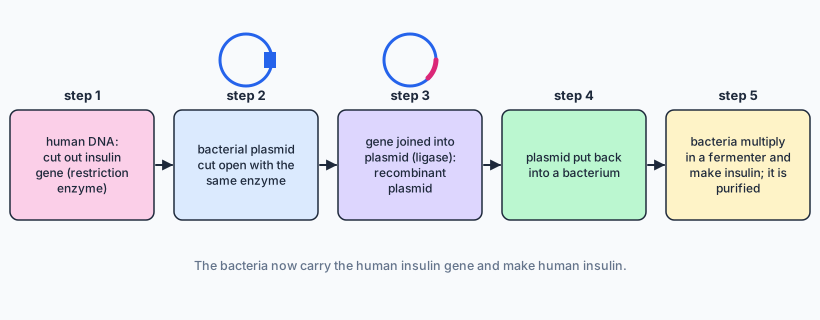
- The gene is cut out of the donor DNA using restriction enzymes, which cut at specific base sequences.
- A vector, usually a bacterial plasmid, is cut with the same enzyme.
- The gene is joined into the plasmid by the enzyme ligase.
- The plasmid is taken up by the host cell (a bacterium, or a plant or animal cell).
- Host cells that took up the gene are selected and grown, and the gene is expressed — the new protein is made.
Examples: bacteria that make human insulin for people with diabetes (replacing insulin extracted from pigs and cattle); Bt crops with a bacterial gene that makes an insecticidal protein, reducing spraying; herbicide-resistant crops; Golden Rice, engineered to make beta-carotene, which the body turns into vitamin A, to reduce childhood blindness where rice is the staple food.
👧Cloning
- Cuttings — a piece of stem is planted and grows roots (helped by rooting powder containing auxin).
- Tissue culture (micropropagation) — small groups of cells are grown on sterile nutrient jelly with hormones, producing thousands of identical plants, used for orchids and bananas.
- Embryo transplants — an early embryo from high-quality animals is split and the parts are implanted in surrogate mothers.
- Adult cell cloning — the nucleus of a body cell is put into an egg cell whose nucleus has been removed; an electric shock starts division, and the embryo is implanted. Dolly the sheep (1996) was the first mammal cloned this way.
🧫Microorganisms, stem cells and gene editing
Microorganisms have long been used in biotechnology: yeast in bread and alcohol, bacteria in yoghurt, and the fungus Rhizopus that binds soybeans into tempeh. Industrial fermenters grow microorganisms at controlled temperature, pH and oxygen to make antibiotics (penicillin from a mould), enzymes and mycoprotein.
Stem cells (Topic 2) might be used to grow replacement tissue. Gene editing with CRISPR-Cas9 lets scientists change a specific base sequence precisely; it has been used to treat sickle-cell disease, but editing human embryos, whose changes would be inherited, is banned in most countries.
✏️Worked example: evaluating a GM crop
Increase: \( (4.8 - 4.0) \div 4.0 \times 100 = 20\% \).
Benefit: fewer insecticide sprays (6 → 1) cut costs and reduce harm to farmworkers and non-target insects such as bees, while producing more food.
Risk: by natural selection, pests may evolve resistance to the Bt protein; seed may cost more and be controlled by a few companies; the gene might spread to wild relatives.
🌎Science in context: who owns biotechnology?
Many GM seeds are patented, so farmers may need to buy new seed each season. Golden Rice, by contrast, was offered free to low-income farmers, yet took over 20 years to reach approval, partly because of opposition to GMOs. Indonesia has approved some GM crops, such as a drought-tolerant sugarcane, while testing others. Biotechnology forces us to ask not only can we do something, but should we, and who decides — the heart of Criterion D.
🧠Quick check
1. Give one advantage and one disadvantage of selective breeding.
Advantage: produces organisms with useful traits (higher yield, disease resistance). Disadvantage: reduces genetic variation, increasing risk of inherited disorders and vulnerability to disease.
2. What is the role of restriction enzymes in genetic modification?
They cut DNA at specific base sequences, cutting the gene out of the donor DNA and cutting open the plasmid.
3. Why are bacteria used to make human insulin?
They reproduce very rapidly and can be grown in huge fermenters, producing large amounts of human insulin that is identical to the body’s own.
4. What problem is Golden Rice designed to solve?
Vitamin A deficiency, which causes blindness and weakens immunity, in places where rice is the main food.
5. Why are cloned plants genetically identical to the parent?
They are produced by mitosis from the parent’s cells, with no meiosis or fertilization.
6. Name a food made using a fungus and one made using bacteria.
Fungus: tempeh (Rhizopus), bread (yeast). Bacteria: yoghurt, cheese.
📝Worksheet
Test yourself on the whole topic with a printable worksheet: questions for all four criteria, from recall to a design task, a data-analysis question and a short reflection, with a full mark scheme.
Worksheets are for members — sign in or join. The topic 1 worksheet is a free sample.