Movement in and out of cells
🎯What you need to be able to do
- Define diffusion and explain the factors that affect its rate.
- Define osmosis in terms of water and a partially permeable membrane.
- Explain the effects of osmosis on animal and plant cells (turgid, flaccid, plasmolysed, bursting).
- Define active transport and explain why it needs energy.
- Calculate surface area to volume ratio and explain its importance.
- Interpret data from osmosis experiments, including percentage change in mass.
💨Diffusion
Diffusion is the net movement of particles from a region of higher concentration to a region of lower concentration, down a concentration gradient, as a result of their random movement. It needs no energy from the cell (it is passive). Examples: oxygen diffuses from the alveoli into the blood; carbon dioxide diffuses into leaves; digested food molecules diffuse from the gut into the blood.
Diffusion is faster when:
- the concentration gradient is steeper;
- the temperature is higher (particles move faster);
- the surface area is larger;
- the distance (thickness of the membrane or wall) is shorter.
💧Osmosis
Osmosis is the net movement of water molecules from a region of higher water potential (a dilute solution) to a region of lower water potential (a concentrated solution) through a partially permeable membrane. The membrane lets small water molecules through but not larger solute molecules such as sugar. Osmosis is a special case of diffusion, and is also passive.
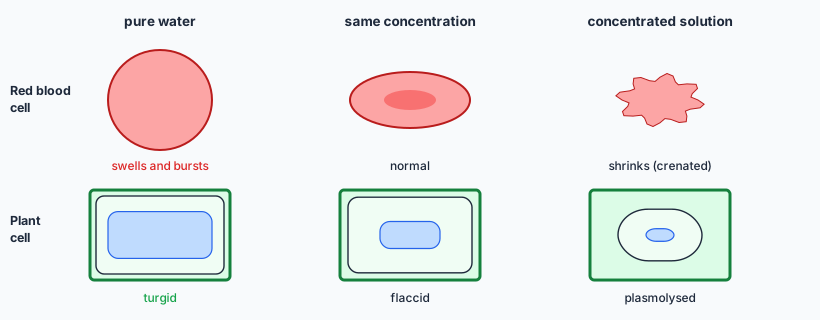
- Animal cells in pure water gain water by osmosis, swell and may burst (lysis); in a concentrated solution they lose water and shrink (crenate). This is why intravenous drips use a saline solution of the same concentration as blood.
- Plant cells in water become turgid: the vacuole swells and presses the cytoplasm against the cell wall, which stops them bursting. Turgid cells keep leaves and stems firm. In a concentrated solution they lose water and become flaccid (the plant wilts); in extreme cases the membrane pulls away from the wall (plasmolysis).
⚡Active transport
Active transport moves substances against a concentration gradient, from low to high concentration, using energy from respiration and carrier proteins in the membrane. Root hair cells use it to absorb mineral ions (such as nitrate) from soil where they are more dilute than inside the root; cells lining the gut use it to absorb the last glucose. Cells that do a lot of active transport contain many mitochondria.
| Diffusion | Osmosis | Active transport | |
|---|---|---|---|
| What moves | any small particles | water only | ions and molecules |
| Direction | high → low concentration | dilute → concentrated solution | low → high concentration |
| Energy from respiration? | no | no | yes |
| Membrane needed? | no | yes, partially permeable | yes, with carrier proteins |
🧊Surface area to volume ratio
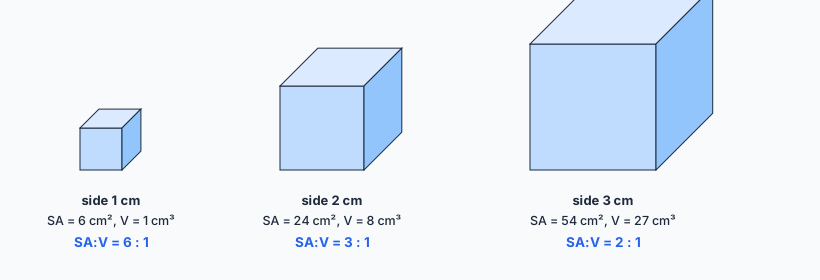
A cell takes in materials through its surface, but uses them throughout its volume. As an object gets larger, its volume increases faster than its surface area, so its surface area to volume ratio (SA:V) falls. A small organism such as an amoeba has a large SA:V and can rely on diffusion across its surface. Large organisms cannot: the centre would be too far away. So they have exchange surfaces with huge areas (alveoli, villi, root hairs, gills), thin walls, and transport systems (blood, xylem) to carry materials to every cell. That is also why cells themselves stay small.
✏️Worked example: potato cylinders in sugar solution
1. Change in mass. 2.20 − 2.50 = −0.30 g.
2. Percentage change. \( \dfrac{-0.30}{2.50} \times 100 = -12\% \).
3. Explanation. The sugar solution is more concentrated (lower water potential) than the potato cells’ contents, so water left the cells by osmosis through their partially permeable membranes, and the cylinder lost mass.
🌎Science in context: oral rehydration therapy
Diarrhoeal diseases such as cholera kill hundreds of thousands of children each year, mostly through dehydration. Oral rehydration solution — clean water with the right amounts of salt and glucose — uses the fact that glucose and sodium are absorbed together by the gut, pulling water in with them by osmosis. This cheap mixture is considered one of the most important medical advances of the 20th century. It is a good example of how understanding a basic cell process can save lives.
🧠Quick check
1. Define diffusion.
The net movement of particles from a region of higher concentration to a region of lower concentration, as a result of their random movement.
2. Why do red blood cells burst in pure water but plant cells do not?
Both gain water by osmosis, but the plant cell’s strong cellulose wall resists the pressure; the red blood cell has no wall.
3. Why does active transport need energy?
It moves substances against their concentration gradient, from low to high concentration, which does not happen by random movement alone.
4. Calculate the SA:V of a cube of side 4 cm.
SA = 6 × 16 = 96 cm2; V = 64 cm3; SA:V = 96/64 = 1.5 (1.5 : 1).
5. Why does a salad wilt if salt dressing is added too early?
The salty solution is more concentrated than the leaf cells, so water leaves the cells by osmosis; they become flaccid and the leaves wilt.
6. Give two features of exchange surfaces that increase the rate of diffusion.
Any two: large surface area, thin walls (short distance), a good blood supply or ventilation to keep the concentration gradient steep.
📝Worksheet
Test yourself on the whole topic with a printable worksheet: questions for all four criteria, from recall to a design task, a data-analysis question and a short reflection, with a full mark scheme.
Worksheets are for members — sign in or join. The topic 1 worksheet is a free sample.