Transport in animals and plants
🎯What you need to be able to do
- Describe the double circulation of mammals and explain its advantage.
- Describe the structure of the heart and the path of blood through it.
- Compare arteries, veins and capillaries and relate structure to function.
- Describe the components of blood and their functions.
- Describe coronary heart disease and its risk factors.
- Describe transport in xylem and phloem, and explain transpiration and the factors that affect it.
❤️The heart and double circulation
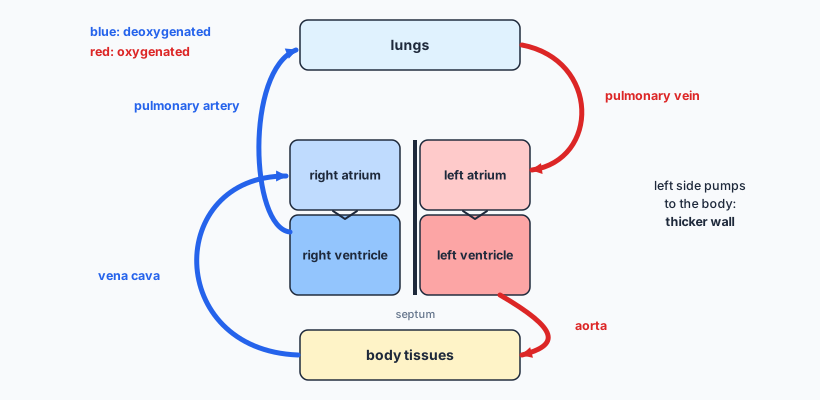
Mammals have a double circulation: blood passes through the heart twice on each complete circuit. The right side pumps deoxygenated blood to the lungs (pulmonary circulation); the left side pumps oxygenated blood to the rest of the body (systemic circulation). This lets blood return to the heart after the lungs to be given a second, high-pressure push, so it reaches the body’s tissues quickly.
The heart has four chambers. The atria receive blood from veins; the ventricles pump it out into arteries. The left ventricle has a much thicker muscular wall than the right, because it pumps blood all round the body, not just to the nearby lungs. Valves stop blood flowing backwards. The heart muscle is supplied with oxygen by the coronary arteries.
Path: vena cava → right atrium → right ventricle → pulmonary artery → lungs → pulmonary vein → left atrium → left ventricle → aorta → body.
🩸Blood vessels
| Arteries | Capillaries | Veins | |
|---|---|---|---|
| Carry blood | away from the heart, at high pressure | through tissues, exchanging materials | back to the heart, at low pressure |
| Wall | thick, with muscle and elastic fibres | one cell thick | thin |
| Lumen | narrow | just wide enough for a red blood cell | wide |
| Valves | no (except at the heart) | no | yes, to stop backflow |
🩸Blood
- Red blood cells carry oxygen, bound to haemoglobin.
- White blood cells defend against pathogens: phagocytes engulf them; lymphocytes make antibodies (Topic 10).
- Platelets are cell fragments that help blood clot at a wound.
- Plasma is the liquid that carries dissolved glucose, amino acids, carbon dioxide, urea, hormones, and heat.
💔Coronary heart disease
Fatty deposits can build up in the walls of the coronary arteries, narrowing them. Less oxygen reaches the heart muscle, causing chest pain; if a clot blocks the artery, part of the muscle dies — a heart attack. Risk factors include a diet high in saturated fat, smoking, lack of exercise, obesity, high blood pressure, stress and genetic factors. Treatments include stents (mesh tubes that hold arteries open), bypass surgery and drugs such as statins that lower blood cholesterol.
✏️Worked example: heart rate and cardiac output
Rest: 70 × 70 = 4900 cm3/min ≈ 4.9 dm3/min.
Exercise: 150 × 110 = 16 500 cm3/min = 16.5 dm3/min, over three times as much.
Why: working muscles respire faster and need more oxygen and glucose, and produce more carbon dioxide. A higher cardiac output delivers more blood to the muscles and removes waste faster.
🌳Transport in plants
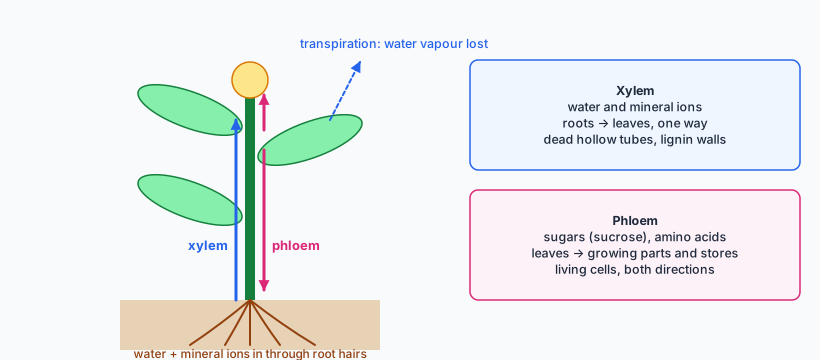
- Xylem vessels are long, hollow tubes of dead cells, strengthened with lignin. They carry water and mineral ions from the roots up to the leaves, and help support the plant.
- Phloem tubes are living cells that carry dissolved sugars (sucrose) and amino acids from the leaves to where they are needed: growing tips, fruits, and storage organs such as roots and tubers. This is called translocation.
Transpiration is the loss of water vapour from the leaves, mostly through the stomata. As water evaporates from the leaf cells, more water is drawn up the xylem in a continuous column — the transpiration stream. It supplies water for photosynthesis, carries minerals, keeps cells turgid and cools the leaf. Transpiration is faster in higher temperature, higher light intensity (stomata open), windy and dry (low humidity) conditions. It is measured with a potometer, which records how fast a cut shoot takes up water.
🌎Science in context: heart disease in Southeast Asia
Cardiovascular disease is now the leading cause of death in Indonesia, linked to smoking, high blood pressure, diabetes and diets high in salt and fried food. Treatments like stents and bypass surgery save lives but are expensive and concentrated in big cities. A Criterion D discussion might compare spending on treatment with spending on prevention, such as anti-smoking campaigns and screening for blood pressure.
🧠Quick check
1. Why is the wall of the left ventricle thicker than the right?
The left ventricle pumps blood all around the body, which needs a higher pressure; the right only pumps to the nearby lungs.
2. What is the function of the valves in the heart and veins?
They prevent blood from flowing backwards.
3. Why do capillaries have walls only one cell thick?
To give a short diffusion distance for exchanging oxygen, glucose, carbon dioxide and other substances with the tissues.
4. Name the blood vessel that carries blood from the heart to the lungs.
The pulmonary artery (it carries deoxygenated blood).
5. What do xylem and phloem each transport?
Xylem: water and mineral ions, upwards. Phloem: sugars (sucrose) and amino acids, up and down the plant.
6. Why does a plant lose water faster on a hot, windy day?
Higher temperature increases evaporation and diffusion of water vapour; wind removes the humid air around the leaf, keeping the concentration gradient steep.
📝Worksheet
Test yourself on the whole topic with a printable worksheet: questions for all four criteria, from recall to a design task, a data-analysis question and a short reflection, with a full mark scheme.
Worksheets are for members — sign in or join. The topic 1 worksheet is a free sample.