Functions
🎯What you need to be able to do
- Use the words function, domain, range, one-one, many-one, inverse and composite correctly — and explain in words why something is, or is not, a function.
- Find the range of a function on a given domain, and write it with the correct notation.
- Explain why a function has no inverse, and restrict its domain so that it does.
- Find the inverse of a one-one function, with its domain.
- Form composite functions such as \( fg(x) \) and \( f^{2}(x) \), and state when they exist.
- Sketch a function and its inverse, and sketch \( y = |f(x)| \) for linear, quadratic, cubic and trigonometric \( f \).
📚The mathematics
The vocabulary
A function is a rule that sends every input in its domain to exactly one output. The set of outputs is the range (the syllabus also calls it the image set). Both halves of the definition matter: every input must have an output, and no input may have two.
- One-one: different inputs always give different outputs. On a graph, every horizontal line meets the curve at most once.
- Many-one: at least two inputs share an output, for example \( f(x) = x^{2} \) has \( f(-3) = f(3) = 9 \).
- “One-many” is not a function at all. \( y = \pm\sqrt{x} \) sends 4 to both 2 and \(-2\).
When asked to explain in words, quote the definition and give a specific counter-example. “It fails the horizontal line test” on its own is a description of a picture, not an explanation; “\( f(1) = f(5) = 2 \), so two inputs share an output and \( f \) is many-one” earns the mark.
Domain and range
The domain is given to you (or is “all real \(x\)” unless something breaks, such as division by zero or the log of a non-positive number). The range you work out, and the reliable way is to sketch the graph over the domain you have been given — not the whole curve.
Write the range in terms of the function, not \(x\): “\( f(x) \ge -11 \)” or “\( 2 < f(x) \le 7 \)”. Writing \( x \ge -11 \) for a range is the most common way to lose this mark, because it describes the wrong axis.
For a quadratic, complete the square to find the vertex (Topic 2). If the vertex lies inside the domain it gives the least or greatest value; if not, the range runs between the values at the ends of the domain.
Inverse functions
An inverse \( f^{-1} \) undoes \( f \): if \( f(a) = b \) then \( f^{-1}(b) = a \). That only works if \( f \) is one-one — a many-one function would need \( f^{-1} \) to send one input to two places, which no function can do. So a quadratic on all of \( \mathbb{R} \) has no inverse, but the same quadratic on \( x \ge \) (its vertex) does.
The method: write \( y = f(x) \), rearrange to make \(x\) the subject, then swap the letters.
The domain of \( f^{-1} \) is part of the answer, and it is the range of \( f \) — not whatever values the formula happens to accept. When the rearrangement produces a \( \pm \), the domain of \( f \) tells you which sign to keep.
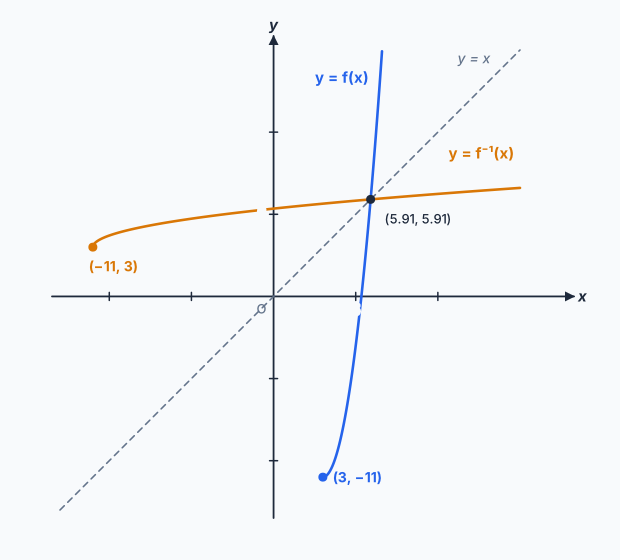
Graphically, \( y = f^{-1}(x) \) is the reflection of \( y = f(x) \) in the line \( y = x \). Every point \( (a, b) \) on one curve becomes \( (b, a) \) on the other, so end points, intercepts and asymptotes swap coordinates too.
Composite functions
\( fg(x) \) means \( f(g(x)) \): apply \(g\) first, then \(f\). Read it right to left. In general \( fg \ne gf \), and \( f^{2}(x) \) means \( f(f(x)) \), not \( [f(x)]^{2} \). (The syllabus never uses \( f^{2} \) for trigonometric functions, where \( \sin^{2}x \) does mean the square.)
\( fg \) only exists if every output of \(g\) is an allowed input of \(f\):
and then the domain of \( fg \) is the domain of \( g \), and the range of \( fg \) sits inside the range of \( f \). So to explain why \( fg \) exists, name the range of \( g \), name the domain of \( f \), and say that the first lies inside the second.
The modulus graph \( y = |f(x)| \)
\( |f(x)| \) is \( f(x) \) with every negative output made positive. On the graph: keep everything above the \(x\)-axis, and reflect every part below it in the \(x\)-axis. The graph never goes below the axis, and it has a sharp corner (a “V”) wherever the original crossed the axis.
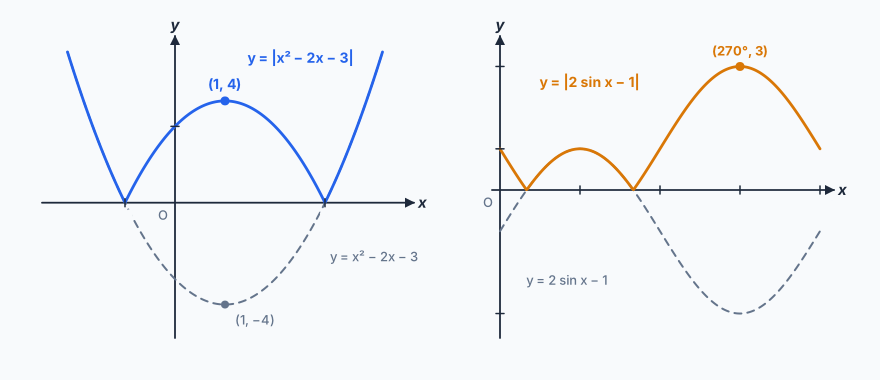
Label where the graph meets the axes and the reflected turning points, because those are what a sketch is marked on. The number of solutions of \( |f(x)| = k \) is then the number of times the horizontal line \( y = k \) meets the sketch.
✏️Worked example
(a) Complete the square: \( 2x^{2} - 12x + 7 = 2\left[(x-3)^{2} - 9\right] + 7 = 2(x-3)^{2} - 11 \). The vertex is at \( x = 3 \). To the right of it the curve only rises, so \(f\) is one-one for \( x \ge 3 \) and the least value is \( k = 3 \).
(b) The least value of \( f \) is at the vertex: \( f(x) \ge -11 \).
(c) Let \( y = 2(x-3)^{2} - 11 \). Then \( (x-3)^{2} = \dfrac{y+11}{2} \), so \( x - 3 = \pm\sqrt{\dfrac{y+11}{2}} \). The domain of \(f\) is \( x \ge 3 \), so \( x - 3 \ge 0 \) and we keep the positive root:
(d) The range of \(f\) is \( f(x) \ge -11 \), and every such value is in the domain of \(g\) (\( x \ge -20 \)), so \( gf \) exists. Its domain is the domain of \(f\), \( x \ge 3 \). Now
so \( x^{2} - 6x - 27 = 0 \), \( (x-9)(x+3) = 0 \). Since \( x \ge 3 \), reject \( x = -3 \): the only solution is \( x = 9 \).
📝Practise
Written in the style of the current Paper 1 (no calculator) and Paper 2 (calculator) questions. Try each one fully before revealing the answer.
1. (No calculator.) The function \(f\) is defined by \( f(x) = (x - 2)^{2} + 1 \) for \( x \in \mathbb{R} \). Explain why \(f\) does not have an inverse. [1]
2. (No calculator.) \( f(x) = \dfrac{2x + 3}{x - 1} \) for \( x \ne 1 \). Find \( f^{-1}(x) \), stating the value of \(x\) for which it is not defined. [3]
3. (No calculator.) \( f(x) = 5 - 2e^{-x} \) for \( x \in \mathbb{R} \). (a) State the range of \(f\). (b) Find \( f^{-1}(x) \) and state its domain. [4]
4. (No calculator.) \( f(x) = 5 - 2x \) and \( g(x) = x^{2} + 1 \), both for \( x \in \mathbb{R} \). (a) Solve \( f^{2}(x) = 11 \). (b) Solve \( fg(x) = -15 \). [4]
5. (No calculator.) \( f(x) = \sqrt{x + 3} \) for \( x \ge -3 \), and \( g(x) = x^{2} - 4 \) for \( x \in \mathbb{R} \). (a) Find \( gf(x) \), and state the domain and range of \( gf \). (b) Explain why \( fg(0) \) is not defined. [4]
6. (No calculator.) Sketch \( y = |x^{2} - 4x| \) and hence find all the solutions of \( |x^{2} - 4x| = 3 \), giving exact values. [5]
7. (Calculator.) \( f(x) = \ln(2x - 1) \) for \( x > \tfrac{1}{2} \). (a) Find \( f^{-1}(x) \) and state its domain and range. (b) On the same axes, sketch \( y = f(x) \) and \( y = f^{-1}(x) \), stating the equations of any asymptotes. [6]
🔗Go deeper — other people’s work
These are external resources, not mine. If one stops working, tell me and everything above it on this page still stands.
- Desmos — plot \( f \), \( f^{-1} \) and \( y = x \) together, and \( y = \operatorname{abs}(f(x)) \), to check any sketch
- Cambridge 0606 examiner reports — “range written in terms of \(x\)” and “wrong order of composition” appear in almost every one