Quadratic functions
🎯What you need to be able to do
- Find the maximum or minimum value of \( ax^{2} + bx + c \) by completing the square, or by differentiation.
- Use that value to sketch the graph, and to find the range of the function on a given domain.
- Use the discriminant to decide whether a quadratic has two, one or no real roots.
- Use the same idea to decide whether a line cuts a curve, touches it, or misses it.
- Solve quadratic equations by factorising, the formula and completing the square.
- Solve quadratic inequalities, and write the solution set in the correct form.
📚The mathematics
Completing the square
Every quadratic can be written as \( a(x + p)^{2} + q \). That form tells you at a glance:
When \( a \ne 1 \), take \(a\) out of the \( x^{2} \) and \(x\) terms only, complete the square inside the bracket, then multiply back:
The step that goes wrong is multiplying the \( -4 \) by 3. Expand your answer back out — it takes ten seconds and catches it every time.
The syllabus also allows differentiation: \( \dfrac{d}{dx}\left(3x^{2} - 12x + 5\right) = 6x - 12 = 0 \) at \( x = 2 \), where \( y = -7 \). Use whichever the question asks for; if it says “by completing the square”, calculus gets no credit.
Range on a domain
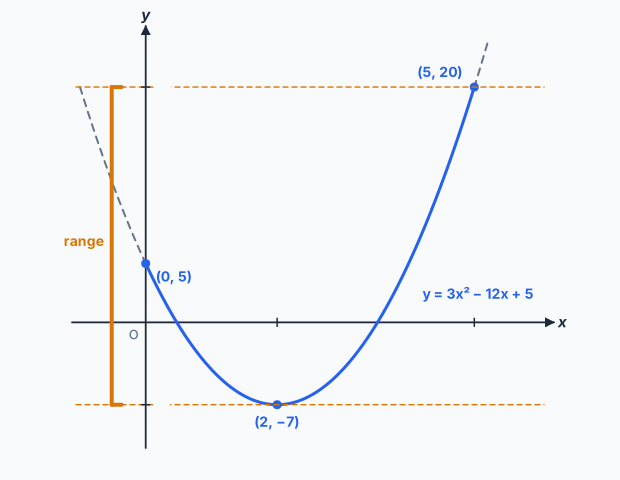
To find the range for a restricted domain, sketch the parabola only over that domain and read off the lowest and highest points. Check three places: both ends of the domain, and the vertex if it lies inside the domain.
The discriminant
For \( ax^{2} + bx + c = 0 \) the roots are \( x = \dfrac{-b \pm \sqrt{b^{2} - 4ac}}{2a} \) (the formula is in the List of formulas). The part under the square root, \( b^{2} - 4ac \), decides how many real roots there are:
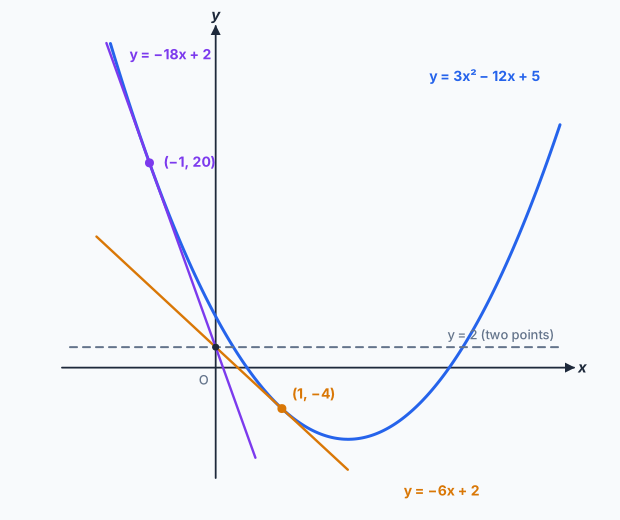
Lines and curves. To find where \( y = mx + c \) meets a quadratic curve, set them equal and rearrange to \( (\ldots)x^{2} + (\ldots)x + (\ldots) = 0 \). That equation has two, one or no roots exactly when the line cuts the curve twice, is a tangent, or does not meet it. “Intersects” on its own means \( \ge 0 \) (touching counts); “at two distinct points” means \( > 0 \).
Quadratic inequalities
Find the critical values (the roots), sketch the parabola, then read off where it is above or below the axis. For \( a > 0 \):
- \( (\ldots) < 0 \) — between the roots: one interval, \( \alpha < x < \beta \).
- \( (\ldots) > 0 \) — outside the roots: two pieces, \( x < \alpha \) or \( x > \beta \).
The syllabus is explicit about the form: \( -3 < x < 4 \) and \( x < 1 \) or \( x > 6 \). Never write the second as \( 6 < x < 1 \), which describes no numbers at all. On Paper 2 a correct solution set earns the marks without working, but on Paper 1 the working is where most of them are.
✏️Worked example
(a) As above, \( f(x) = 3(x - 2)^{2} - 7 \). The minimum point is \( (2, -7) \).
(b) The vertex \( x = 2 \) is inside the domain, so the least value is \(-7\). At the ends, \( f(0) = 5 \) and \( f(5) = 75 - 60 + 5 = 20 \). So \( -7 \le f(x) \le 20 \).
(c) Set the line equal to the curve:
A tangent means equal roots, so \( b^{2} - 4ac = 0 \): \( (12 + k)^{2} - 36 = 0 \), so \( 12 + k = \pm 6 \), giving \( k = -6 \) or \( k = -18 \).
(d) The discriminant \( (12 + k)^{2} - 36 \) is a positive quadratic in \(k\) with roots \(-18\) and \(-6\), so it is positive outside them: \( k < -18 \) or \( k > -6 \).
📝Practise
Written in the style of the current Paper 1 (no calculator) and Paper 2 (calculator) questions.
1. (No calculator.) Find the values of \(k\) for which the equation \( kx^{2} + 4x + k - 3 = 0 \) has two equal roots. [3]
2. (No calculator.) Find the set of values of \(k\) for which the line \( y = 2x + k \) meets the curve \( y = x^{2} - 4x + 11 \) at two distinct points. [3]
3. (No calculator.) Solve \( 2x^{2} - 7x - 15 < 0 \). [3]
4. (No calculator.) Find the values of \(x\) for which \( x(x + 4) \ge 2x + 15 \). [3]
5. (No calculator.) \( f(x) = 4 + 6x - x^{2} \). (a) Write \( f(x) \) in the form \( a - (x - b)^{2} \). (b) Find the range of \(f\) for \( -1 \le x \le 4 \). [4]
6. (No calculator.) Find the values of \(m\) for which the line \( y = mx - 1 \) does not meet the curve \( y = x^{2} + 3 \). [3]
7. (Calculator.) Solve \( 3x^{2} - 5x - 4 = 0 \), giving your answers correct to 3 significant figures. [2]
🔗Go deeper — other people’s work
These are external resources, not mine. If one stops working, tell me and everything above it on this page still stands.
- Desmos — put a slider on \(k\) in \( y = kx + 2 \) and watch the line become a tangent at the two critical values
- Khan Academy — completing the square and quadratic inequalities