Trigonometry
🎯What you need to be able to do
- Use sine, cosine, tangent, secant, cosecant and cotangent for angles of any size, in degrees or radians.
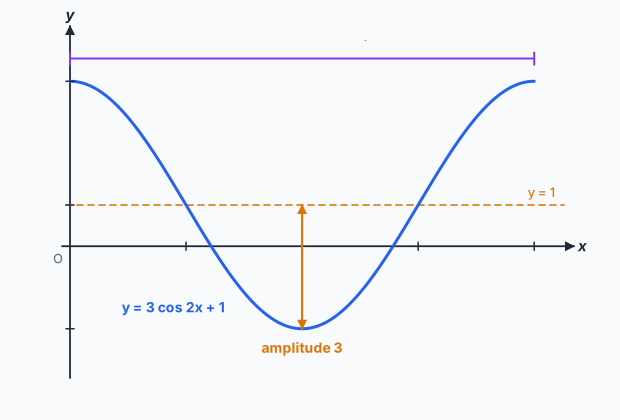
- State the amplitude and period of a trigonometric function and relate the graphs of related functions.
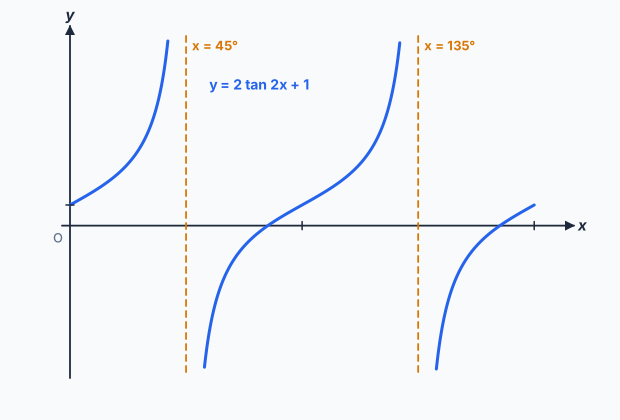
- Draw \( y = a\sin bx + c \), \( y = a\cos bx + c \) and \( y = a\tan bx + c \), labelling the asymptotes of a tan graph.
- Use \( \sin^{2}A + \cos^{2}A = 1 \), \( \sec^{2}A = 1 + \tan^{2}A \) and \( \operatorname{cosec}^{2}A = 1 + \cot^{2}A \).
- Solve trigonometric equations in a given domain, including ones with a compound angle such as \( 2x + \tfrac{\pi}{6} \).
- Prove identities involving all six functions.
📚The mathematics
Six functions, any angle
For angles beyond \( 90^{\circ} \), the sign depends on the quadrant: all positive in the first, sine in the second, tangent in the third, cosine in the fourth (“CAST” going anticlockwise from the fourth). The size comes from the related acute angle. So \( \cos 240^{\circ} = -\cos 60^{\circ} = -\tfrac{1}{2} \), and \( \sec 240^{\circ} = -2 \).
Paper 1 expects the exact values:
Amplitude, period and the graphs
For \( y = a\sin bx + c \) and \( y = a\cos bx + c \) (with \( a > 0 \)):
For \( y = a\tan bx + c \) the period is \( \dfrac{180^{\circ}}{b} \) (or \( \dfrac{\pi}{b} \)), there is no amplitude, and there are vertical asymptotes where \( bx = 90^{\circ}, 270^{\circ}, \ldots \). The syllabus says the \(x\)-coordinate of each asymptote must be labelled.
The identities
All three are in the List of formulas; the second and third are the first divided by \( \cos^{2}A \) and by \( \sin^{2}A \). Use them to turn an equation into a single function (usually a quadratic in it), and to prove identities.
Solving equations in a domain
- Rearrange to one function equal to a number (use an identity, or divide \( \sin \) by \( \cos \) to get \( \tan \)).
- If the angle is compound, such as \( 2x + \tfrac{\pi}{6} \), transform the domain first: if \( 0 \le x \le \pi \) then \( \tfrac{\pi}{6} \le 2x + \tfrac{\pi}{6} \le 2\pi + \tfrac{\pi}{6} \).
- Find the principal value, then every other value in the (transformed) domain, using the symmetry of the graph.
- Undo the compound angle, and check every answer lies in the original domain.
Never cancel a factor such as \( \sin x \) from both sides — factorise instead, or you lose the solutions of \( \sin x = 0 \). The syllabus also warns you that the domain may be in degrees or radians: answer in the same unit, to 1 d.p. for degrees and 3 s.f. for radians unless told otherwise.
Proving identities
Start from the more complicated side and work towards the other; never work on both sides at once. Writing everything in terms of \( \sin \) and \( \cos \), and combining fractions over a common denominator, solves most of them. Finish by stating the other side.
✏️Worked example
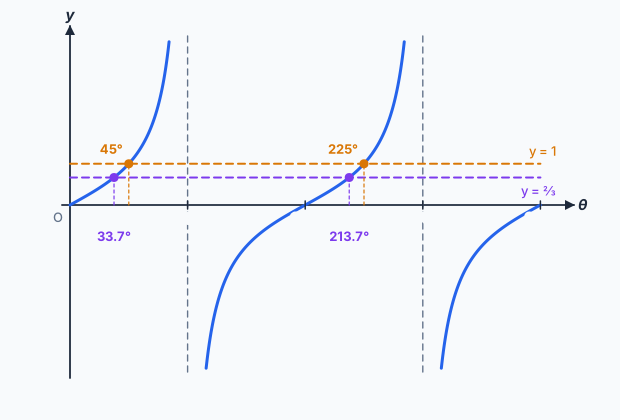
(a) Replace \( \sec^{2}\theta \) by \( 1 + \tan^{2}\theta \): \( 3 + 3\tan^{2}\theta - 5\tan\theta - 1 = 0 \), so \( 3\tan^{2}\theta - 5\tan\theta + 2 = 0 \) and \( (3\tan\theta - 2)(\tan\theta - 1) = 0 \).
- \( \tan\theta = 1 \): \( \theta = 45^{\circ} \) or \( 45^{\circ} + 180^{\circ} = 225^{\circ} \).
- \( \tan\theta = \tfrac{2}{3} \): \( \theta = 33.7^{\circ} \) or \( 213.7^{\circ} \).
(b) \( \cos\left(2x + \tfrac{\pi}{6}\right) = \tfrac{\sqrt{3}}{2} \). With \( 0 \le x \le \pi \), the compound angle runs over \( \tfrac{\pi}{6} \le 2x + \tfrac{\pi}{6} \le \tfrac{13\pi}{6} \). In that interval \( \cos u = \tfrac{\sqrt{3}}{2} \) at \( u = \tfrac{\pi}{6},\ \tfrac{11\pi}{6},\ \tfrac{13\pi}{6} \). So \( 2x = 0,\ \tfrac{5\pi}{3},\ 2\pi \), giving
(c) Start from the left-hand side and write the bracket in terms of \( \sin \) and \( \cos \):
📝Practise
Written in the style of the current Paper 1 (no calculator) and Paper 2 (calculator) questions.
1. (No calculator.) Find the exact values of \( \sec\tfrac{5\pi}{6} \) and \( \operatorname{cosec} 300^{\circ} \). [2]
2. (No calculator.) For \( y = 5\sin\tfrac{x}{3} - 2 \), where \(x\) is in degrees, write down (a) the amplitude, (b) the period, (c) the greatest and least values of \(y\). [3]
3. (Calculator.) Solve \( 4\cot\theta = \tan\theta \) for \( 0^{\circ} < \theta < 360^{\circ} \). [4]
4. (Calculator.) Solve \( 3\sin\tfrac{\theta}{2} + 4\cos\tfrac{\theta}{2} = 0 \) for \( 0^{\circ} \le \theta \le 720^{\circ} \). [4]
5. (Calculator.) Solve \( 2\sec(x - 0.3) = 5 \) for \( 0 \le x \le 2\pi \), where \(x\) is in radians. [4]
6. (No calculator.) Solve \( 2\cos^{2}x + 3\sin x = 3 \) for \( 0^{\circ} \le x \le 360^{\circ} \). [5]
7. (No calculator.) Show that \( \sec^{2}\theta + \operatorname{cosec}^{2}\theta = \sec^{2}\theta\operatorname{cosec}^{2}\theta \). [3]
8. (No calculator.) Prove that \( \tan^{2}\theta - \sin^{2}\theta = \tan^{2}\theta\sin^{2}\theta \). [3]
🔗Go deeper — other people’s work
These are external resources, not mine. If one stops working, tell me and everything above it on this page still stands.
- Desmos — plot \( y = a\sin(bx) + c \) with sliders; set the angle unit to degrees for Paper 1-style domains
- Cambridge 0606 examiner reports — missing solutions from untransformed domains are a regular comment